COMPUTE | ENERGY | PERMITTING | NOVEMBER 2026 | Week 48 · Part I
The Chips Are Available. The Grid Connection and the Permit Are Not – and That Is Why Europe Holds Roughly 5 % of Global AI Compute
Europe's conversation is about GPUs. The binding constraint is a transformer bay and a signature.
Europe holds nearly 5 % of the world's operational AI compute. The explanation that dominates board discussions – too few chips, too little capital – is not what the evidence shows. Bruegel and the industry bodies point to energy availability, grid readiness and permitting complexity.
Executive Summary
IN 60 SECONDS:
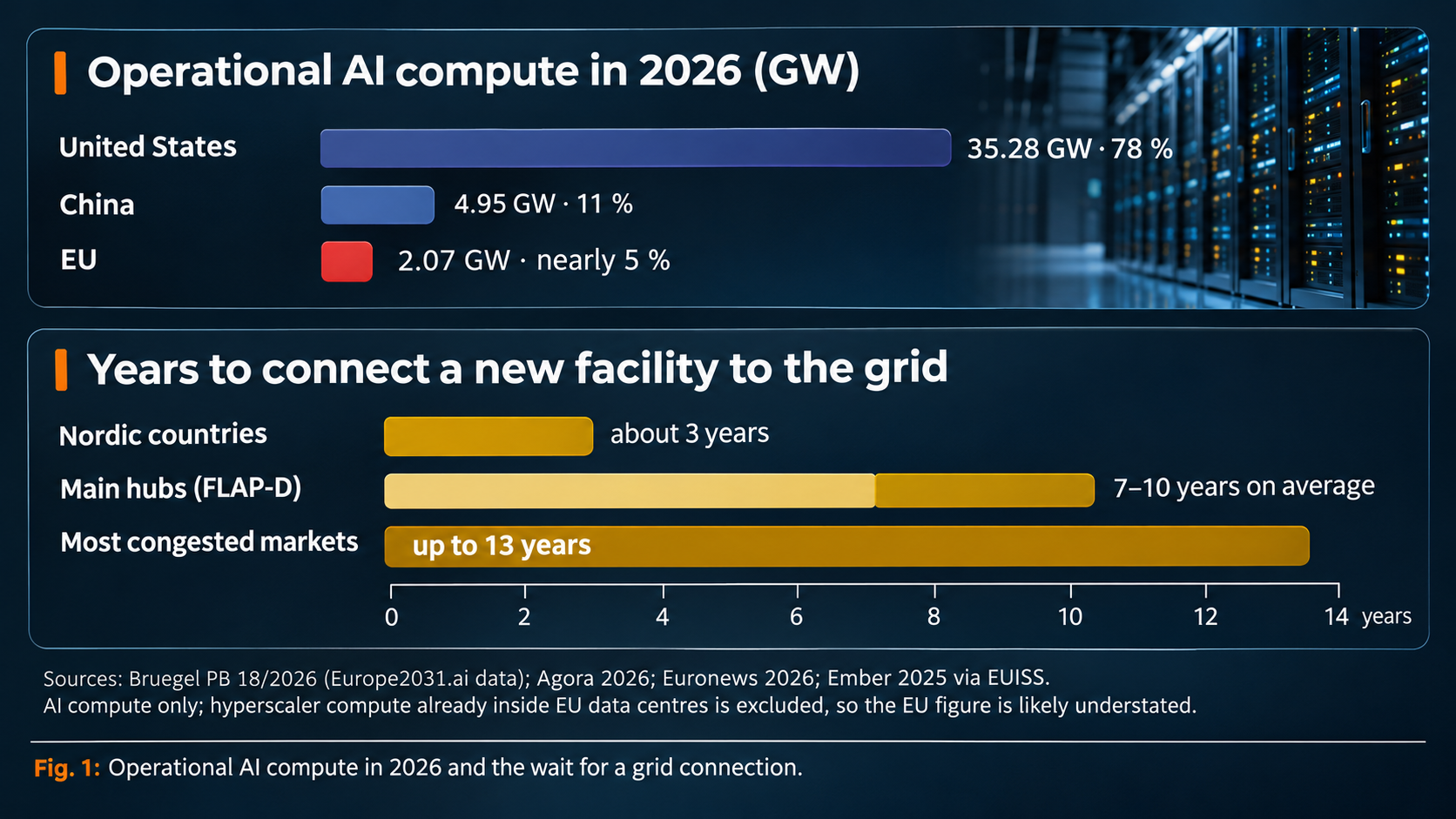
Bruegel puts EU operational AI compute at about 2.07 GW in 2026 – nearly 5 % of the global total, against 35.28 GW in the US and 4.95 GW in China.* The European Data Centre Association states that growth is constrained "not by capital or customer appetite, but by energy availability, grid readiness, and permitting complexity."*
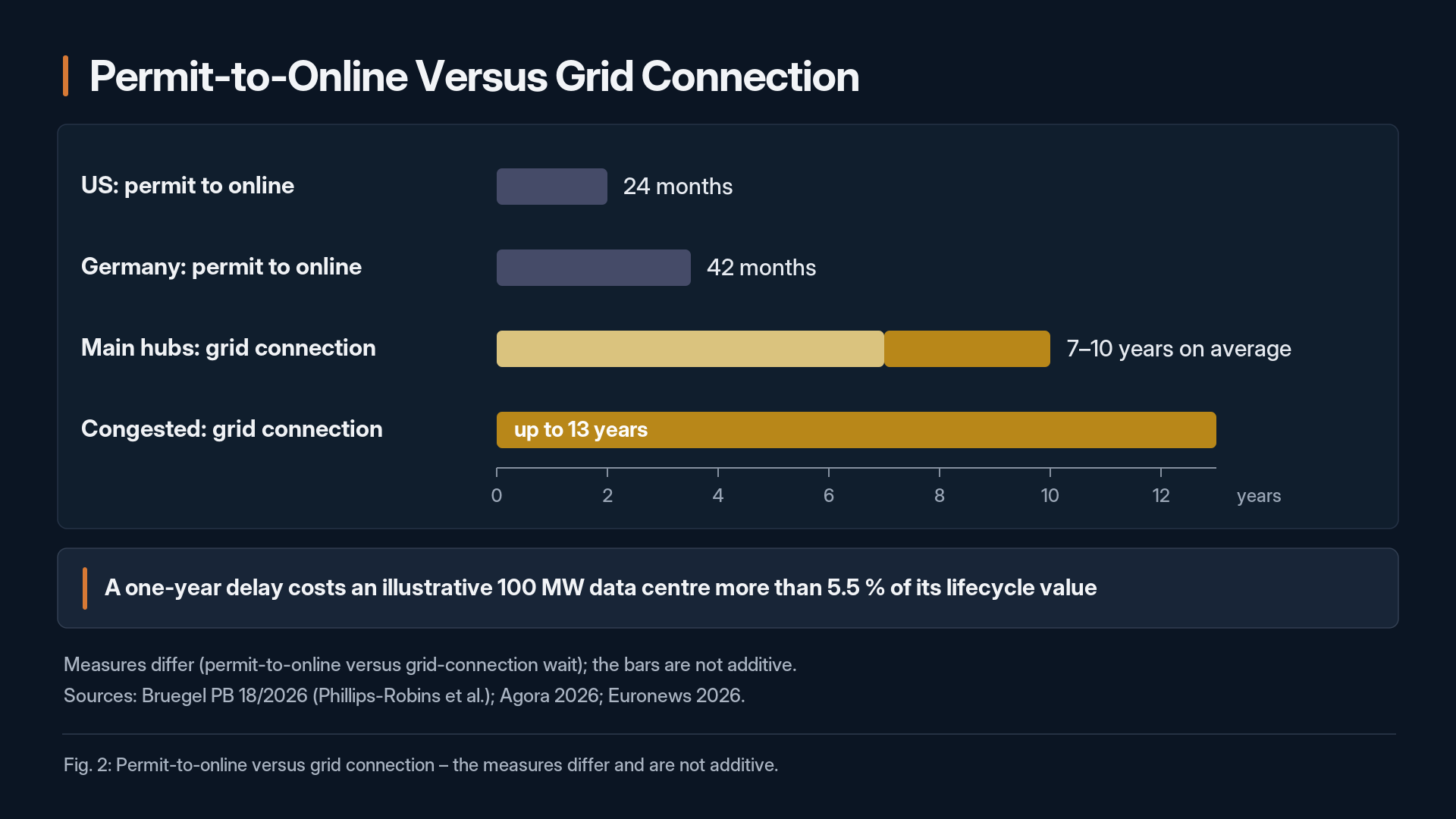
Grid connection takes on average 7–10 years in the main European hubs and up to 13 years in the most congested markets;* the US averages 24 months from permit to going online, Germany 42. DC Byte tracks 93 GW of EMEA IT capacity and finds about 60 % of the pipeline still at an early stage.*
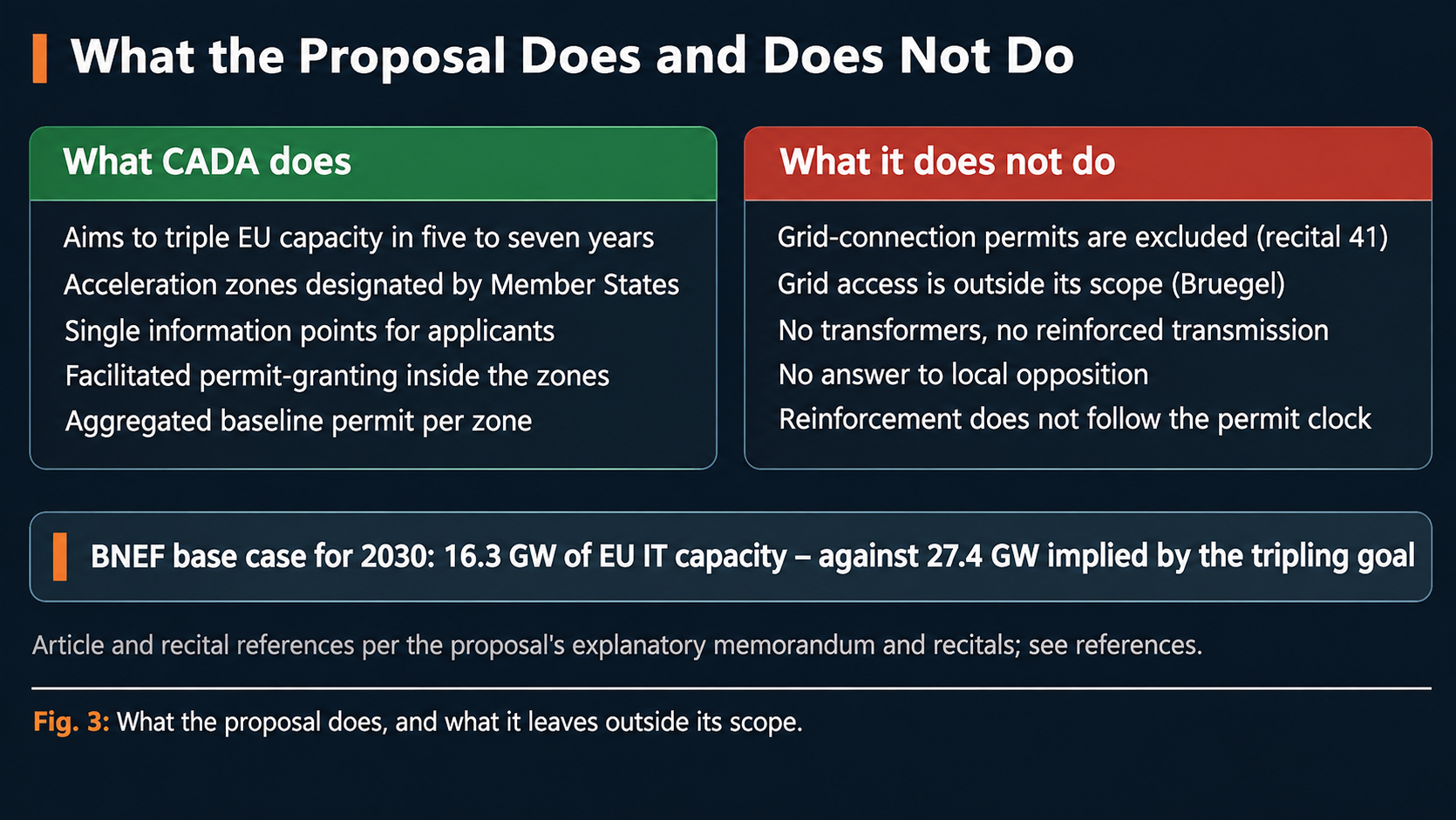
The Commission's Cloud and AI Development Act proposal (COM(2026) 502) aims to triple EU data-centre capacity within five to seven years, but its acceleration zones exclude grid-connection permits, and Bruegel notes that grid access lies outside its scope.* Decision makers who still frame the gap as "we need more GPUs" are looking at the wrong bottleneck.
1. The Numbers That Define the Gap
Europe's gap is measured in gigawatts and years, not in chips.
Using Europe2031.ai data, Bruegel puts EU operational AI compute at about 2.07 GW in 2026 – nearly 5 % of global installed capacity. The US has 35.28 GW (78 %), nearly 18 times the EU; China has 4.95 GW (11 %), more than twice. The dataset excludes compute inside US hyperscalers' existing EU data centres, so the EU figure is likely understated. Estimates of total installed data-centre capacity in Europe depend on scope: CBRE expects 13 GW for Europe by the end of 2026, BloombergNEF reports 19.2 GW for EMEA in the first quarter of 2026.*
The wait is the second number. Connecting a new facility in the main hubs – Frankfurt, London, Amsterdam, Paris, Dublin – takes on average 7–10 years; in the most congested primary markets, up to 13. Across the EU the IEA gives a range of 2–10 years; the Nordic countries sit near 3 years, Germany and the Netherlands near 10 (Ember). Announcements outrun energisation: DC Byte tracks 93 GW of EMEA IT capacity and sees about 60 % of the pipeline still at an early stage.*
👉 Key Insight
Announced megawatts are not connected megawatts. The gap is the difference.
2. Why Energy and Permitting Are the Binding Constraints
Capital is available. Speed to power is not.
Demand is rising fast: BloombergNEF's base case lifts EMEA data-centre capacity from 19.2 GW to 53.1 GW by 2035. Bruegel concludes that capital is not the binding constraint – private finance is not failing, and speed to operation is the key location factor. A one-year delay costs an illustrative 100 MW data centre more than 5.5 % of its lifecycle value. The US averages 24 months from permit to going online; Germany 42.
Reservation rules compound the problem. In Denmark, Energinet's connection queue reached 60 GW against national peak demand of about 7 GW, and new connections were paused (reported 2026).* The Commission's own proposal points to queue management that weighs project readiness rather than pure first-come-first-served. Ireland shows the end state when compute outruns planning: data centres took 23 % of national electricity in 2025 (CSO),* and Dublin and Amsterdam have paused new connections.
👉 Key Insight
A permit lets you build. Only a connection lets you operate.
3. What the Policy Response Has and Has Not Done
The proposal accelerates the permit. It leaves the connection to others.
The Cloud and AI Development Act proposal (COM(2026) 502, 3 June 2026) aims to triple EU data-centre capacity within five to seven years. Member States are to designate data-centre acceleration zones (Art. 10), with single information points (Art. 12) and facilitated permit-granting (Art. 13).* Recital 41 provides an aggregated baseline permit for each zone – "excluding the grid connection permits."
It does not, by itself, build transformers, reinforce transmission or resolve local opposition. Bruegel notes that grid access is left out of the Act's scope, and BloombergNEF's base case shows EU IT capacity of 16.3 GW in 2030 against about 27.4 GW implied by the tripling goal – "well short." Private capital is available; the physical and administrative path to energisation is not.
👉 Key Insight
Compute leadership without power leadership is a press release.
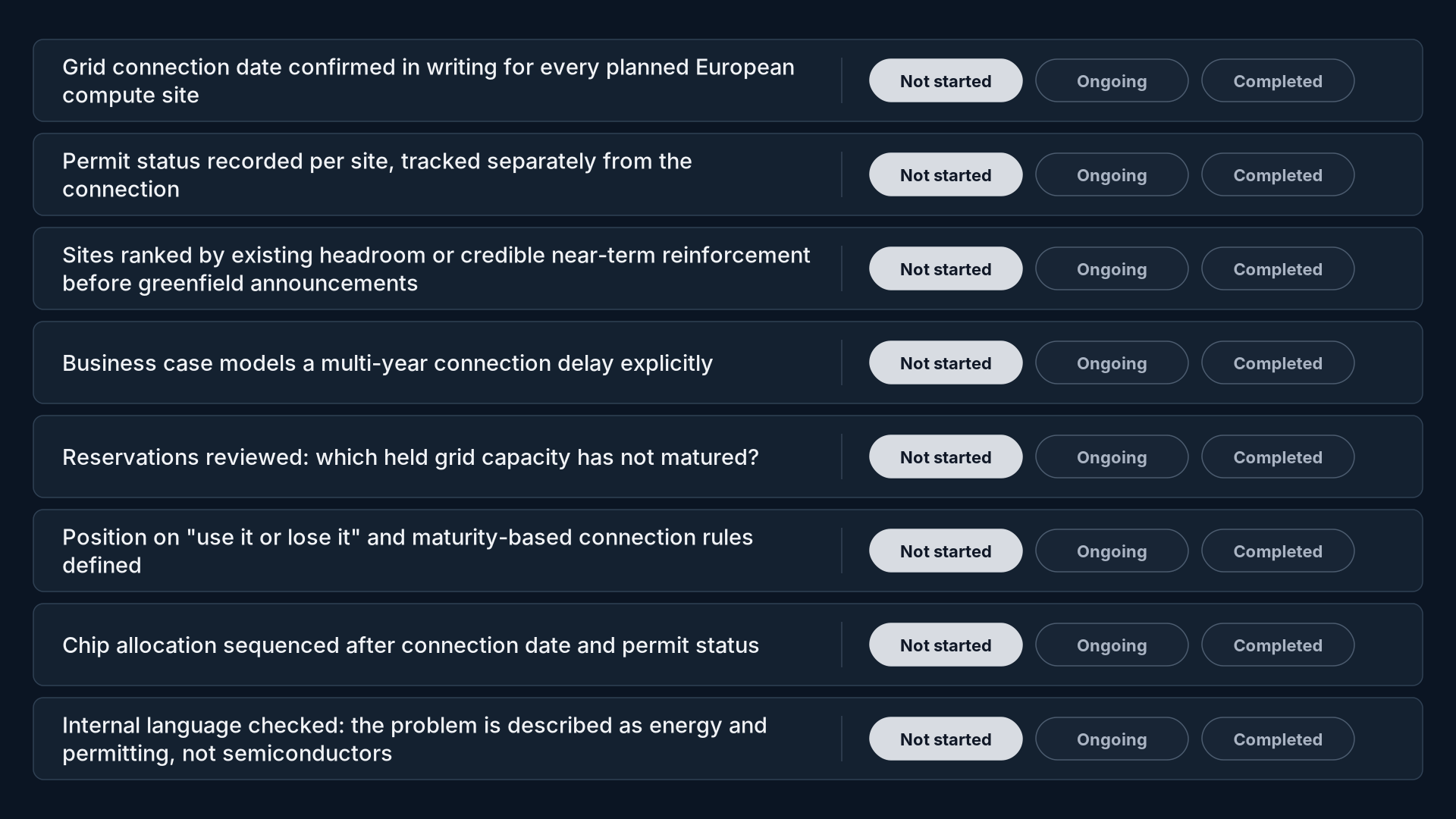
Action Plan for Decision Makers
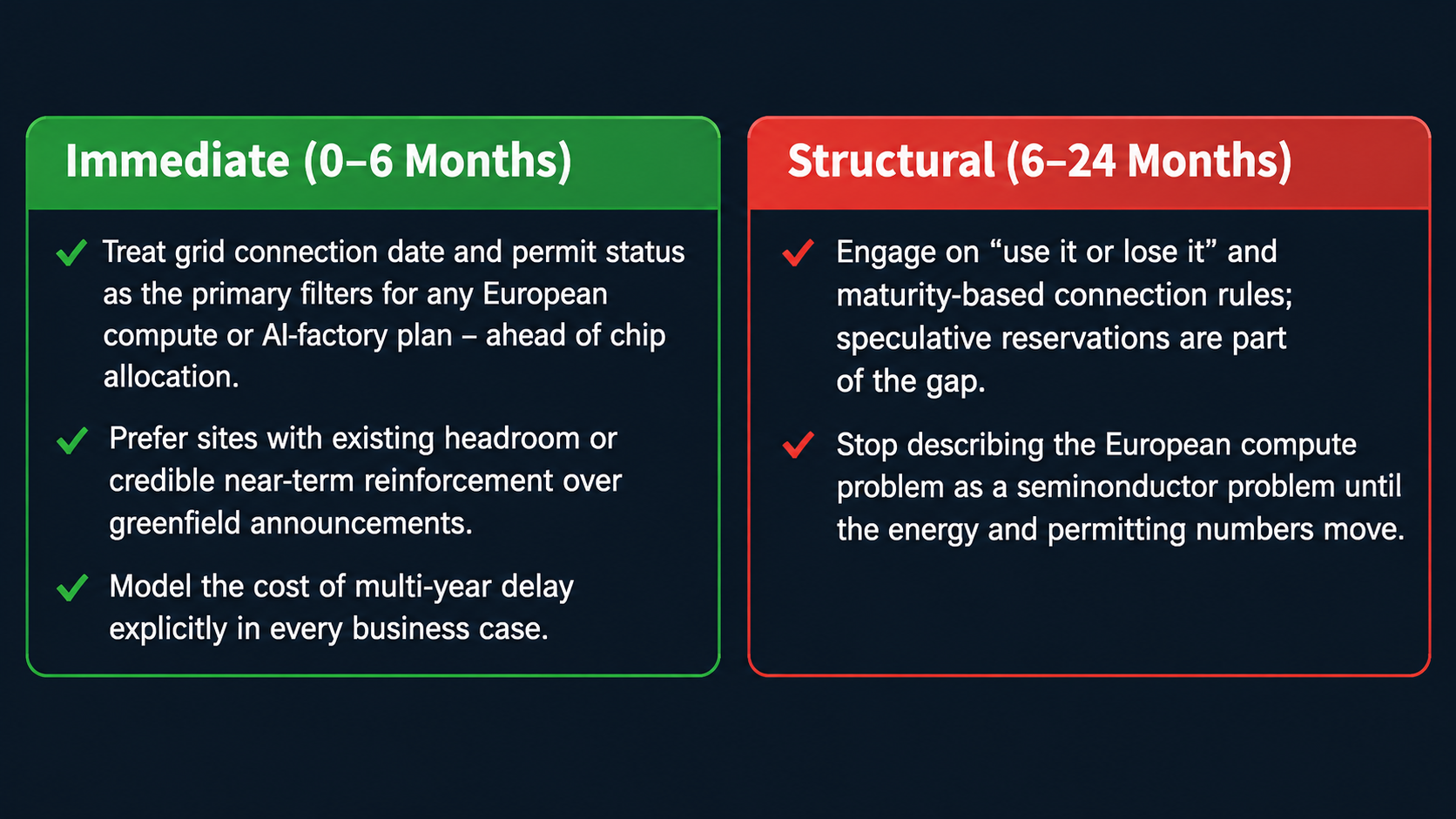
Checklist
Final Thought
Europe's conversation is about GPUs. The binding constraint is a transformer bay and a signature. Part II of this week asks what that constraint means for the industry that is meant to put AI into factories: robots, which need power as much as models do.
Efficiency Before Energy means counting the connected megawatt before the announced one.
Systems don't fail. Decisions do.
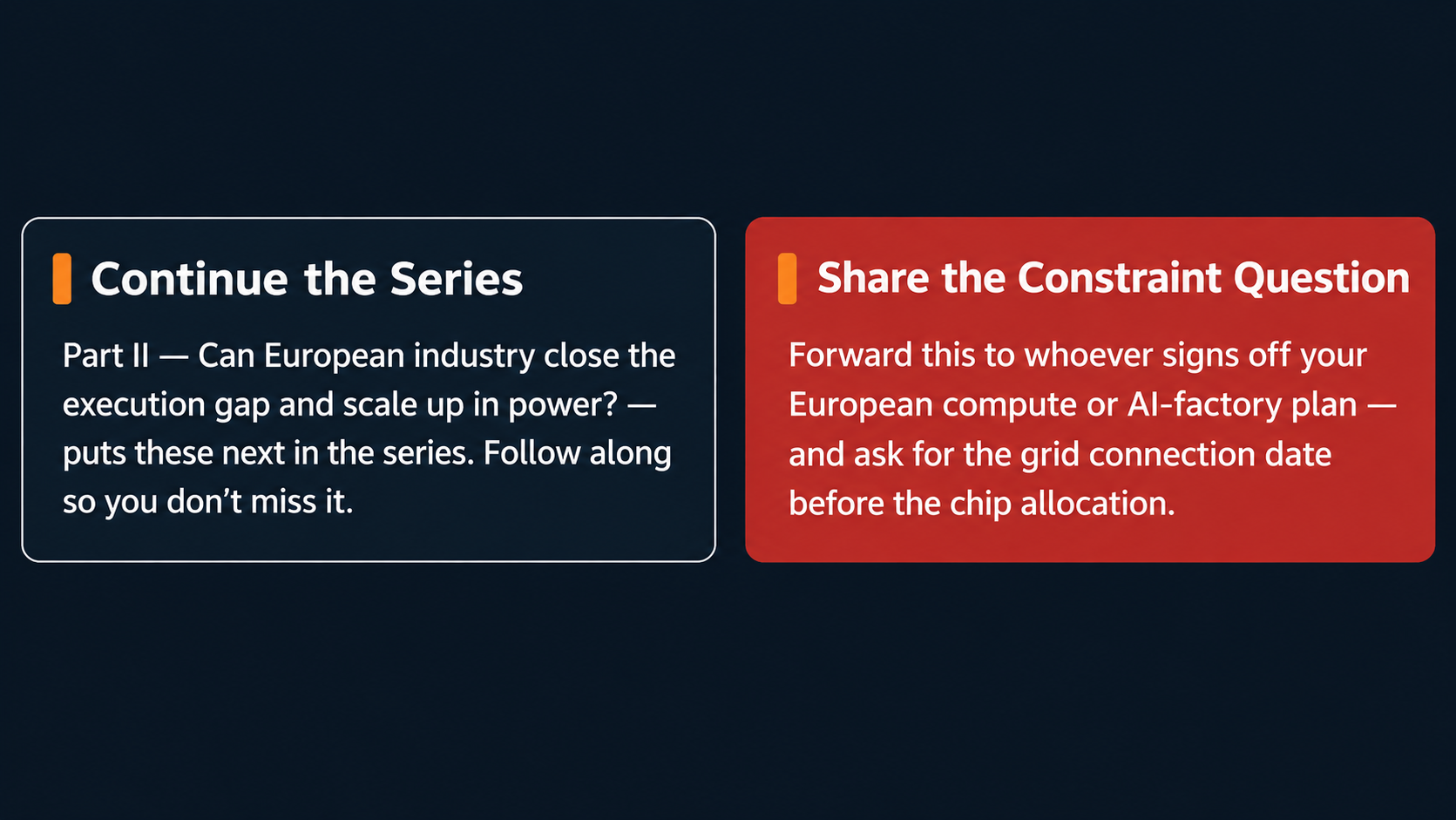
Take the Next Step
Subscribe to the Weekly Punch for weekly strategic clarity, direct to your inbox.
References
Martens, B. and Schenk, T. (2026) How can Europe address its pressing AI compute infrastructure shortfall? Bruegel Policy Brief 18/2026, 10 September 2026. Brussels: Bruegel. [Checked: 2.07 GW / nearly 5 %, US and China figures, permit-to-online times, 5.5 % delay cost, EUDCA quotation, scope of the CADA.]
European Commission (2026) Proposal for a Regulation on the Cloud and AI Development Act (CADA), COM(2026) 502, 3 June 2026. [Recitals 38 and 41 and the explanatory memorandum read; article numbers 10–13 are taken from the memorandum – confirm against the final text.]
Agora Energiewende (2026) How data centre flexibility can help solve Europe's grid bottleneck. Press release, 20 April 2026. Berlin: Agora Energiewende. [Checked: lead times of 7–10 years; Dublin and Amsterdam moratoria.]
International Energy Agency (2025) Overcoming energy constraints is key to delivering on Europe's data centre goals. IEA commentary. Paris: IEA. [Checked: 2–10 years across the EU, 7–10 years in FLAP-D; tripling aim.]
Bômont, C. and Hobhouse, C. (2026) Feeding the Beast: Energy security as a precondition for the EU's AI power. EUISS Brief 15, September 2026. Paris: EU Institute for Security Studies. [Cites Ember (2025), Grids for data centres in Europe: about 3 years in the Nordics to about 10 in Germany and the Netherlands; Ember original not retrieved.]
BloombergNEF (2026) EMEA Data Center Outlook: 5 Things To Know, 25 September 2026. [Checked: 19.2 GW (1Q 2026), 53.1 GW (2035), EU IT capacity 9.1 / 16.3 / 26.4 GW; the article's "2.5x" multiple does not match its own figures and is not used.]
CBRE (2026) European Data Centres Figures Q2 2026, 17 August 2026. [Checked: 13 GW by end-2026.]
Secondary reports, originals to be confirmed: Euronews (2026) Europe is hungry for AI data centres – but its energy grid cannot feed them, 5 May 2026 (up to 13 years in the most congested markets); Data Center Knowledge (2026) EMEA Data Center Expansion Faces a Delivery Test, 7 October 2026, citing DC Byte (93 GW; about 60 % early-stage); The Next Web (2026), 19 August 2026 (Energinet queue of 60 GW against about 7 GW peak demand); Datacentre Review (2026), 7 July 2026, citing the Irish Central Statistics Office (23 % in 2025).
Brief figures not confirmed and not used as stated: about 16 GW installed capacity in Europe; a structural grid deficit of nearly 20 GW by the mid-2030s; a minority of tracked projects permitted or under construction (under 50 % or under 20 % built); an 18–24 month build time for a shell; the Kearney and DC Blueprint analyses.
Disclaimer: This article summarizes policy briefs, a legislative proposal, industry reports and press coverage. Capacity figures differ by scope and date; figures marked * rest on secondary reports or on sources not checked in the original. Readers should verify all quantitative claims against the source documents before relying on them. Verification Gate: flagged for pre-publication source check.
Ownership as Design.
Note: This article reflects my personalviews based on industry experience and publicly available information. It does not constitute professional, legal, or investment advice and does not represent the views of my employer. AI-generated visuals, concept and content by the author.
