LEADERSHIP | NORMAL ACCIDENTS | NOVEMBER 2026 | Week 47 · Part III
Interactive Complexity Plus Tight Coupling Makes Some Failures Normal – They Do Not Announce Themselves with a Single Broken Part
After the accident, the investigators look for the broken part. In some systems there isn't one.
In 1984 Charles Perrow argued that certain systems produce accidents through their structure, not through their components. For leaders of autonomous industrial systems, that moves the question from "who failed?" to "what did we build?"
Executive Summary
IN 60 SECONDS:
Perrow's central claim: in systems that are both interactively complex and tightly coupled, accidents are normal – not aberrations. Interactive complexity means components interact in ways that are not fully visible or planned. Tight coupling means fast processes, sequences that are hard to interrupt and little slack.*
In the author's application, multi-agent factories add exactly these properties: agents, guards, models, operators and update pipelines interact in ways designers did not fully enumerate, and actuation can be fast. When both properties are present, small failures can cascade before anyone understands the interaction.*
Boards that look for a single root-cause component will miss the quiet failure mode Perrow described. The leadership task is to decide where complexity and coupling must be reduced – not only to write better procedures.
1. What Perrow Identified
Two properties, taken together, make accidents normal.
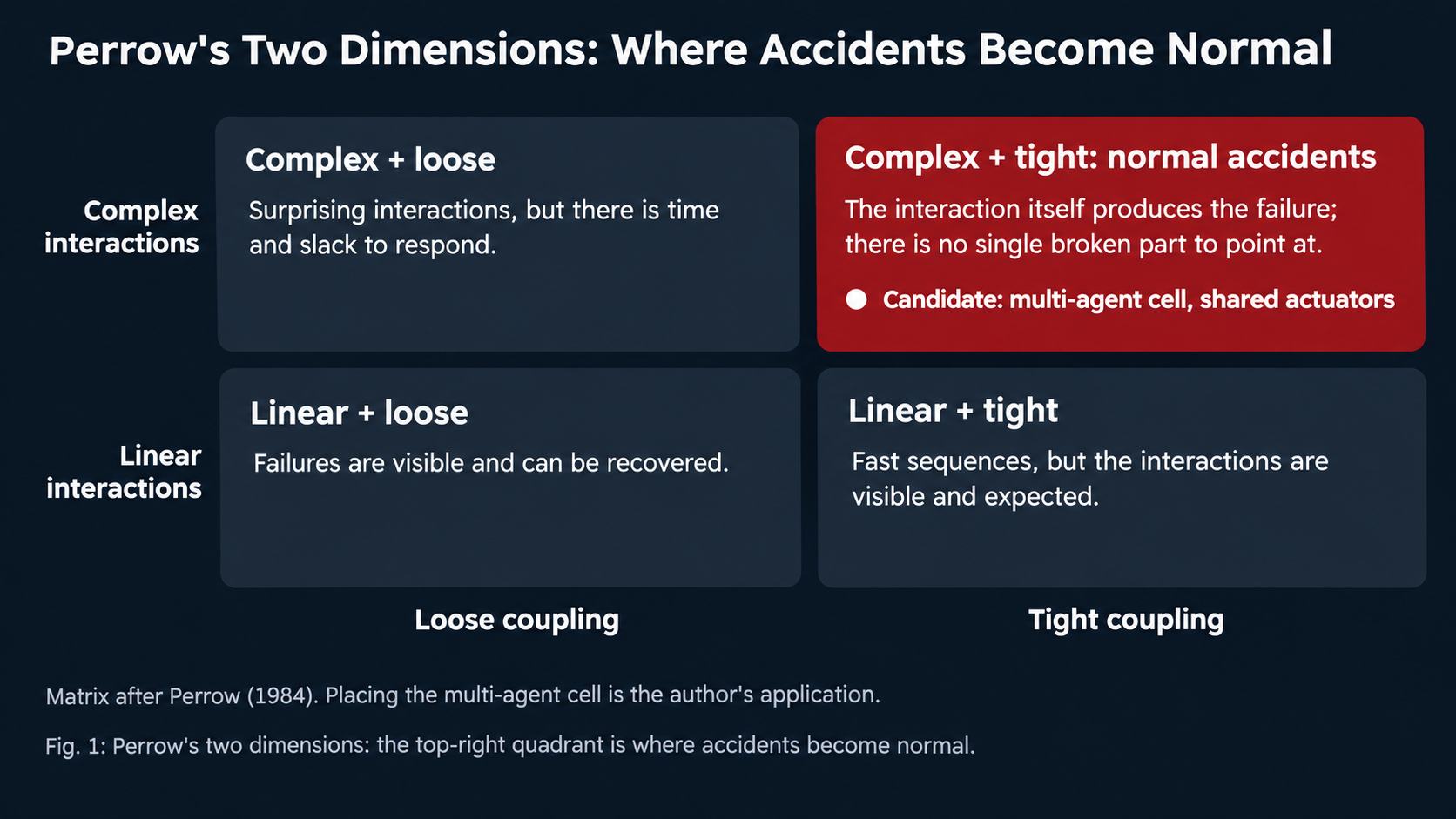
Perrow identified two system properties that together create what he called normal accidents. Interactive complexity: components interact in ways that are unexpected, non-linear and not fully transparent. Tight coupling: little buffer, fast propagation, and limited opportunity to intervene once the sequence has started.*
Linear, loosely coupled systems can fail and still be recovered: the failure is visible, and there is time. Complex, tightly coupled systems can produce system accidents from the interaction itself – which is why the investigation afterwards often cannot find the one part to blame.
👉 Key Insight
The failure is in the interaction, not in any single part that can be pointed at afterwards.
2. Multi-Agent Cells as Candidate Systems – One Example
An illustrative example – not a reported incident – shows how the structure does the work.
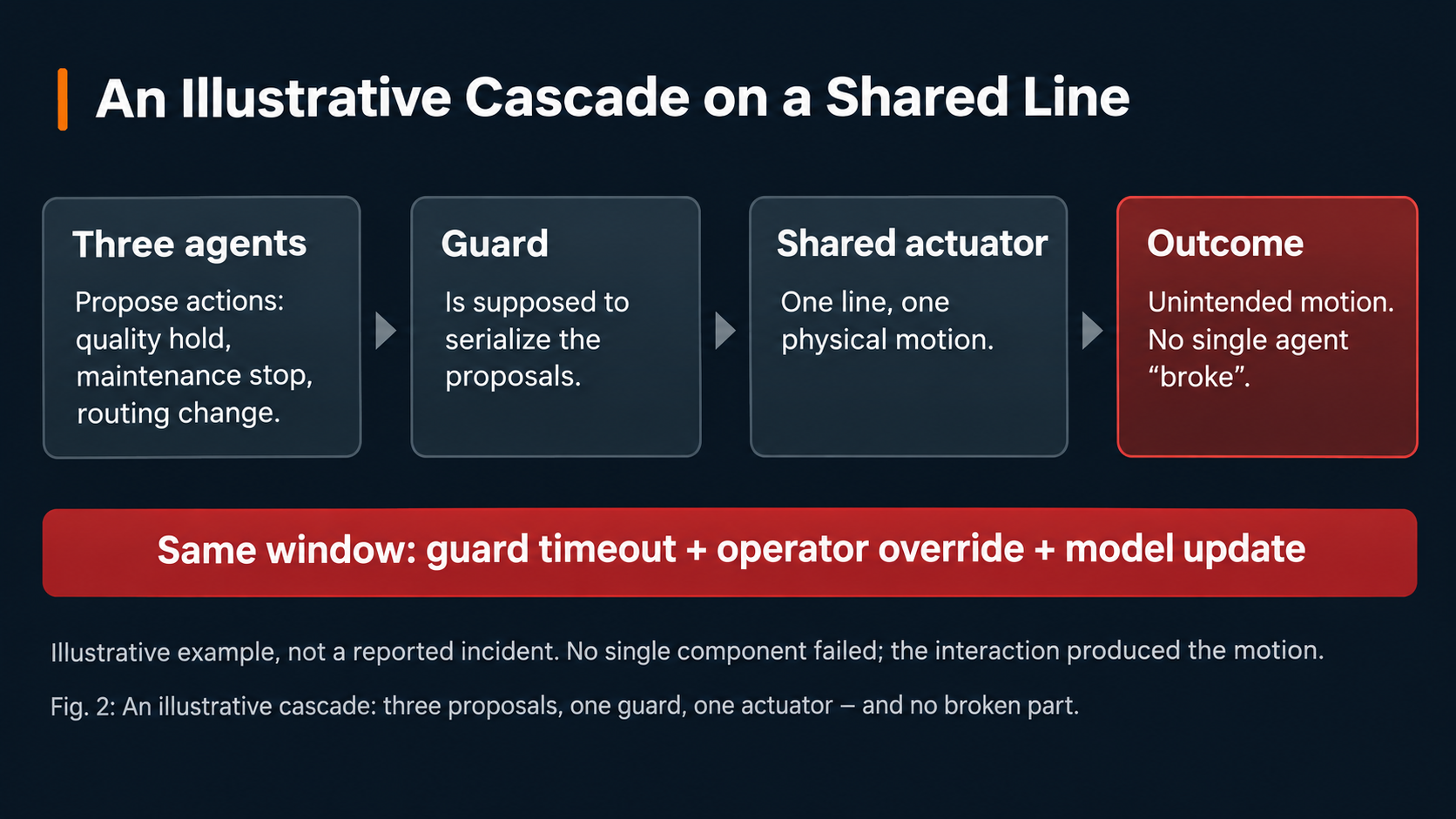
Three agents can propose actions on a shared line: a quality hold, a maintenance stop, a routing change. A guard is supposed to serialise them. Under load, the guard's timeout, an operator override and a model update land in the same window. No single agent "broke." The interaction produced an unintended motion.
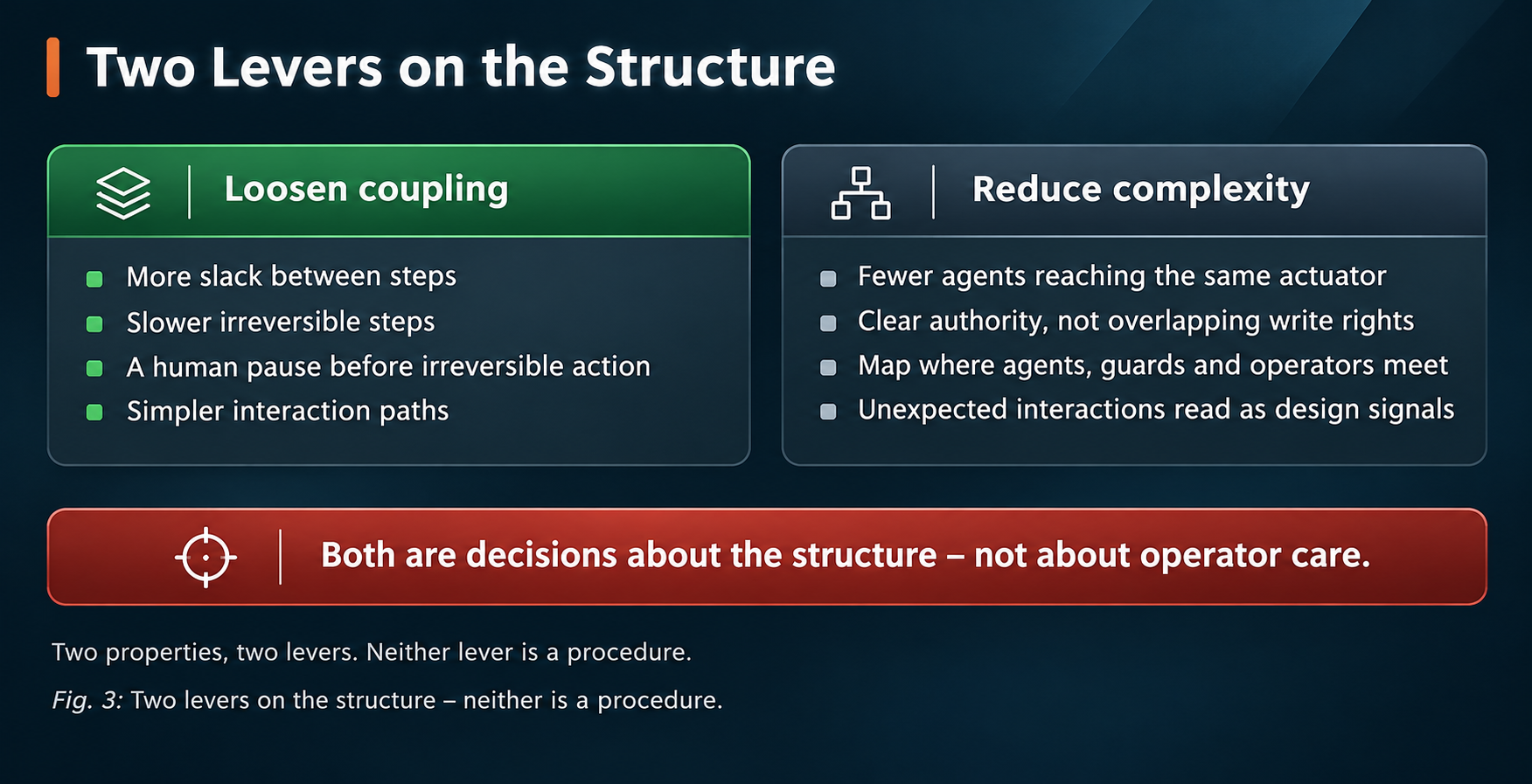
Perrow's frame: this is the kind of accident the system's structure makes normal, unless coupling is loosened – more slack, slower irreversible steps, simpler interaction paths – or complexity is reduced, with fewer agents that can reach the same actuator. Dekker's drift lens would add that each prior near-miss was normalised; Perrow's point is that the structure itself makes the cascade expectable.
👉 Key Insight
No procedure fixes an interaction nobody enumerated. Slack and fewer shared actuators do.
3. What Leadership Cannot Outsource
Procedures and monitoring do not change the structure.
More procedures do not remove interactive complexity. More monitoring does not add slack if the actuation path stays tight. The board-level choice is which interactions are allowed to be fast and opaque, and which must be slowed, buffered or simplified.
That choice is not a technical appendix. It sets the structure within which every later procedure, test and review has to work.
👉 Key Insight
Procedures describe how people should behave. Only the board decides how fast the system is allowed to propagate.
Action Plan for Decision Makers
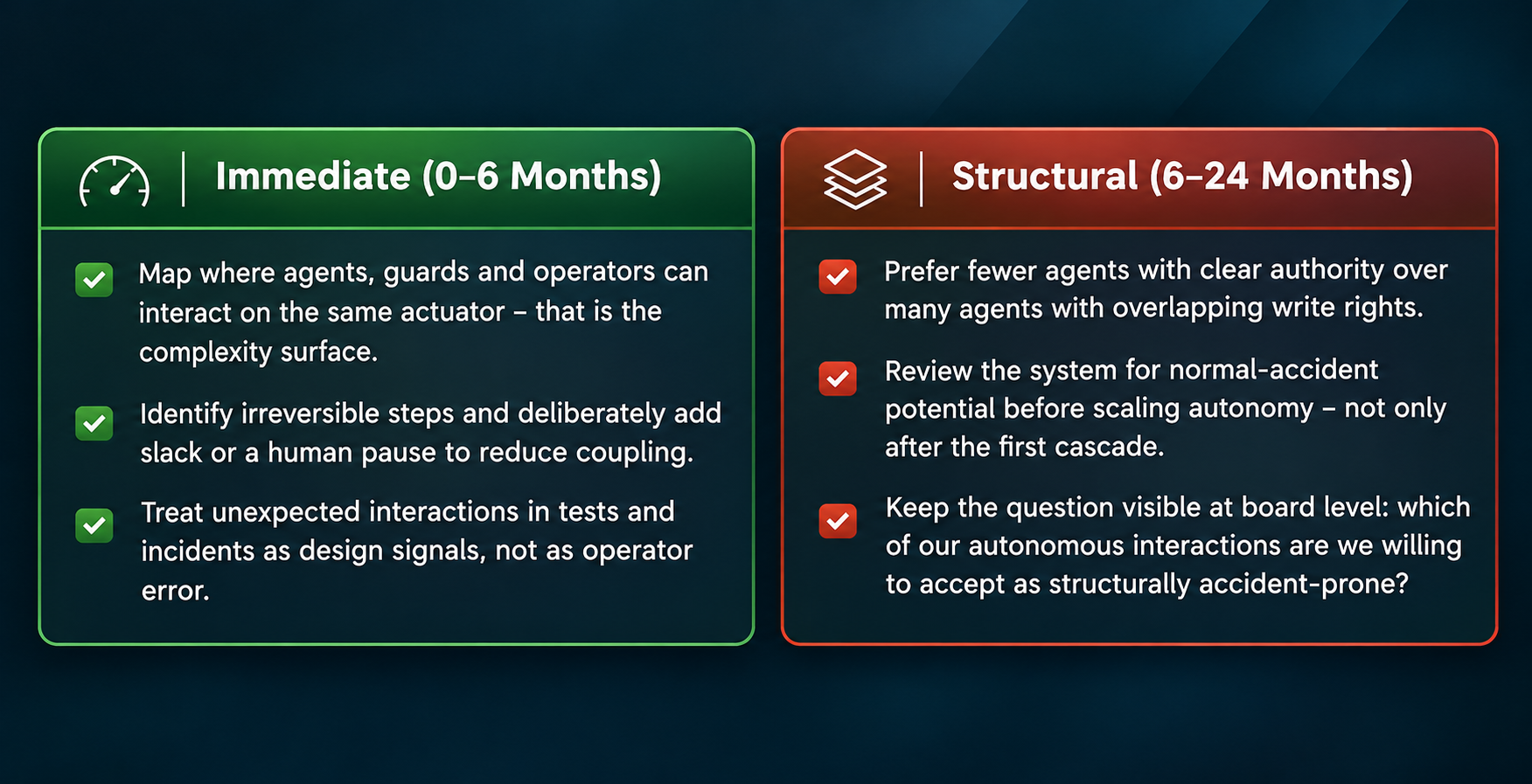
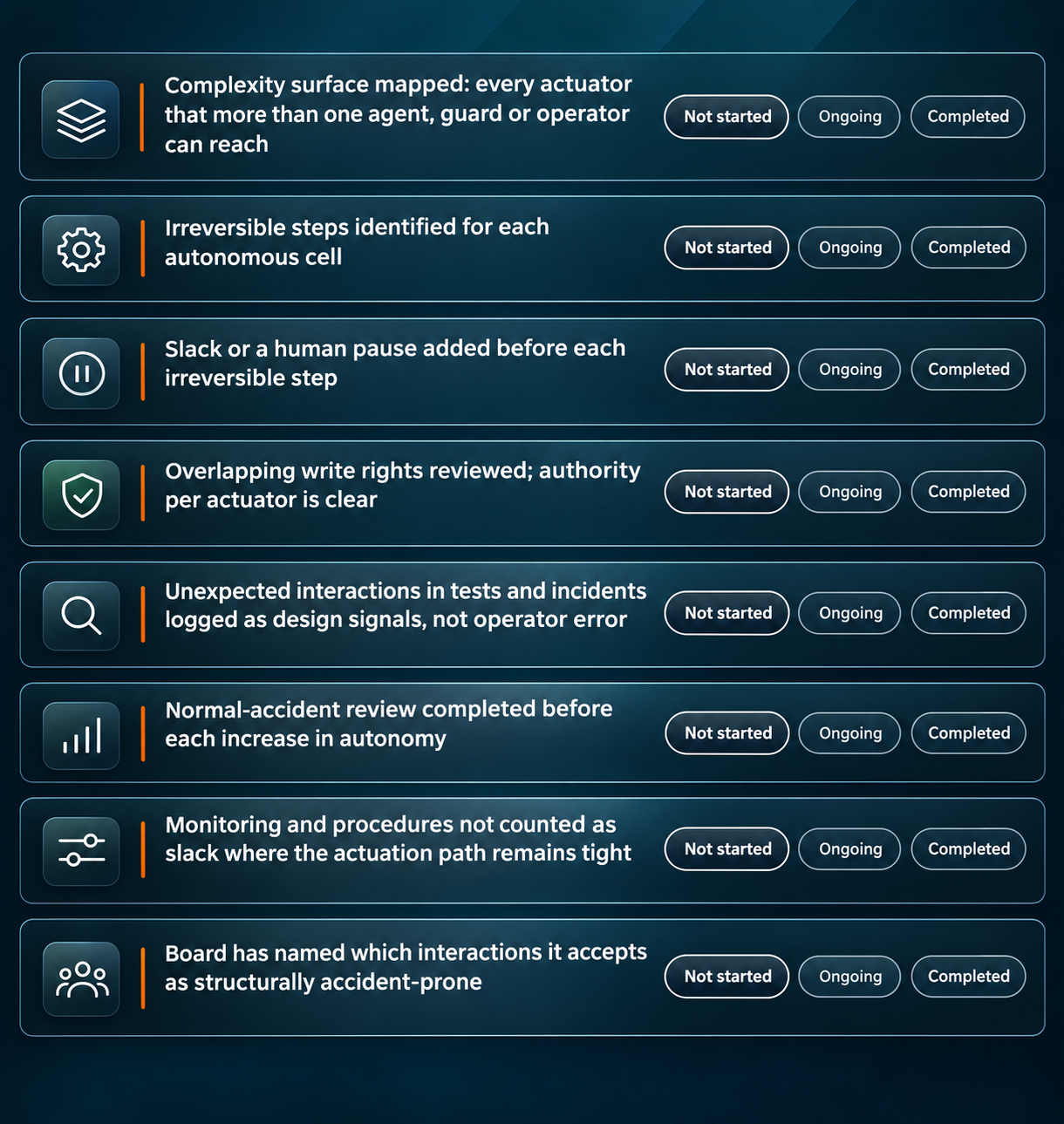
Checklist
Final Thought
After the accident, the investigators look for the broken part. In some systems there isn't one – the decision that mattered was made earlier, in how fast the system may propagate and how many things may reach the same actuator. Parts I and II of this week dealt with liability and evidence; this part deals with structure.
Efficiency Before Energy means taking out the structure that only creates risk, before adding more energy to monitor it.
Systems don't fail. Decisions do.
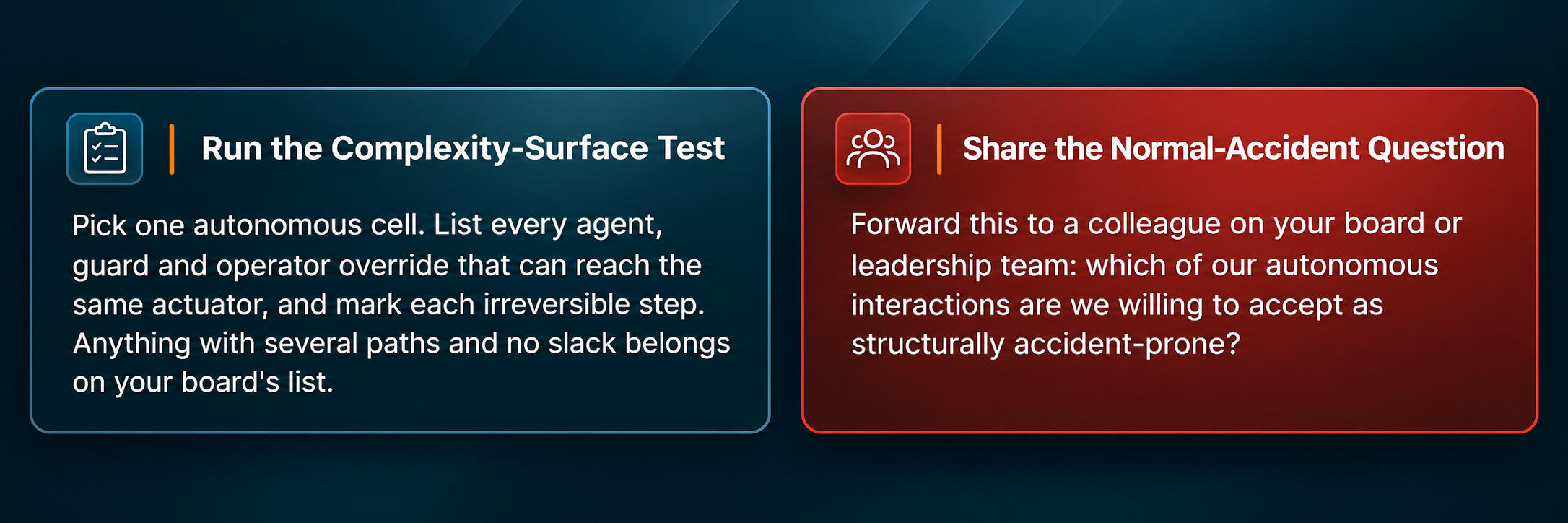
Take the Next Step
Subscribe to the Weekly Punch for weekly strategic clarity, direct to your inbox.
References
Perrow, C. (1984) Normal Accidents: Living with High-Risk Technologies. New York: Basic Books. Updated edition: Princeton, NJ: Princeton University Press, 1999. [Bibliographic details to be confirmed against the publisher's record; the book is summarized, not quoted.]
Dekker, S. (2011) Drift into Failure: From Hunting Broken Components to Understanding Complex Systems. Farnham: Ashgate. [Related lens only (incremental normalisation over time); not the primary frame of this piece. Bibliographic details to be confirmed.]
Disclaimer: This article applies Perrow's framework to multi-agent industrial systems. That application, and the example in section 2, are the author's own and illustrative, not a reported incident. Perrow's and Dekker's arguments are summarized, not quoted, and should be checked against the original books before readers rely on them. Verification Gate: flagged for pre-publication source check.
Ownership as Design.
Note: This article reflects my personalviews based on industry experience and publicly available information. It does not constitute professional, legal, or investment advice and does not represent the views of my employer. AI-generated visuals, concept and content by the author.
