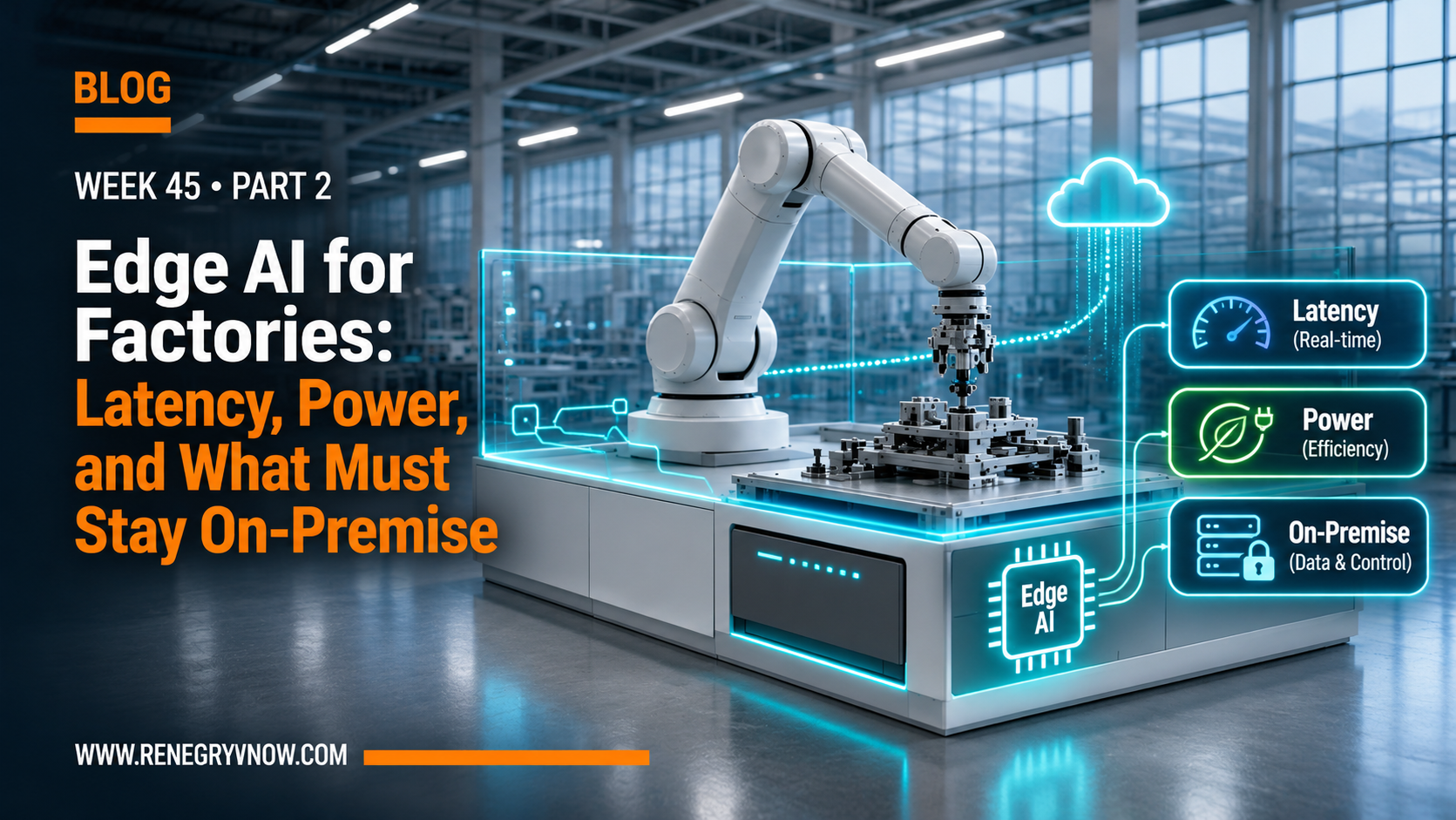
EDGE AI | FACTORIES | NOVEMBER 2026 |Week 45 · Part II
Line-Speed Decisions Cannot Wait for a Cloud Round Trip. Some Inference Must Live Next to the Machine, Inside a Power and Safety Budget
Part I asked what may leave the fence. Part II asks what cannot wait for the trip.
A chat answer can take a second. A reject gate cannot. Line-speed decisions are made in milliseconds, next to the machine, inside a power and thermal budget – and a network hop alone can use up the whole window. Where inference runs is not an IT preference. It is part of the control design.
Executive Summary
IN 60 SECONDS:
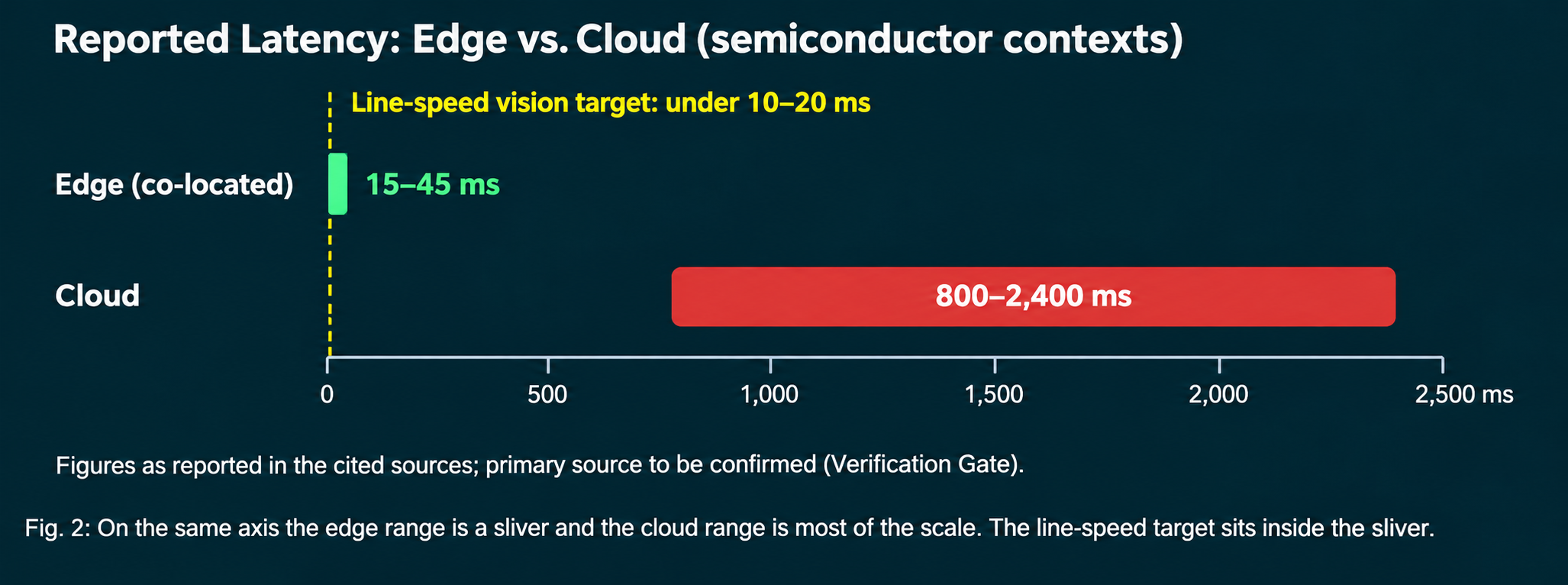
Cloud round trips of hundreds of milliseconds to seconds are irrelevant for chat. They are disqualifying for high-speed reject, robot guidance and safety-zone monitoring. Edge systems co-located with equipment are reported in the 15–45 ms range in semiconductor contexts, against 800–2,400 ms for cloud; line-speed vision targets sit under 10–20 ms.*
Low-power NPUs and edge accelerators now deliver useful TOPS at single-digit to low tens of watts, making always-on inference inside tools viable.* On 21 October 2026, Schneider Electric, HPE and NVIDIA announced industrial AI agents at the edge, citing data sovereignty, attack surface and AI consumption costs.*
What must stay on-premise is not "all AI." It is every decision whose delay or data exit has a safety, quality or IP consequence.
1. Latency and Power Set the Tier
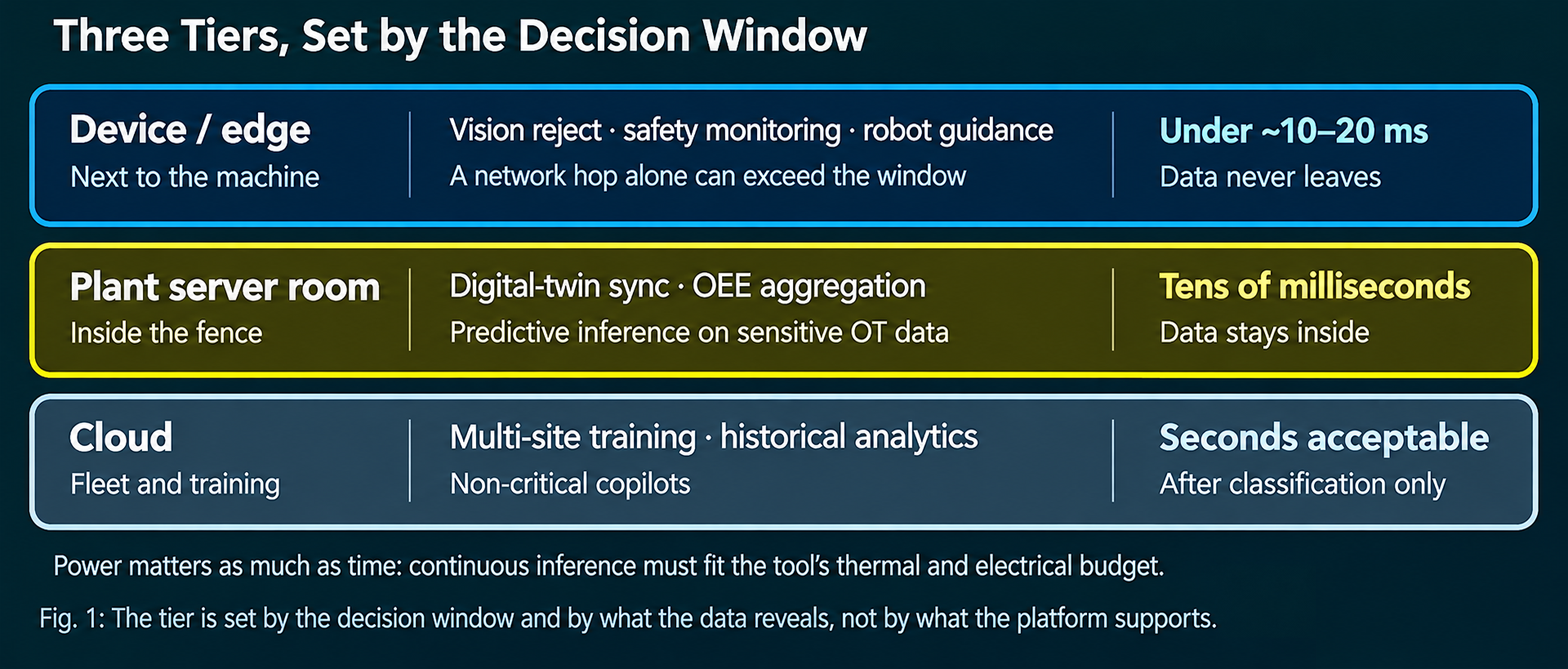
Three tiers, set by the decision window and by what the data reveals.
Device or edge: vision reject, safety monitoring, robot guidance. Decision windows sit under roughly 10–20 ms, and the network hop alone can exceed them.* Plant server room: digital-twin sync, OEE aggregation, predictive inference on sensitive OT data. Tens of milliseconds are acceptable, and the data stays inside. Cloud: multi-site training, historical analytics, non-critical copilots. Seconds are acceptable, but only after data classification.
Power matters as much as time. Continuous inference on every camera must fit the tool's thermal and electrical budget, not a data-center assumption.
👉 Key Insight
If the part has already moved three stations before the answer returns, the architecture is wrong.
2. What the Field Is Doing
The field has stopped treating edge as an experiment.
Semiconductor and high-speed lines treat edge as essential, not experimental. Edge systems co-located with equipment are reported at 15–45 ms in semiconductor contexts, against 800–2,400 ms for cloud round trips.*
Designs are tiered: Jetson-class or equivalent hardware at the station, RTX/L40-class hardware in the server room, cloud only for fleet management and training.* Agentic workloads are moving on-device or on-prem so that sensor data never crosses the corporate boundary and inference cost stays predictable. The Schneider Electric, NVIDIA and HPE announcement of 21 October 2026 is the clearest recent example: its first three agents cover OT monitoring, cybersecurity and energy optimization, run on HPE Private Cloud AI, and are justified by data sovereignty, a smaller attack surface and AI consumption costs.*
Reliability belongs on the list. Edge keeps running when the WAN does not, a requirement operators state more often than pure security.*
👉 Key Insight
Edge is not only about speed. It is about the decision still being yours when the network is not.
3. What Must Stay On-Premise
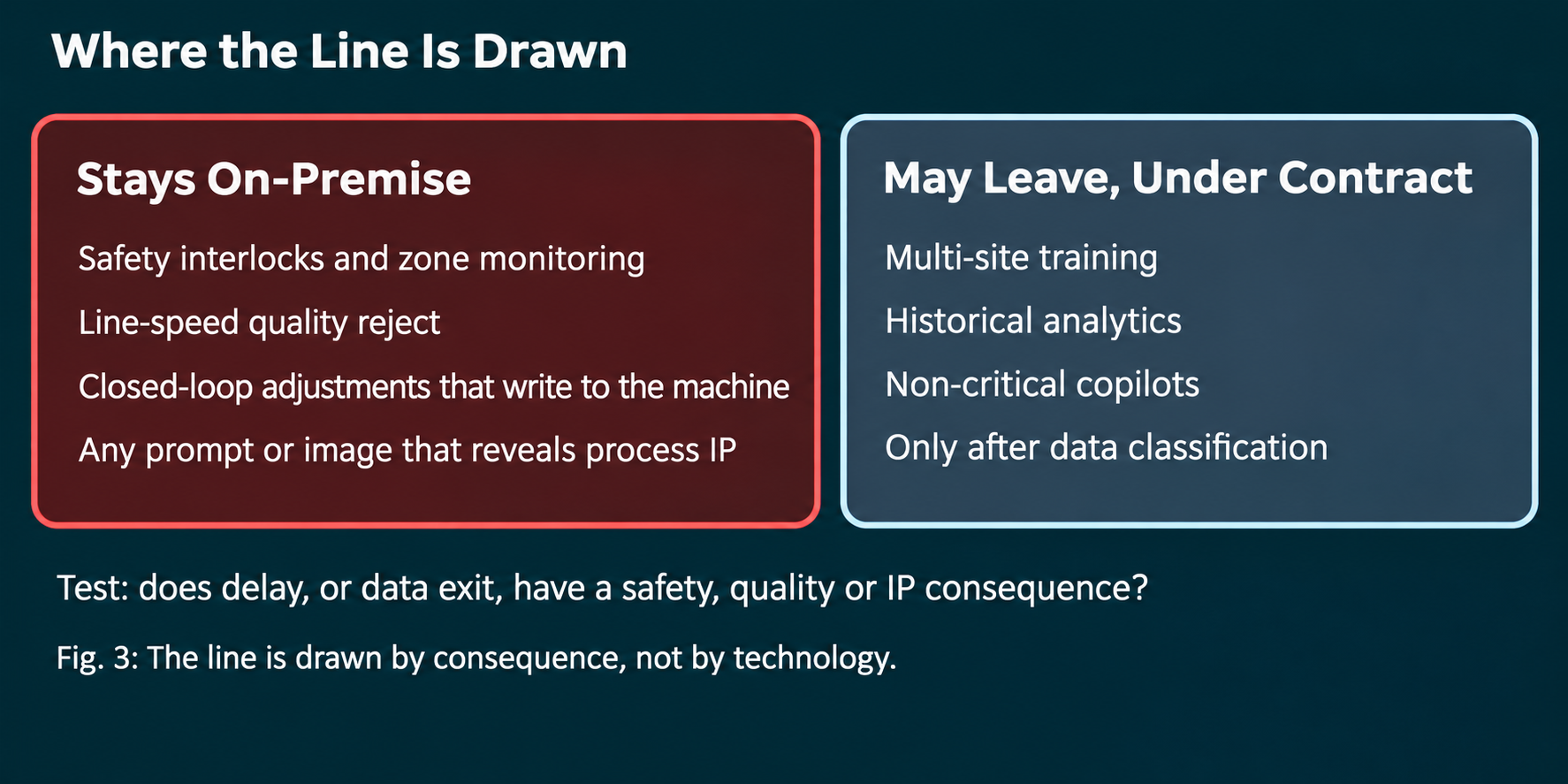
Four categories stay beside the machine. Training can leave, under contract. These cannot.
Safety interlocks and zone monitoring. Line-speed quality reject. Closed-loop adjustments that write to the machine. Any prompt or image that reveals process IP.
Everything else can be argued. Ask one question of each use case: does delay, or data exit, have a safety, quality or IP consequence? If yes, it stays.
👉 Key Insight
On-premise is the default for the control loop. Cloud is the option for everything that can wait and can be shared.
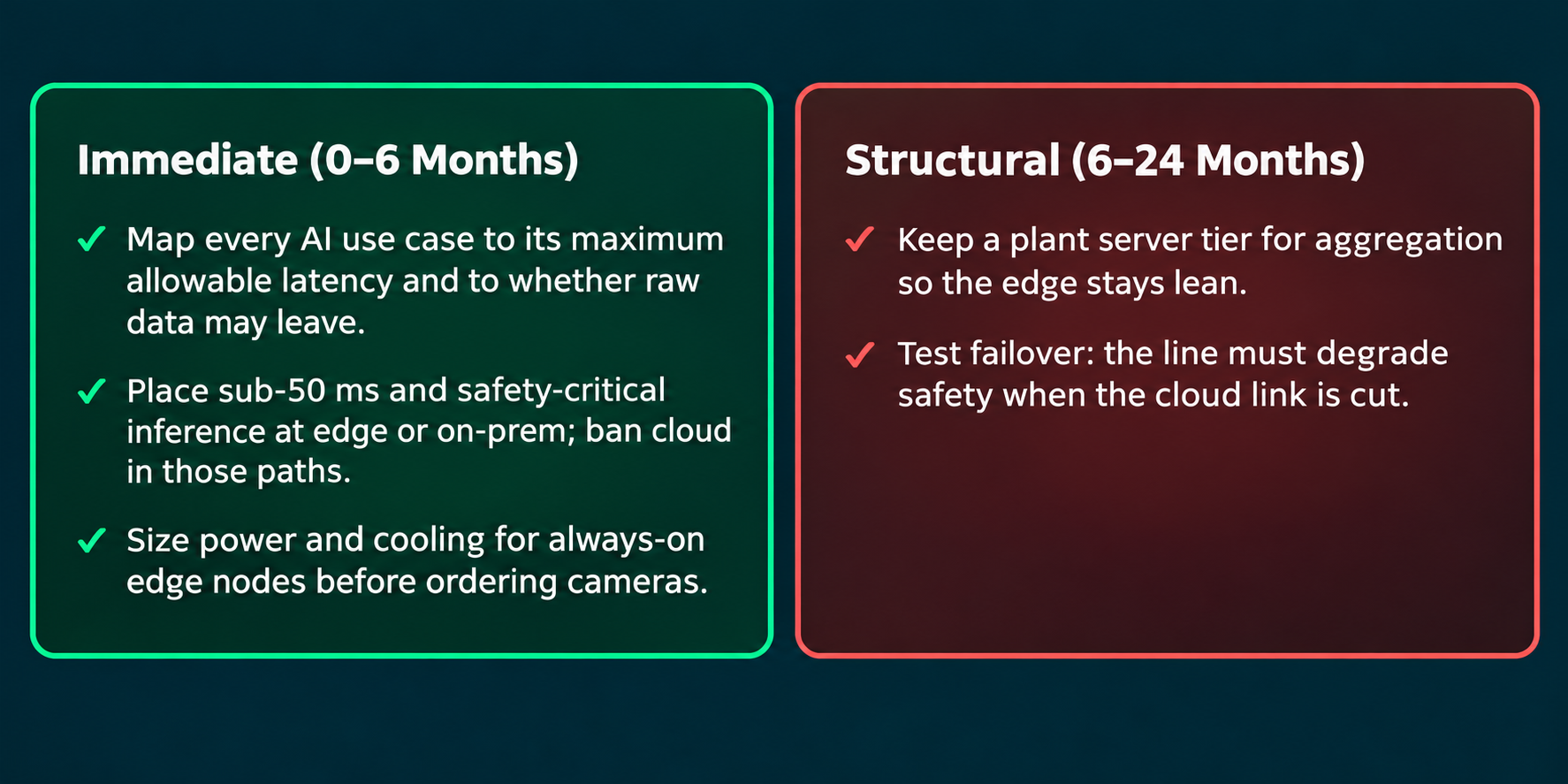
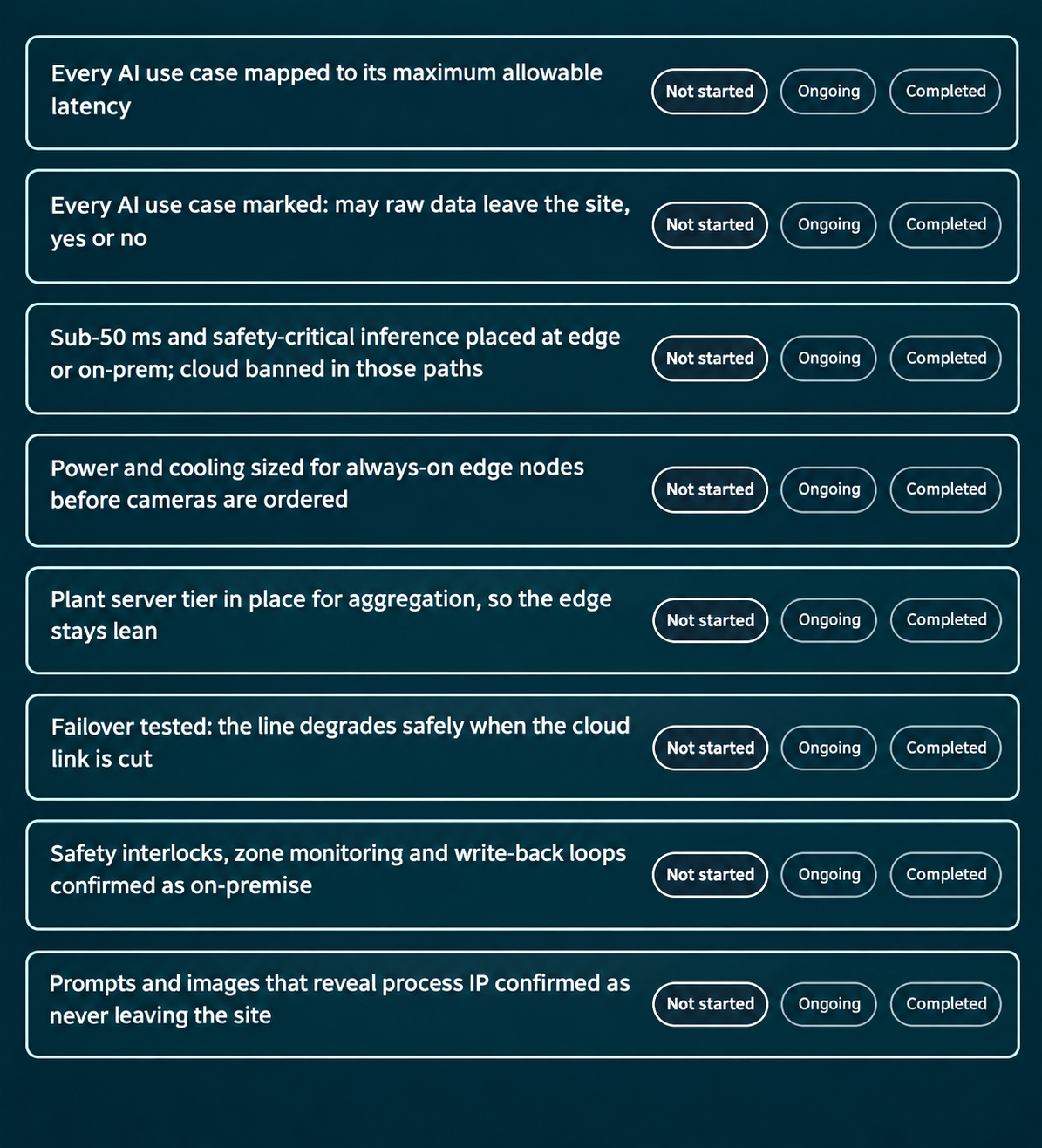
Action Plan for Decision Makers
Checklist
Final Thought
A chat answer can take a second. A reject gate cannot. Part III closes the week with the question that comes before any placement decision: what obstacle are you actually trying to remove?
Efficiency Before Energy means sizing the inference to the decision, not shipping every frame to a data center and back.
Systems don't fail. Decisions do.
Take the Next Step
Subscribe to the Weekly Punch for weekly strategic clarity, direct to your inbox.
References
Schneider Electric, NVIDIA and HPE (2026) Strategic collaboration to accelerate physical AI for process industries ('Industrial AI Agents at the Edge'), announced 21 October 2026; as reported by Hydrocarbon Processing.
Edge versus cloud latency in semiconductor manufacturing (15–45 ms versus 800–2,400 ms), as cited in the Week 45 brief (EMSNow / SEMI-related discussion). [Primary source not located; to be confirmed before publication.]
Line-speed vision and safety latency targets (under 10–20 ms), tiered hardware designs and NPU power envelopes (industry tier guides, 2026). [Primary sources to be confirmed before publication.]
Manufacturing Dive (2026) on on-device agentic AI constraints: power, latency, sovereignty. [Primary source to be confirmed before publication.]
Disclaimer: This article synthesizes publicly available vendor, industry and research reporting current as of publication. Latency, power and hardware figures vary by setup and change quickly; readers should verify current figures against the original publications before relying on them for investment or deployment decisions. Verification Gate: flagged for pre-publication source check.
Ownership as Design.
Note: This article reflects my personalviews based on industry experience and publicly available information. It does not constitute professional, legal, or investment advice and does not represent the views of my employer. AI-generated visuals, concept and content by the author.
