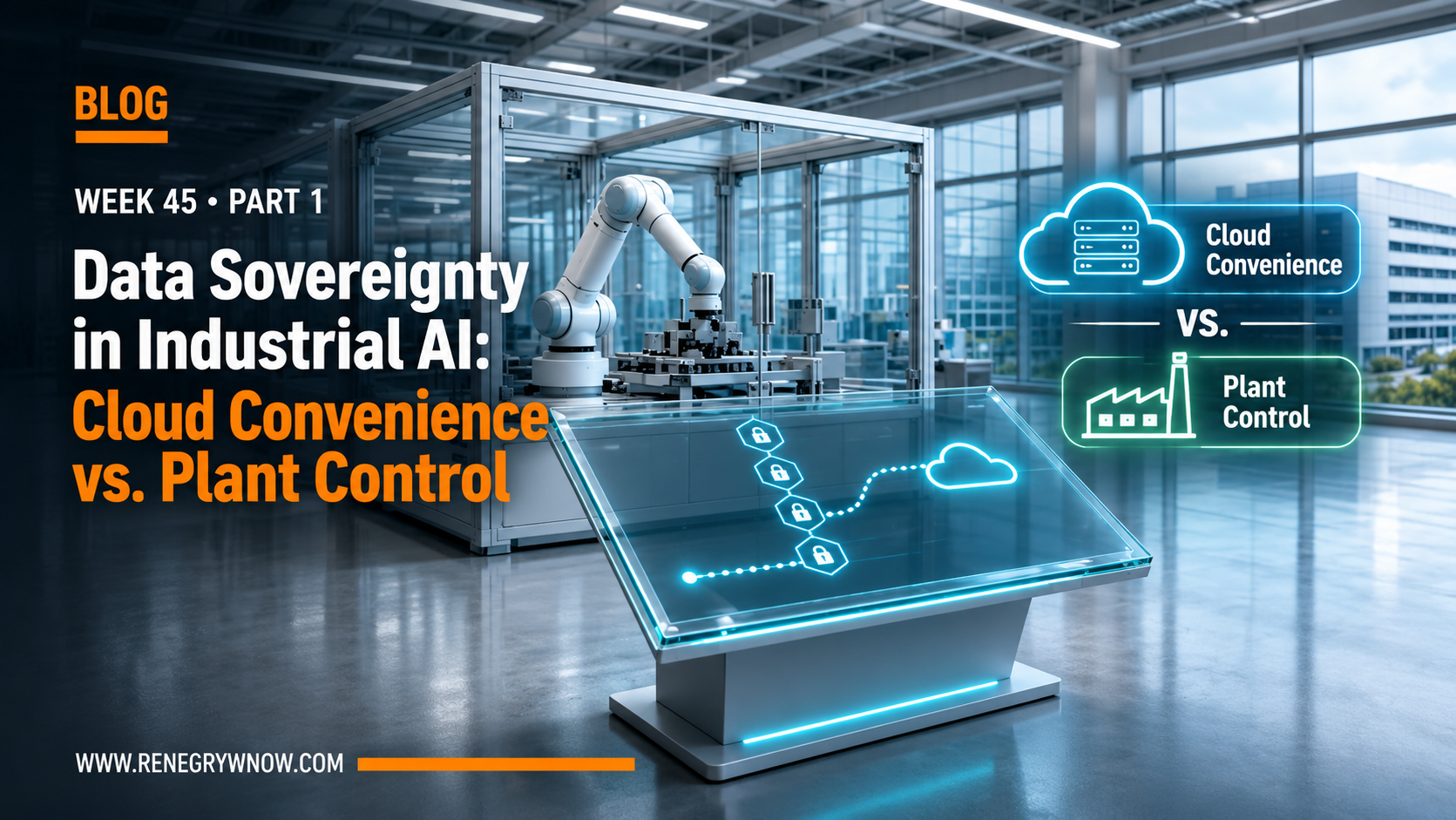
DATA SOVEREIGNTY | INDUSTRIAL AI | NOVEMBER 2026 | Week 45 · Part I
The Cloud Is Fast for Prototypes. The Plant Decides What May Leave the Fence, and What Must Not
Week 44 asked what the model understands and what stops it from skipping the obvious. Week 45 asks something plainer: where does it run, and who can prove it?
The cloud is the default because it is easy. For industrial data, easy is not the same as controlled. Process recipes, defect images and operator prompts are competitive IP, and sooner or later a regulator, a customer or a competitor will ask where the model saw them. "The vendor handles it" is not an answer.
Executive Summary
IN 60 SECONDS:
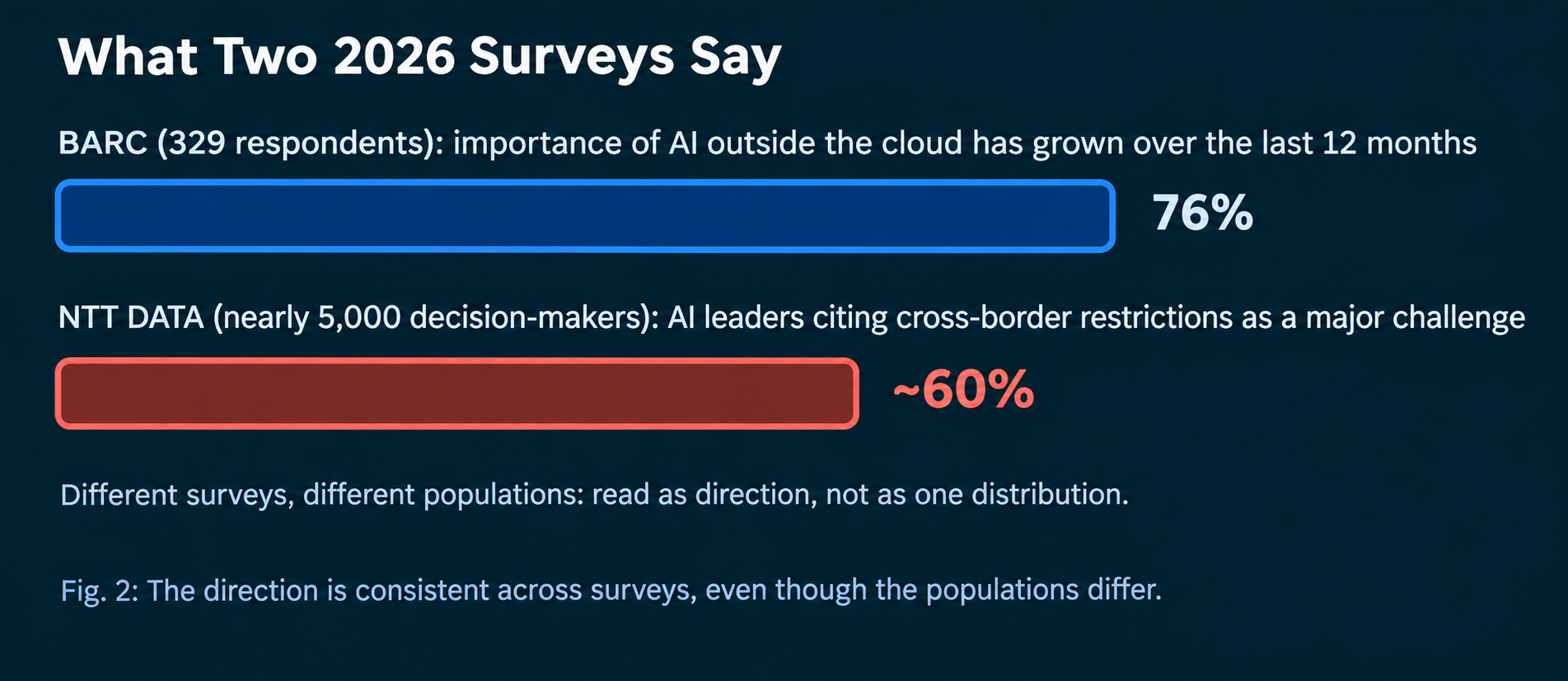
Cloud remains the default for many AI workloads because it is elastic and model-rich. For industrial data it is increasingly the wrong default. In BARC's 2026 study (329 respondents), 76% of organizations said the importance of deploying AI workloads outside the cloud has grown over the last twelve months.*
Nearly 60% of AI leaders in an NTT DATA survey already cite cross-border data restrictions as a major challenge.* EU residency, NIS2-style obligations, customer contracts and the plain fact that process recipes and quality images are competitive IP push plants toward regional or on-premise placement.
Decision Makers who treat "put it in the cloud" as the strategy are trading control for convenience – and will discover the trade only when a regulator, a customer or a competitor asks where the model saw the data.
1. What Sovereignty Means on a Plant
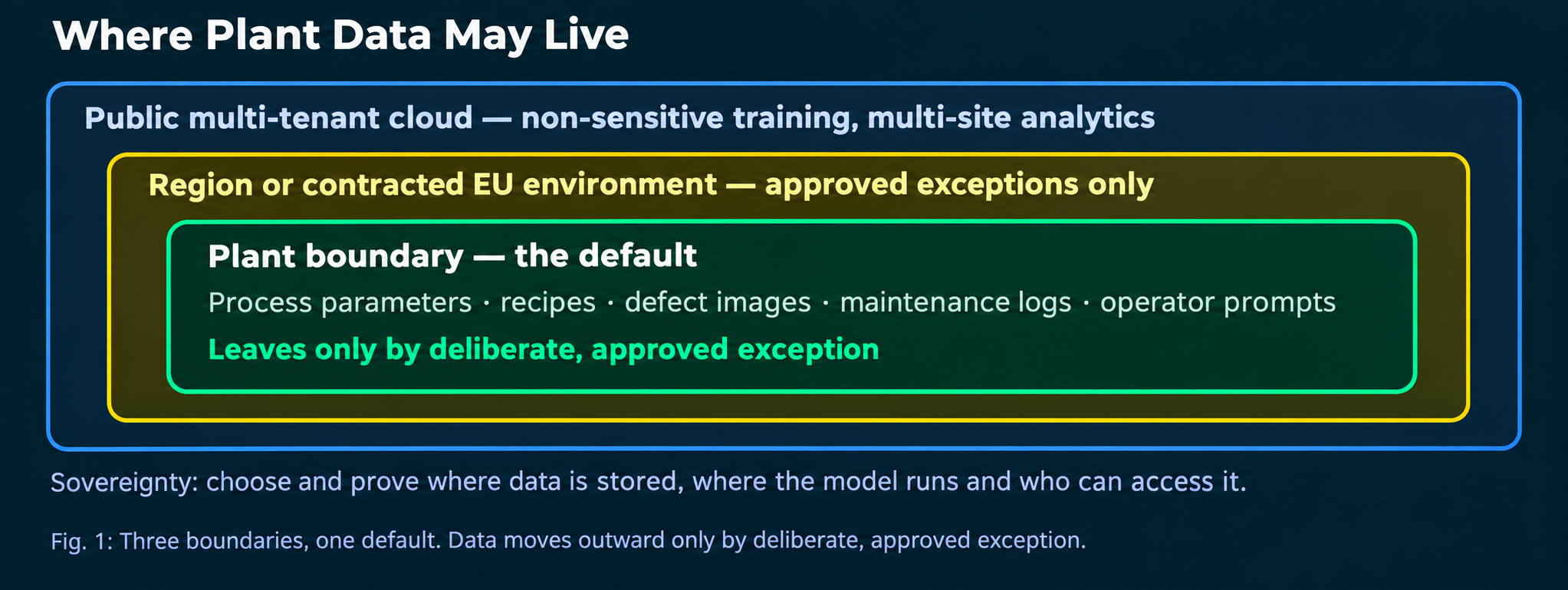
Sovereignty is not a slogan. It is the ability to choose and prove.
Four things have to be provable: where the data is stored, where the model runs, who can access it, and that it is not used to train a public foundation model.
For a manufacturer that means process parameters, defect images, maintenance logs and operator prompts stay inside defined boundaries, plant, region or contracted EU environment, unless a deliberate exception is approved.
👉 Key Insight
Cloud convenience is an OpEx choice. Plant control is an IP and liability choice.
2. The Pressure in 2026
Four pressures are moving at the same time. None of them is a technology problem.
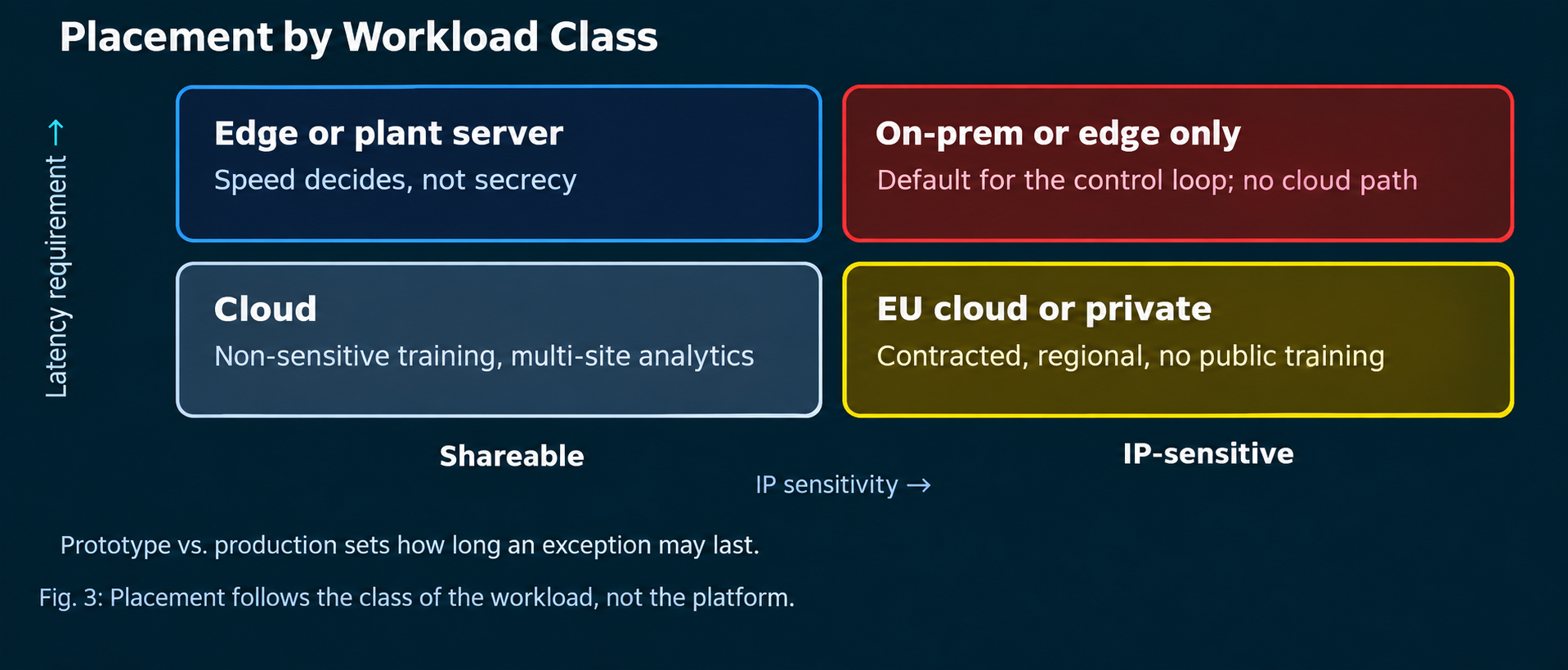
Workload placement is becoming deliberate: cloud for non-sensitive training and multi-site analytics; on-prem or edge for confidential production data and real-time inference (BARC; Microsoft Foundry Local and comparable sovereign patterns).* Cross-border and residency rules make "global-by-default" fragile, so organizations are moving to regional architectures with central policy and local execution.*
Physical and power sovereignty now appear alongside data: a model that cannot run when the shared cloud or the grid is constrained is not controlled.
Vendors have noticed. Sovereign AI instances, private cloud AI and EU clouds now market isolation explicitly, because industrial buyers refuse to let process IP train external models. On 21 October 2026, Schneider Electric, NVIDIA and HPE announced "Industrial AI Agents at the Edge" on HPE Private Cloud AI, arguing that critical operational data is often too valuable, sensitive or regulated to move beyond operational boundaries and that keeping data close to its source reduces the attack surface.*
👉 Key Insight
The question is no longer whether the cloud is allowed. It is whether you can prove where the model saw the data.
3. The Decision That Actually Matters
Classify the workload first. Choose the venue second.
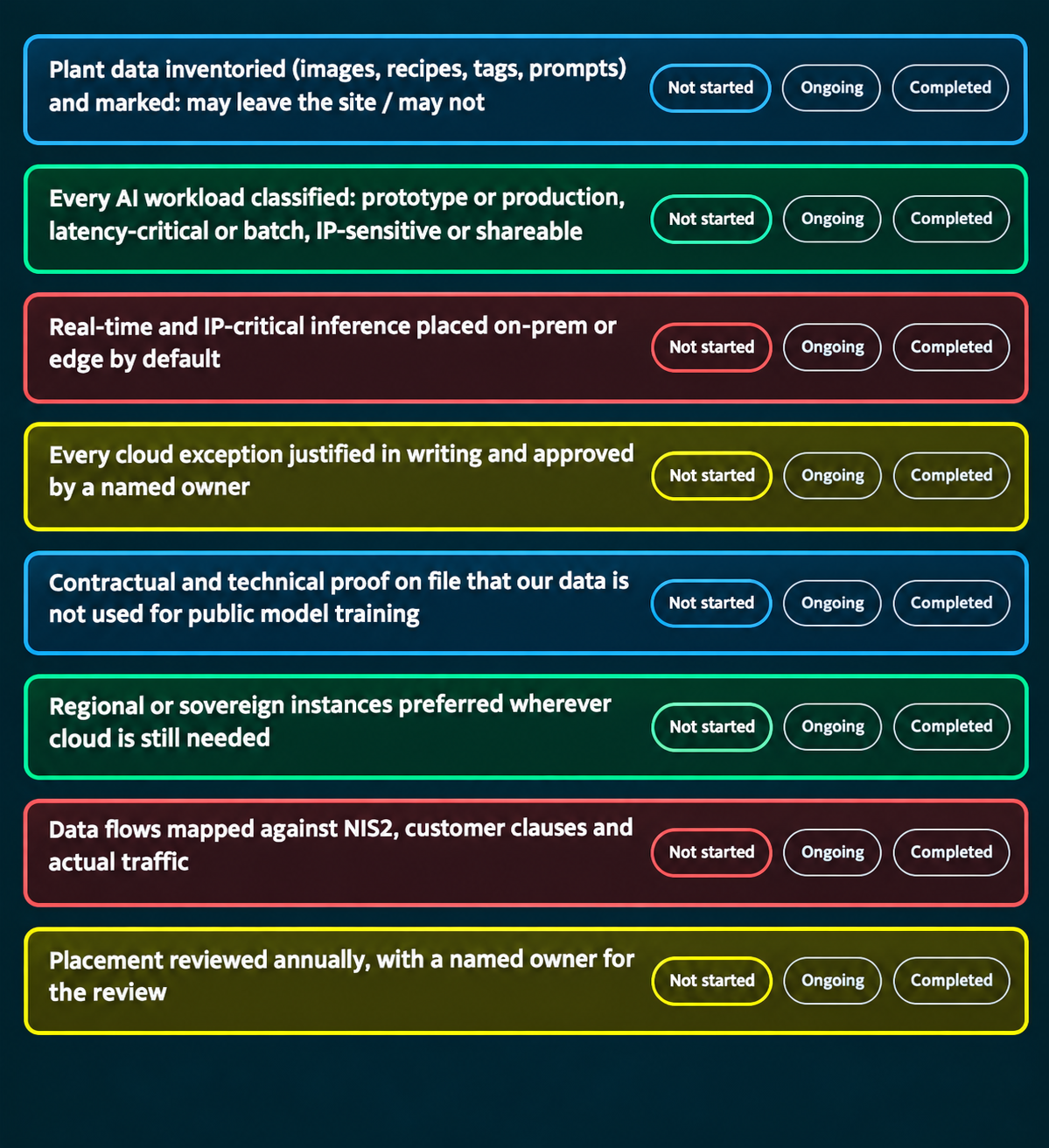
Classify each industrial AI workload: prototype or production, latency-critical or batch, IP-sensitive or shareable. Only then choose cloud, EU cloud, private or on-prem.
A single "AI platform" that sends every image and tag to a multi-tenant region is not a strategy. It is an unexamined default.
👉 Key Insight
Sovereignty is workload placement with evidence – not a checkbox on a cloud contract.
Action Plan for Decision Makers
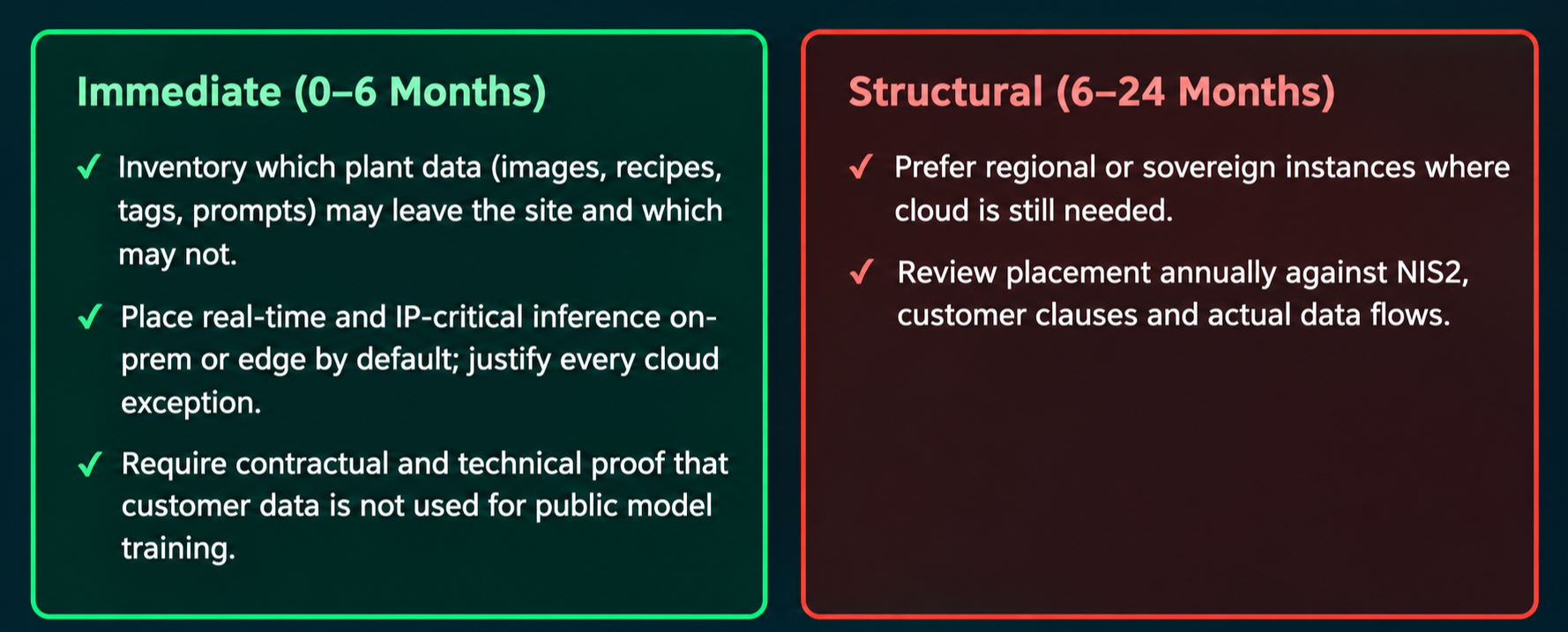
Checklist
Final Thought
Someone will ask where the model saw the data. The answer should be a document, not a promise. Part II of this week turns from where data may go to what cannot wait for the trip: latency, power and the control loop.
Efficiency Before Energy means moving less data is cheaper than securing, transporting and later explaining it.
Systems don't fail. Decisions do.
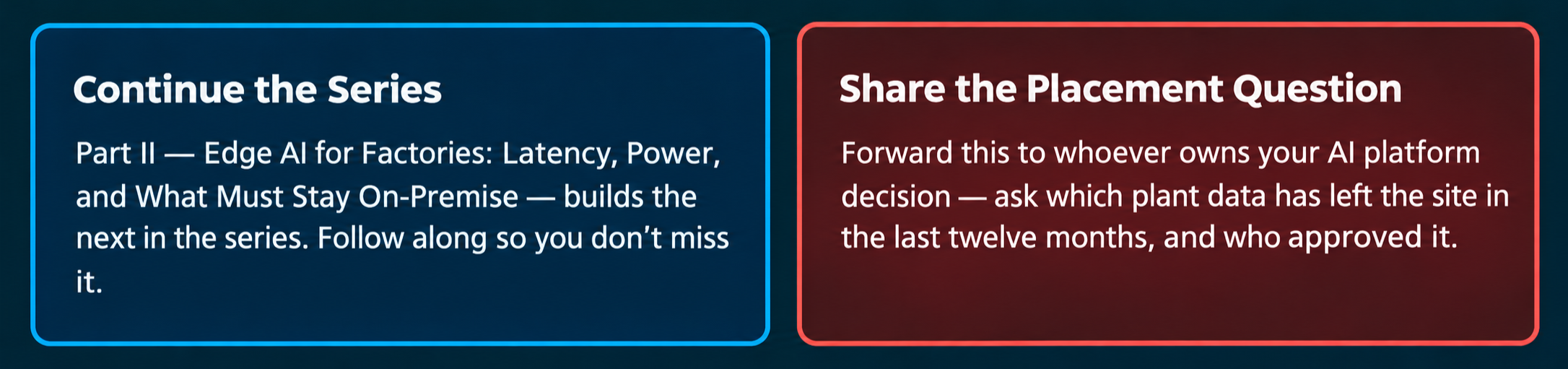
Take the Next Step
Subscribe to the Weekly Punch for weekly strategic clarity, direct to your inbox.
References
BARC (2026) Where Enterprise AI Runs: Deliberate Workload Placement Across Cloud, On-Premises, and Edge (Enterprise AI: A Study on Strategic Workload Placement). Online survey of 329 respondents, June–July 2026; published 22 October 2026.
NTT DATA (2026) Research on barriers to enterprise AI adoption (nearly 5,000 senior decision-makers), as reported by IT Brief Australia, 15 May 2026. [Primary NTT DATA publication and the Data Centre Review report to be confirmed before publication.]
Schneider Electric, NVIDIA and HPE (2026) Strategic collaboration to accelerate physical AI for process industries ('Industrial AI Agents at the Edge'), announced 21 October 2026; as reported by Hydrocarbon Processing.
European Parliament and Council of the European Union (2022) Directive (EU) 2022/2555 on measures for a high common level of cybersecurity across the Union (NIS 2 Directive). Official Journal of the European Union, L 333, 27 December 2022.
Microsoft (2026) Sovereign AI from edge to cloud (Azure; Foundry Local). [Primary source to be confirmed before publication.]
Operational and power sovereignty in industrial AI (CIO reporting, 2026). [Primary source to be confirmed before publication.]
Disclaimer: This article synthesizes publicly available survey, vendor and regulatory reporting current as of publication. Survey figures vary by population and setup and change quickly; readers should verify current figures against the original publications before relying on them for investment, compliance or deployment decisions. Verification Gate: flagged for pre-publication source check.
Ownership as Design.
Note: This article reflects my personalviews based on industry experience and publicly available information. It does not constitute professional, legal, or investment advice and does not represent the views of my employer. AI-generated visuals, concept and content by the author.
