
LEADERSHIP | STRATEGY | NOVEMBER 2026 | Week 45 · Part III
A List of AI Tools Is Not a Strategy. A Diagnosis of the Actual Obstacle Is
Most AI strategies are shopping lists with a growth target on top.
Richard Rumelt's test is short: can you state the obstacle in two sentences, the policy that addresses it, and the actions that do not contradict each other? This is an independent piece on leadership, not on technology. It asks what changes when the diagnosis comes before the tool.
Executive Summary
IN 60 SECONDS:
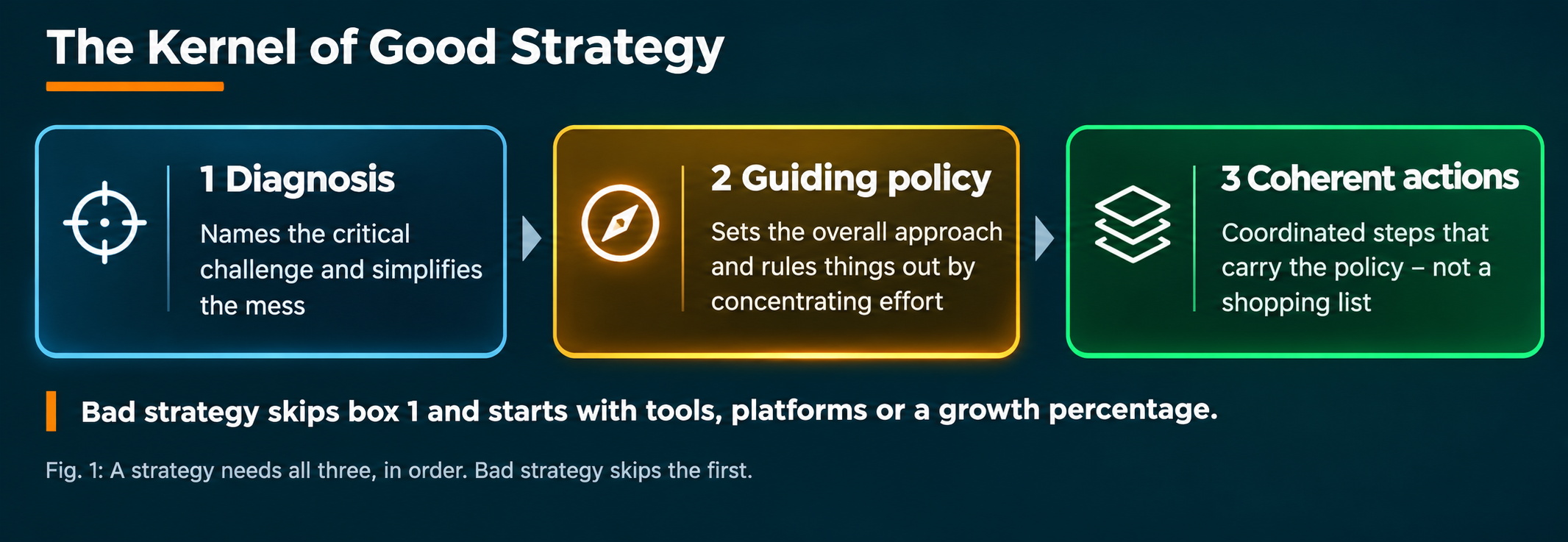
Rumelt's kernel has three parts, in order: a diagnosis that names the critical challenge and simplifies the mess; a guiding policy that sets the overall approach and rules things out; coherent actions that carry the policy.*
Most "AI strategies" skip the first part. They open with tools, platforms or a growth percentage – goals and fluff without an obstacle, which is bad strategy in Rumelt's sense. In a plant the obstacle is rarely "we lack an LLM." It is usually latency on the line, data that cannot leave, integration debt, or a constraint the current process cannot see.
Diagnosis first forces the tool choice to follow the problem – not the vendor slide.
1. What Rumelt Required
Diagnosis, guiding policy, coherent actions – in that order.
Diagnosis explains the nature of the challenge and identifies the few aspects that matter. Guiding policy is the approach that creates advantage by concentrating effort and excluding alternatives. Coherent actions are coordinated steps, not a shopping list.
A document that says "deploy AI across operations" has stated an ambition. It has not diagnosed why the current system fails or what must change.
👉 Key Insight
No diagnosis, no strategy – only a wish list of tools.
2. Diagnosis Before the Platform – One Example
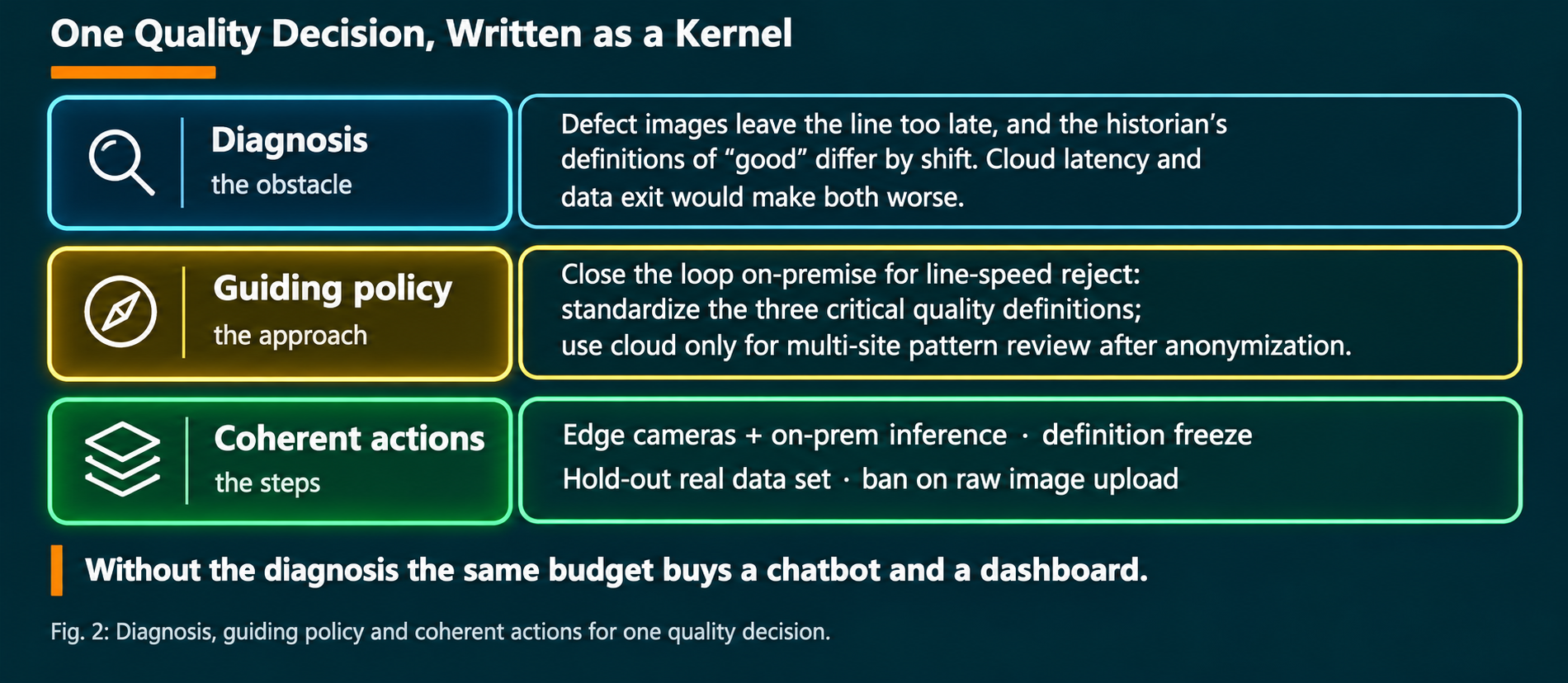
A leadership team is about to buy a cloud AI suite for "quality."
Before the purchase, write the three parts down. The figure shows what that looks like for one quality decision.
Without the diagnosis the same budget buys a chatbot and a dashboard. With it, the tools are consequences.
👉 Key Insight
The test of a diagnosis: it makes some tools obviously wrong.
3. Bad Strategy Patterns in Industrial AI
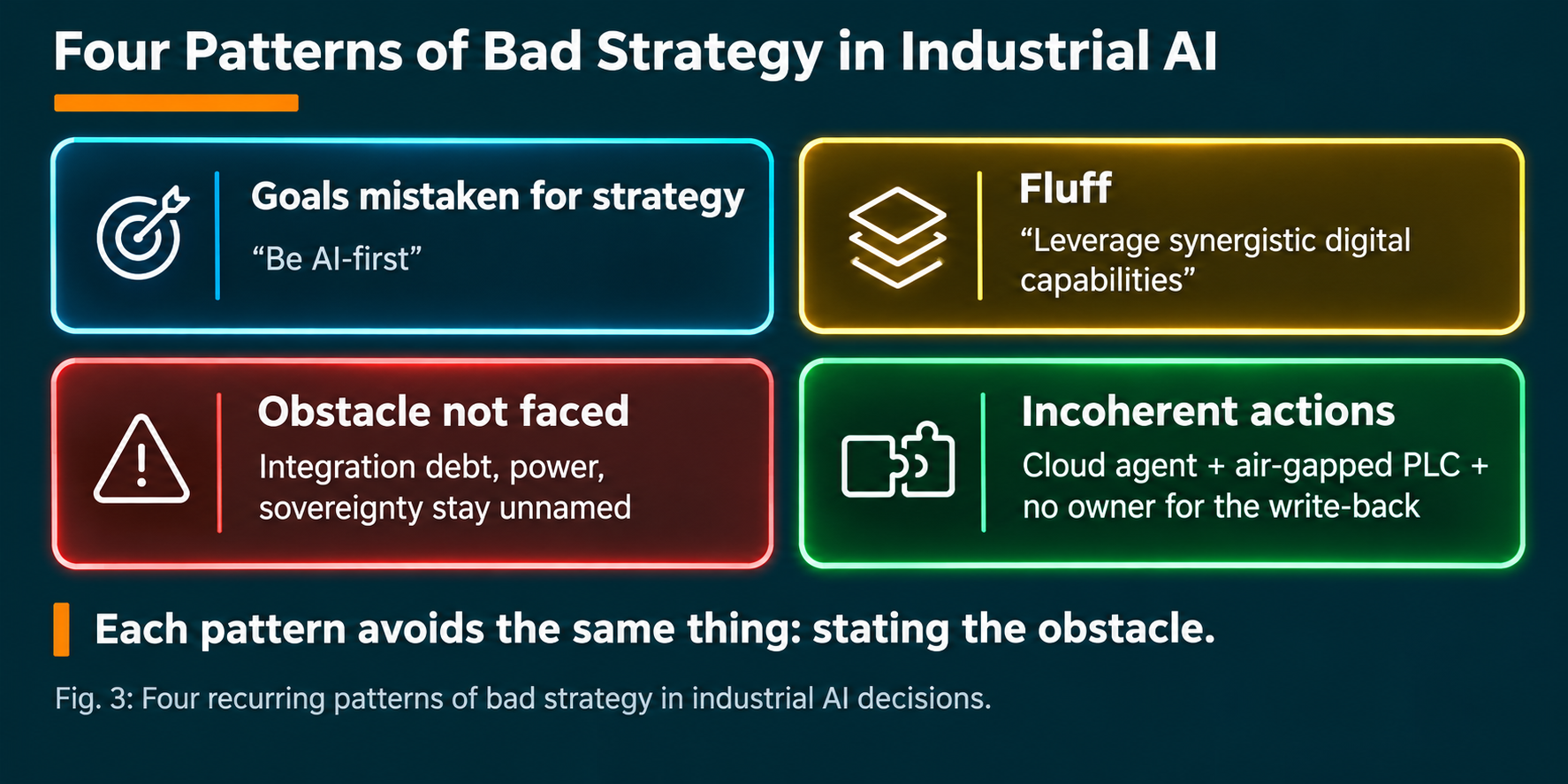
Four patterns recur. Each avoids the same thing: facing the obstacle.
Mistaking goals for strategy ("be AI-first"). Fluff ("leverage synergistic digital capabilities"). Failure to face the obstacle: integration debt, power, sovereignty. Incoherent actions: a cloud agent, an air-gapped PLC and no owner for the write-back.
Rumelt's test is simple: can you state the challenge in two sentences, the policy that addresses it, and the actions that do not contradict each other?
👉 Key Insight
The test costs two sentences. A deck that cannot pass it has not decided anything yet.
Action Plan for Decision Makers
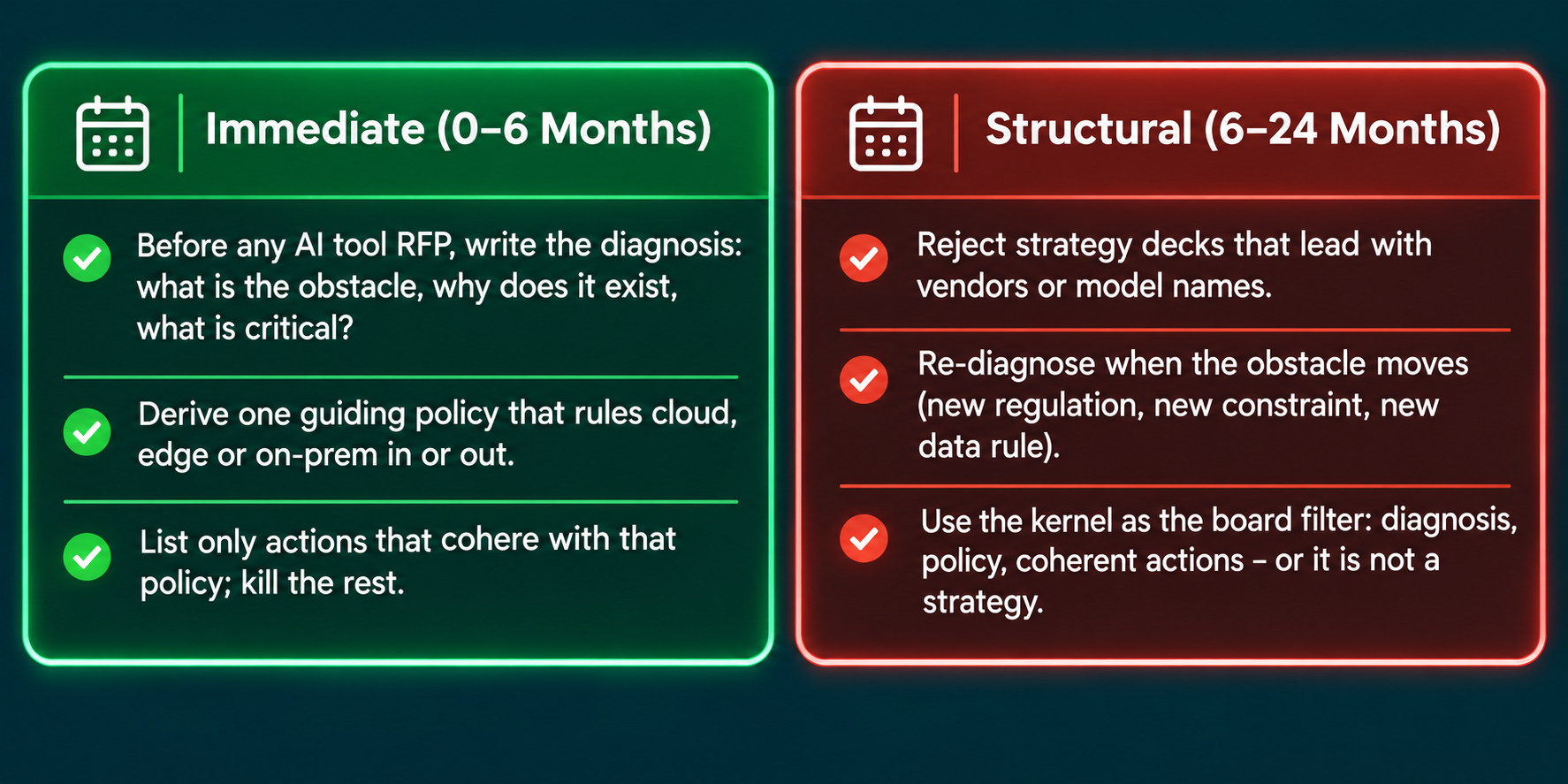
Checklist
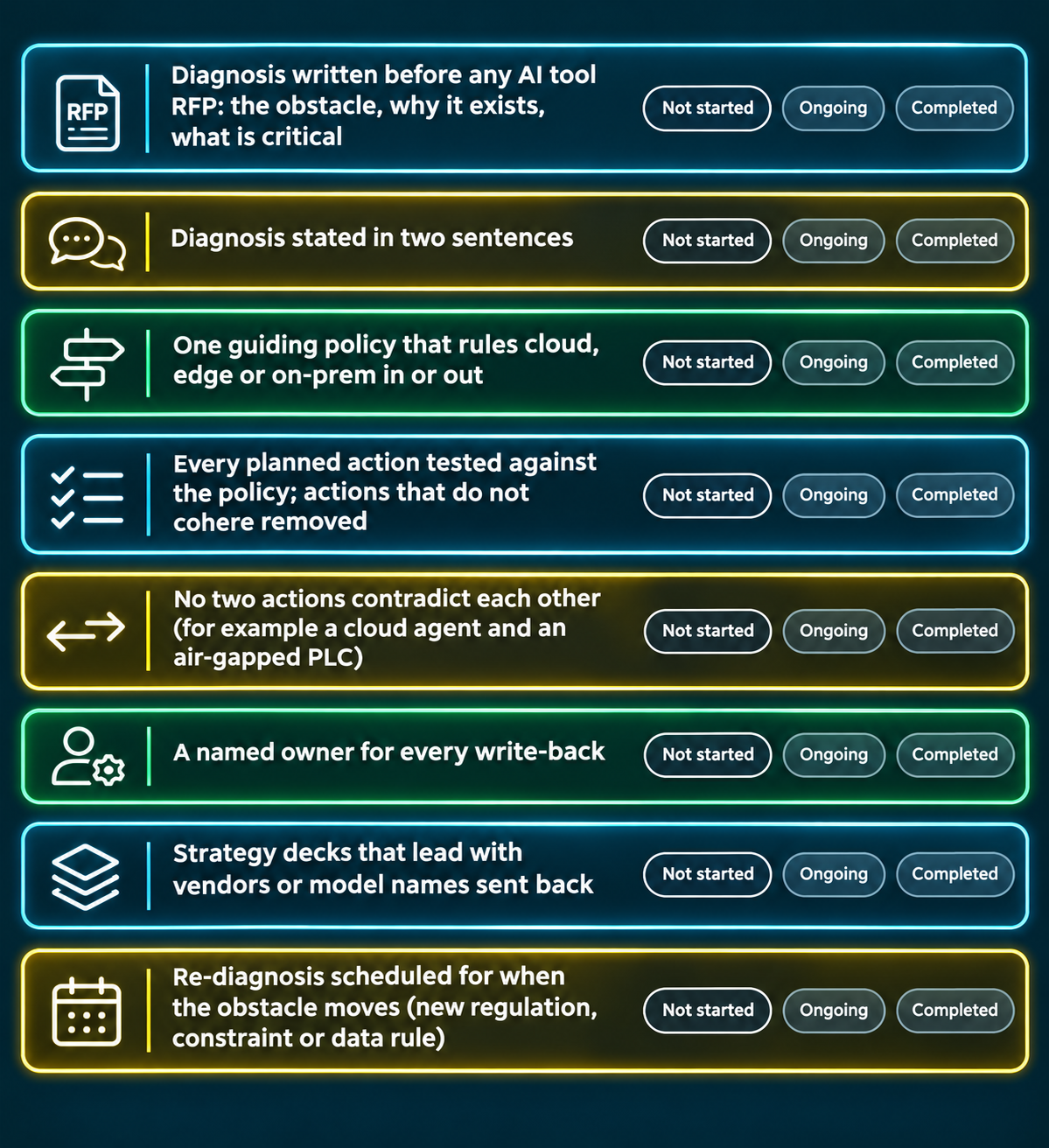
Final Thought
A shopping list does not become a strategy by adding a growth target on top. Parts I and II of this week named two obstacles worth diagnosing – data that cannot leave and decisions that cannot wait. The discipline is the same for every plant: name the obstacle before you buy the tool.
Efficiency Before Energy means the cheapest investment is the one the diagnosis rules out.
Systems don't fail. Decisions do.
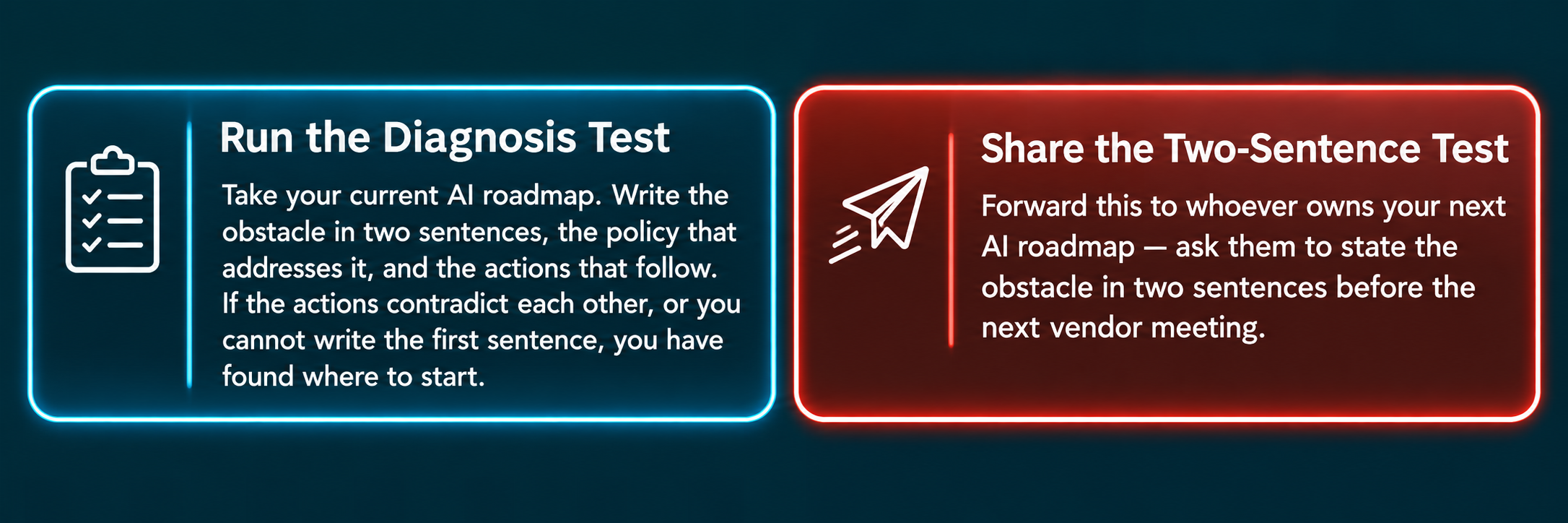
Take the Next Step
Subscribe to the Weekly Punch for weekly strategic clarity, direct to your inbox.
References
Rumelt, R.P. (2011) Good Strategy/Bad Strategy: The Difference and Why It Matters. New York: Crown Business.
Disclaimer: This article applies the argument of a published book to industrial AI tool and architecture decisions; the application is the author's own and is not drawn from the cited work. Quotations and the kernel as summarized should be checked against the book before relying on them. Verification Gate: flagged for pre-publication source check.
Ownership as Design.
Note: This article reflects my personalviews based on industry experience and publicly available information. It does not constitute professional, legal, or investment advice and does not represent the views of my employer. AI-generated visuals, concept and content by the author.
