Deciding When Both Forecasts Can Be Wrong: Leadership Lessons from Tetlock's Superforecasting
LEADERSHIP | UNCERTAINTY | OCTOBER 2026 | Week 42 · Part III
Grid Queues and Capex Cases Are Both Forecasts. The Leaders Who Update Beat the Leaders Who Defend the Spreadsheet
This is an independent leadership piece based on Philip E. Tetlock's Superforecasting. The book is used here as a decision discipline for industrial AI under dual uncertainty, not as a prediction manual, and not as a continuation of this week's data-center argument.
Every connection date in an interconnection queue and every utilization number in a Capex case is a forecast. Both are frequently wrong by the same quarter, for the same reason: not because anyone lied, but because almost nobody built in a way to find out early and change course. Superforecasting is the practice of treating a forecast as a forecast, all the way through to the decision it is supposed to inform.
Executive Summary
IN 60 SECONDS:
Tetlock's finding, across years of forecasting tournaments, is that some people are consistently better at judging uncertain outcomes.* They are not oracles. They think in probabilities, break problems into parts, seek disconfirming evidence, and update when the world moves.
They avoid the two failures that dominate board papers: false precision ("the connection will be ready in 2028") and frozen conviction ("we already decided").
Grid timelines and AI Capex cases are both forecasts. Both are often wrong in the same quarter. Superforecasting is the leadership practice of treating them as such.
1. What Tetlock Actually Showed
Good forecasters are not smarter about the future. They are more disciplined about exactly two things: assigning probabilities instead of narratives, and updating when the world moves.
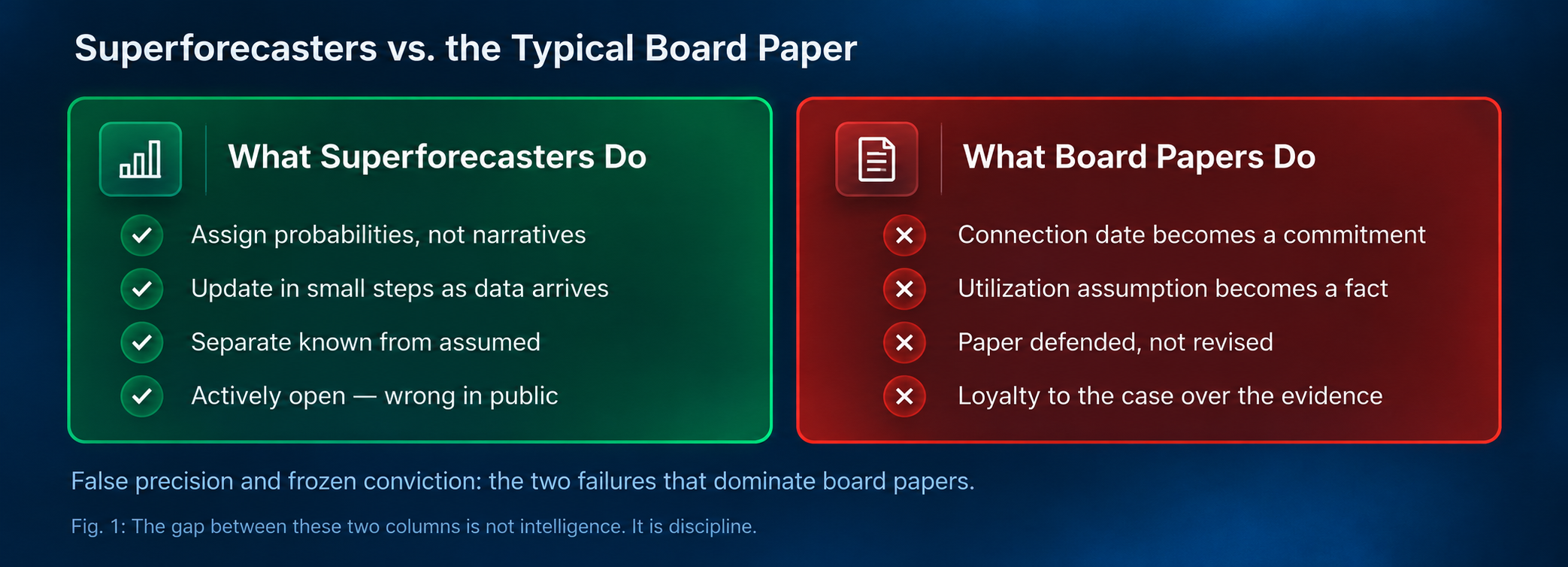
Across the Good Judgment Project's long-running forecasting tournaments, Tetlock and Gardner found that the best forecasters assign probabilities rather than tell stories, update in small steps as new data arrives rather than waiting for a single dramatic revision, and separate what is actually known from what has merely been assumed for planning convenience. They are, in Tetlock's phrase, actively open-minded: willing to be shown wrong in public, and willing to say so.*
Organizations tend to do the opposite. A connection date quoted once in a feasibility study becomes a commitment everyone plans around. A utilization assumption typed into a spreadsheet becomes a fact nobody revisits. When the queue slips and the actual load comes in lower than modeled, the paper gets defended not revised.
👉 Key Insight
The costly error is not a wrong forecast. It is a forecast that cannot be updated.
2. Two Forecasts, One Decision:
Practical Example
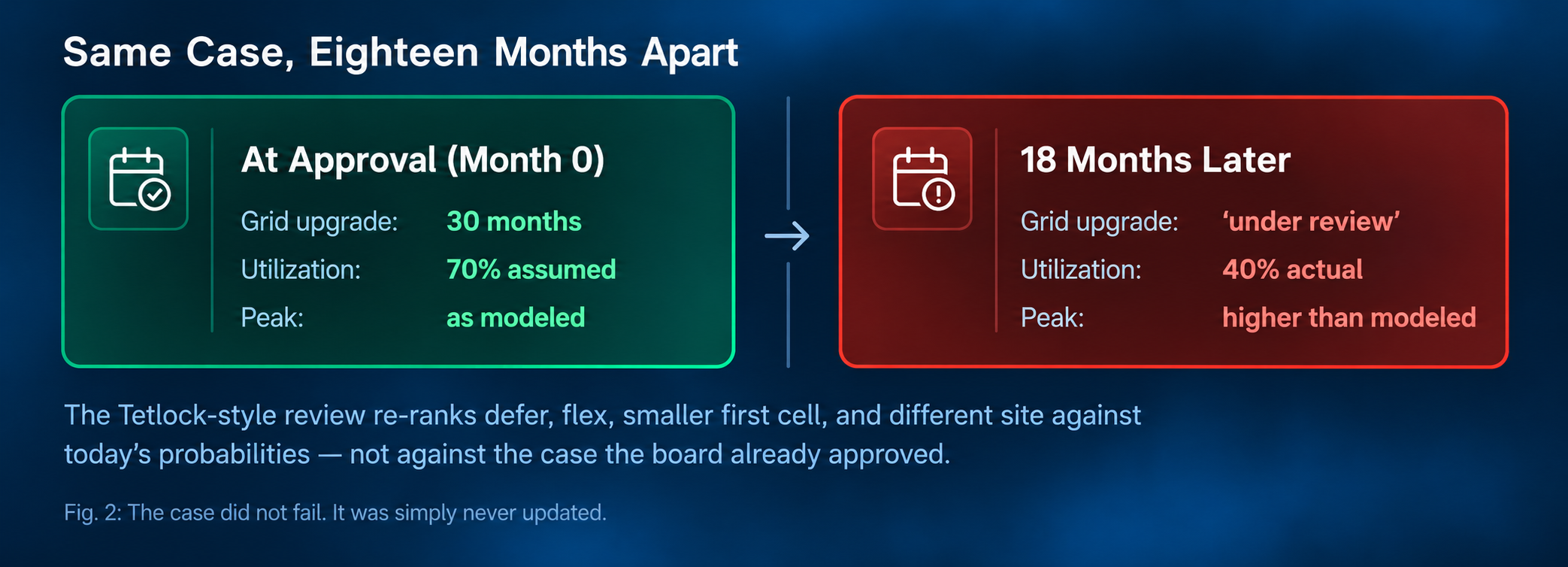
A plant case assumes a grid upgrade in 30 months, a robot cell at 70% utilization, and payback in four years. Eighteen months later, none of the three numbers has held.
The upgrade is now "under review." Measured utilization is running at 40%, not 70%. The peak the cell actually draws is higher than modeled. None of this is unusual, it is, in fact, close to the pattern this series has already documented in grid queues and robot-power planning elsewhere this quarter. What differs is what a Tetlock-style leadership review does next. It does not ask who was loyal to the original case. It asks: what is the probability the feeder is actually usable by date X, given what we know now? What is the probability utilization reaches Y within the payback window? What decision changes if both answers are below 50%?
Once those questions are asked and answered, the options, defer, flex the load, start with a smaller first cell, choose a different site, get re-ranked against the current numbers, not the original ones. The original business case is archived as a record of what was believed at the time. It is not protected as a decision that must still be defended.
👉 Key Insight
The leadership failure was never the 30-month estimate. It was treating month 18's new information as a threat to the case instead of an update to it.
3. How to Run It Without a Tournament
None of this requires forecasting tournaments, a research team, or a new department. It requires redesigning one recurring meeting.
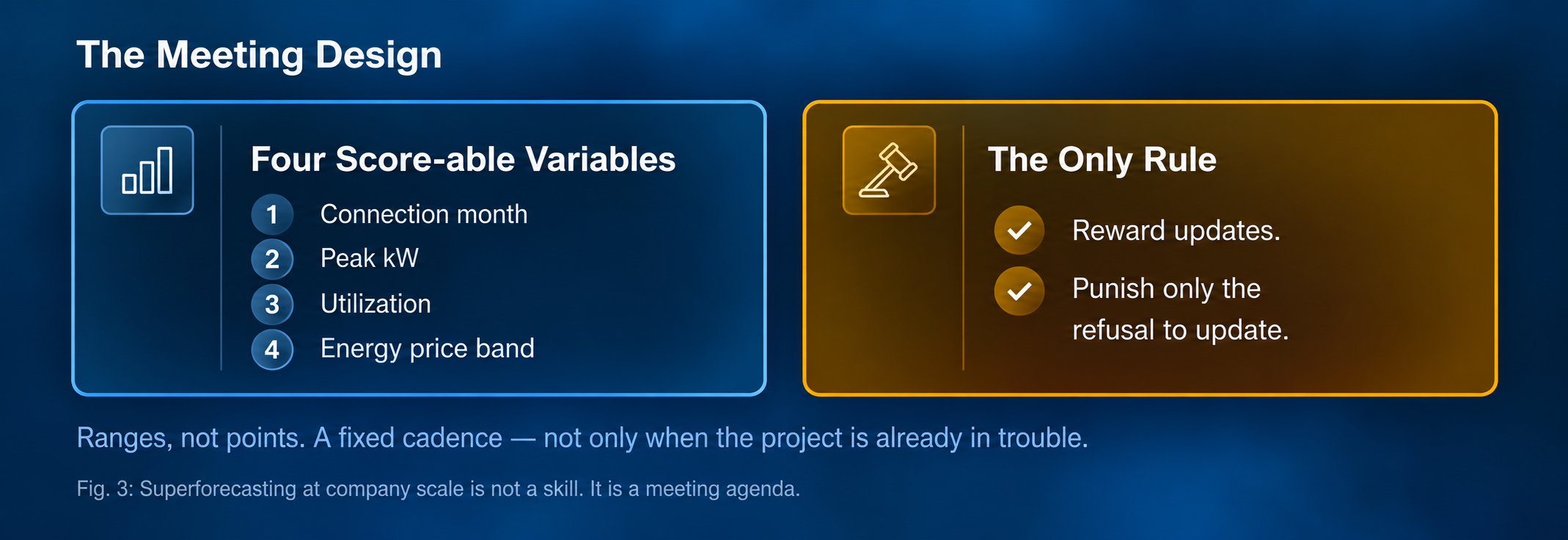
Break the case into questions that can actually be scored later: connection month, peak kW, utilization, energy price band. Assign ranges to each one, not single points, a range is honest about what is known; a point pretends to a precision nobody has. Name, in writing, the specific evidence that would move each number, and who is responsible for watching for it. Review on a fixed cadence set in advance, not only once the project is visibly in trouble, by which point the review is a postmortem rather than a correction.
The incentive structure has to match the design. Reward people for updating a number when the evidence changes. Punish only the refusal to update, never the act of being wrong about an honestly-ranged forecast. A team that is punished for updating will simply stop telling you when the numbers move, which is the one outcome a leadership team cannot afford.
👉 Key Insight
Superforecasting in a company is a meeting design: probabilities, triggers, and permission to change the plan.
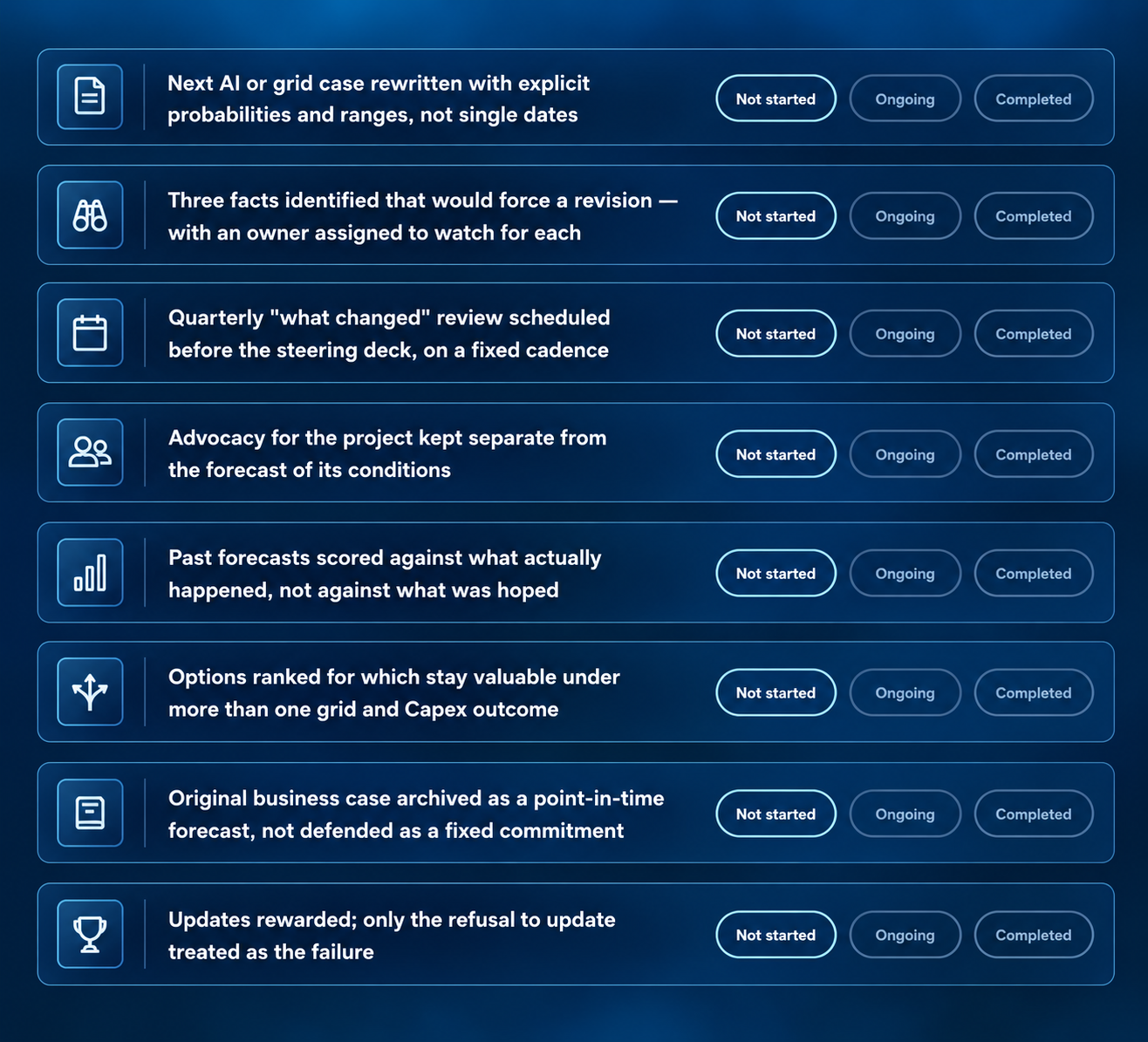
Action Plan for Decision Makers
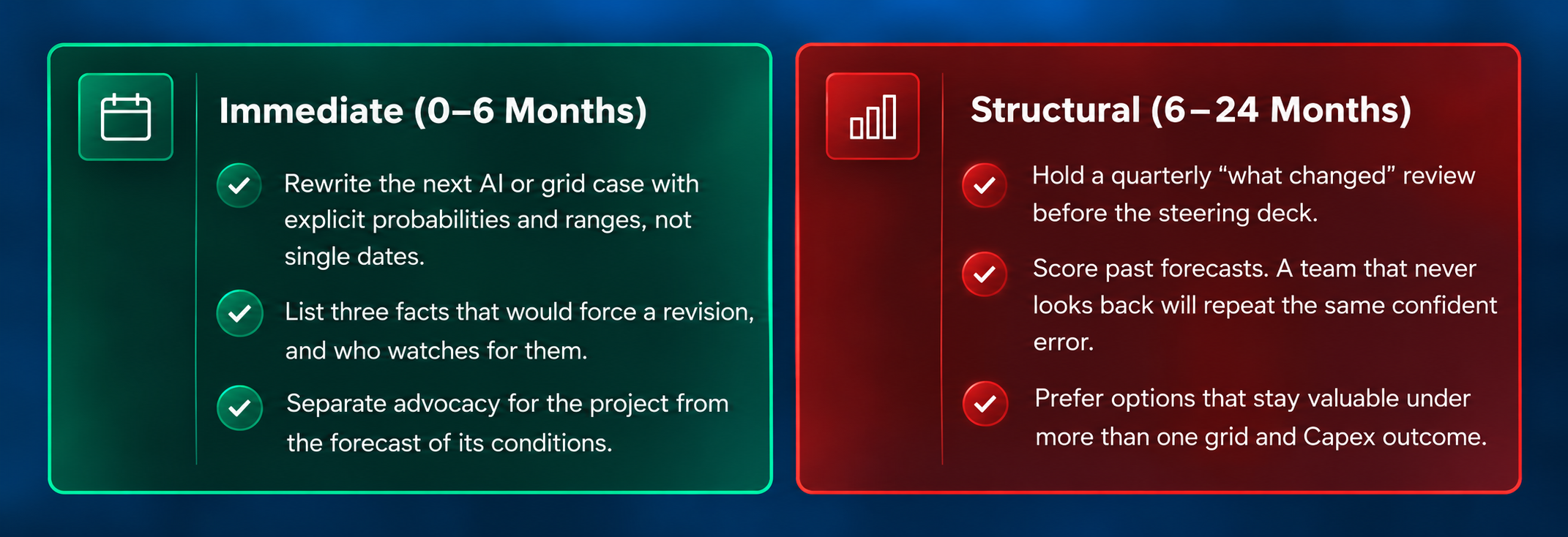
Checklist
Final Thought
Part I and Part II of this week's set each turned a forecast into something that reads like a fact: a flexible-megawatt number, a declared peak. Both are useful for exactly as long as someone keeps checking them against what the campus actually does. A superforecaster would recognize both documents immediately, not as predictions to defend, but as probabilities to keep updating.
Efficiency Before Energy means the forecast you defend costs more than the one you update — and knowing which one you are holding before the quarter proves it for you.
Systems don't fail. Decisions do.
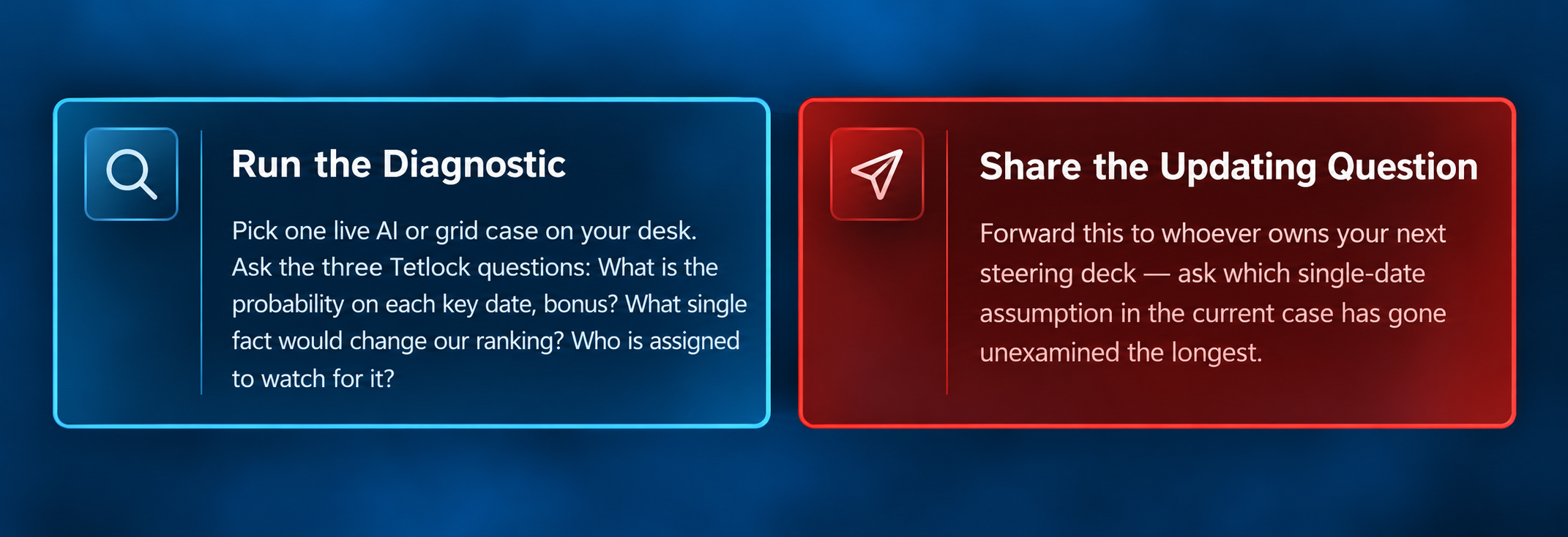
Take the Next Step
Subscribe to the Weekly Punch for weekly strategic clarity, direct to your inbox.
References
Tetlock, P.E. and Gardner, D. (2015) Superforecasting: The Art and Science of Prediction. New York: Crown Publishers.
Disclaimer: This article applies concepts from the cited source to industrial AI and grid-investment decision-making. It is an independent leadership analysis, not an endorsement by or summary review from the author or publisher. Readers should consult the original source directly before citing its findings. Verification Gate: flagged for pre-publication source check.
Ownership as Design.
Note: This article reflects my personalviews based on industry experience and publicly available information. It does not constitute professional, legal, or investment advice and does not represent the views of my employer. AI-generated visuals, concept and content by the author.
