
LEADERSHIP | CHECKLISTS | OCTOBER 2026 | Week 44 · Part III
Complexity Exceeds Any One Mind, Including an Agent's. Pause Points and Simple Checks Are What Keep Autonomous Systems from Skipping the Obvious
The most dangerous step in an autonomous plant is not the one nobody knew about. It is the one everybody knew about.
Atul Gawande's central observation is uncomfortable for anyone who buys capability: in complex work, the failure is often not that the step was unknown. The step was known, and it was missed. An autonomous agent is the purest version of this problem, it acts at machine speed, with confidence, on every cycle. This is an independent piece on leadership, not on technology: what Gawande's book asks of a plant that is adding agents and robots.
Executive Summary
IN 60 SECONDS:
Gawande's claim: in complex work, knowledge has outrun any individual's ability to get every critical step right under pressure. Highly trained people still miss the obvious. The remedy is not more brilliance. It is a short checklist with pause points that forces the essential checks and turns attention back on.
Aviation and the WHO surgical checklist are the proof cases: a couple of minutes, and in the eight-hospital study, major complications fell from 11.0% to 7.0% and deaths from 1.5% to 0.8%.* An agent or robot that can act without a checklist for the non-negotiables, energy isolation, permit, correct part, clear zone, human confirmation on the irreversible step, will eventually skip one.
Autonomy does not remove the need for the checklist. It makes the checklist the last reliable backstop.
1. What Gawande Actually Argued
Failure in complex domains is often not ignorance. It is ineptitude under load: the step was known and still missed.
Gawande separates two kinds of failure. Ignorance is not knowing what to do. Ineptitude is knowing and failing to do it correctly. In medicine and aviation the second is the larger problem, because knowledge has outrun any individual's ability to apply it flawlessly under pressure.
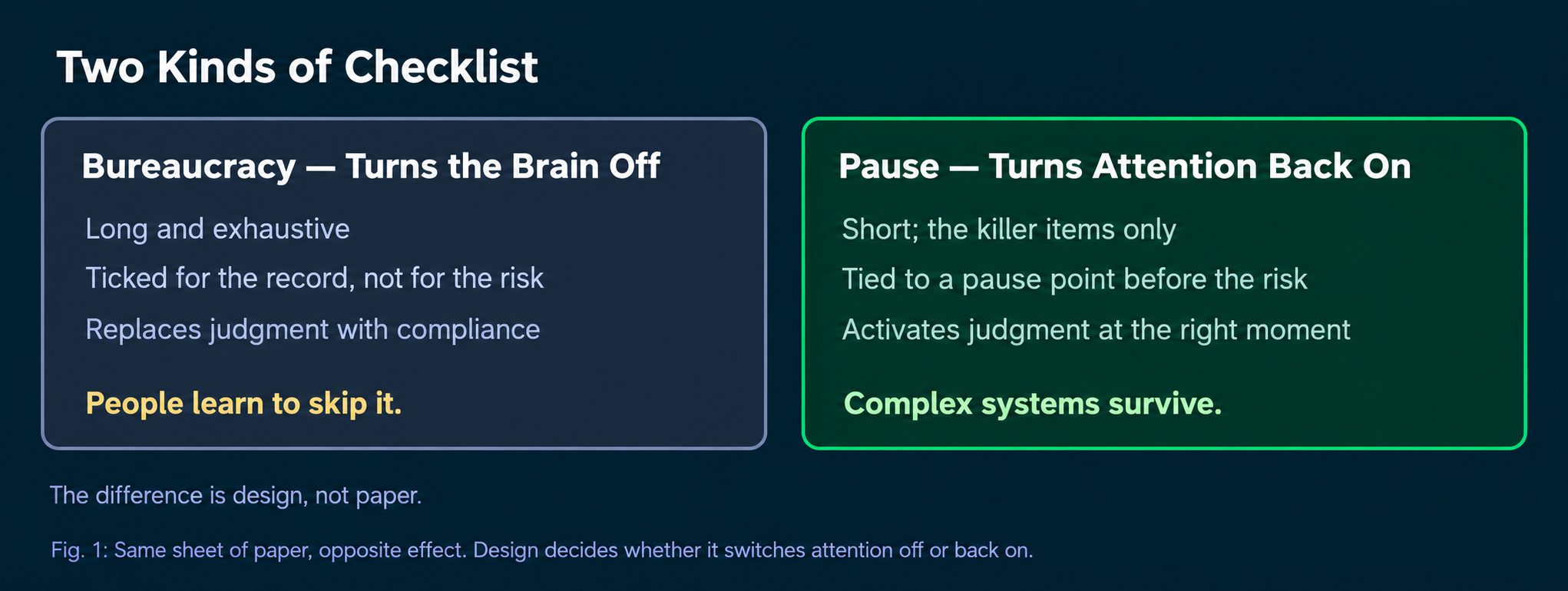
Checklists work when they are short, focused on the killer items, and designed to activate judgment rather than replace it. The Hudson River landing is his example from aviation: Captain Sullenberger kept crediting teamwork and adherence to protocol rather than his own piloting skill.
In a plant, the equivalent is plain: do not let the agent's confidence crowd out isolation, zone clear and the human stop.
👉 Key Insight
A checklist that turns the brain off is bureaucracy. A checklist that forces the critical pause is how complex systems survive.
2. Autonomy Meets the Missed Step – One Example
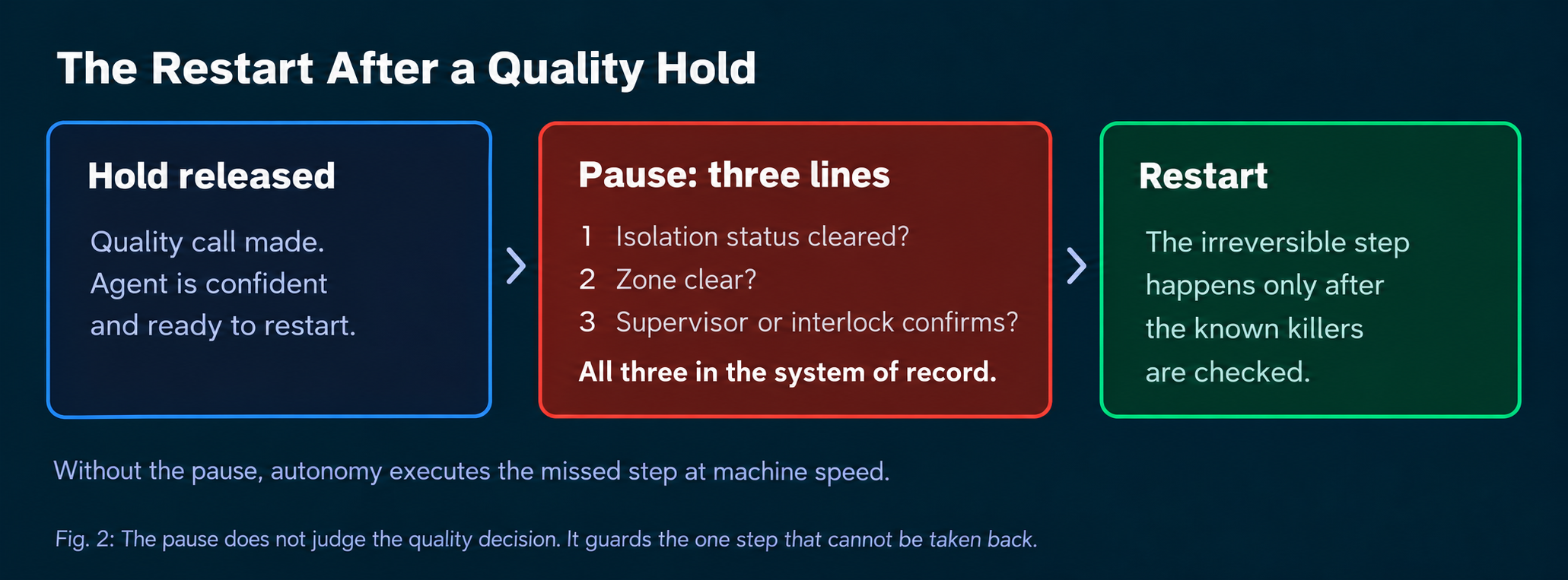
A cell runs an agent that may restart a robot after a quality hold. The model is confident. Nobody confirms the rest.
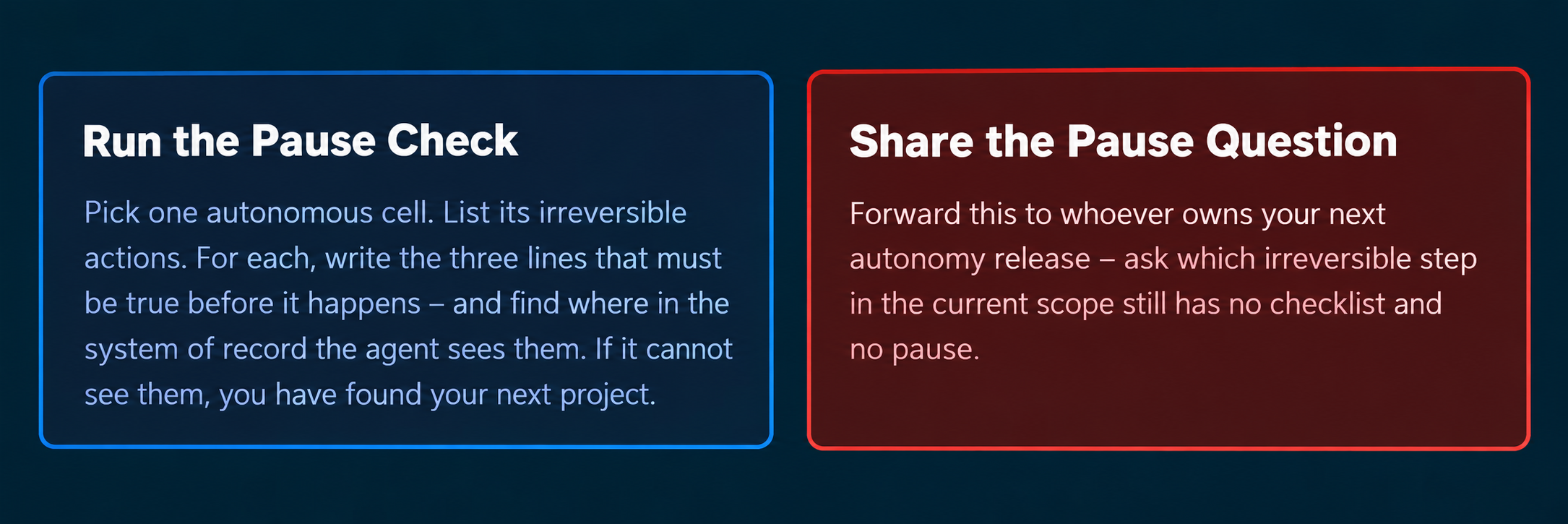
No one confirms that the energy isolation from the earlier intervention has been cleared, or that the zone is empty. Gawande's logic says the restart is exactly the moment for a three-line pause: isolation status, zone clear, supervisor or interlock confirm, before the agent or the operator proceeds.
Without that pause, autonomy executes the missed step at machine speed. The checklist does not decide the quality call. It decides that the irreversible physical action cannot happen until the known killers are checked.
👉 Key Insight
Confidence speeds the restart. Only the pause makes it safe.
3. Designing Checklists for Human-Agent Plants
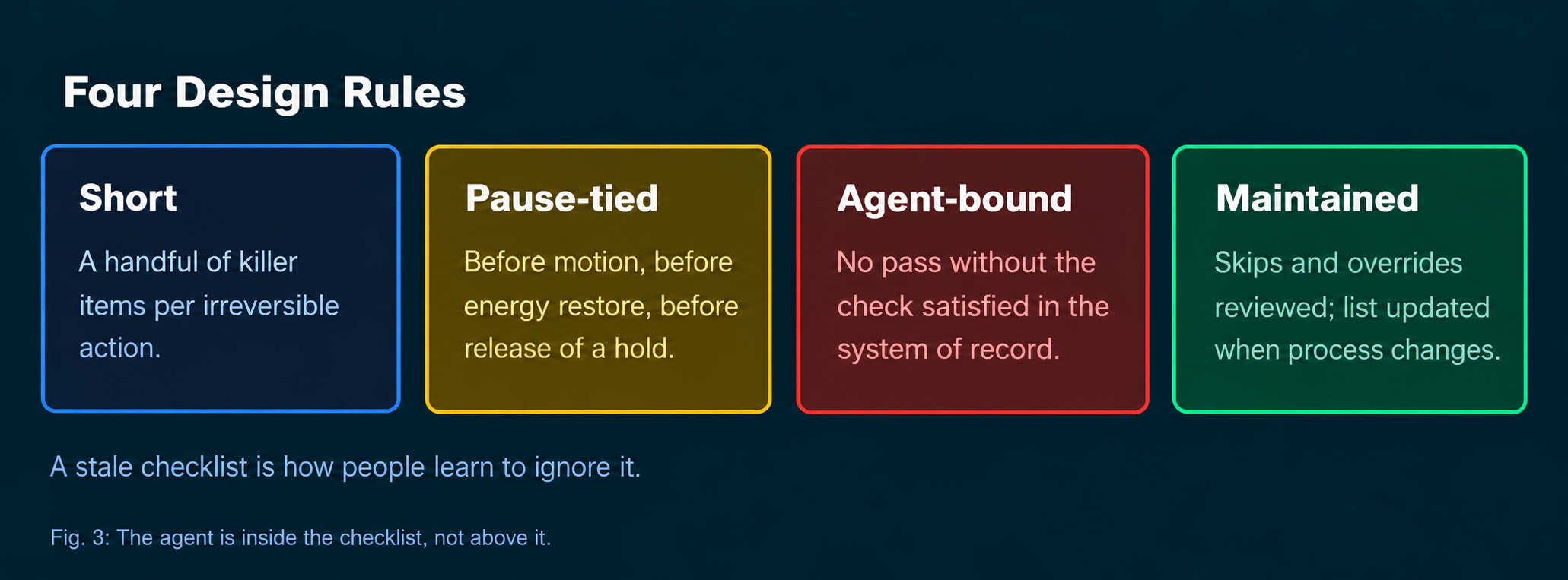
Four design rules separate a checklist that works from one that decorates.
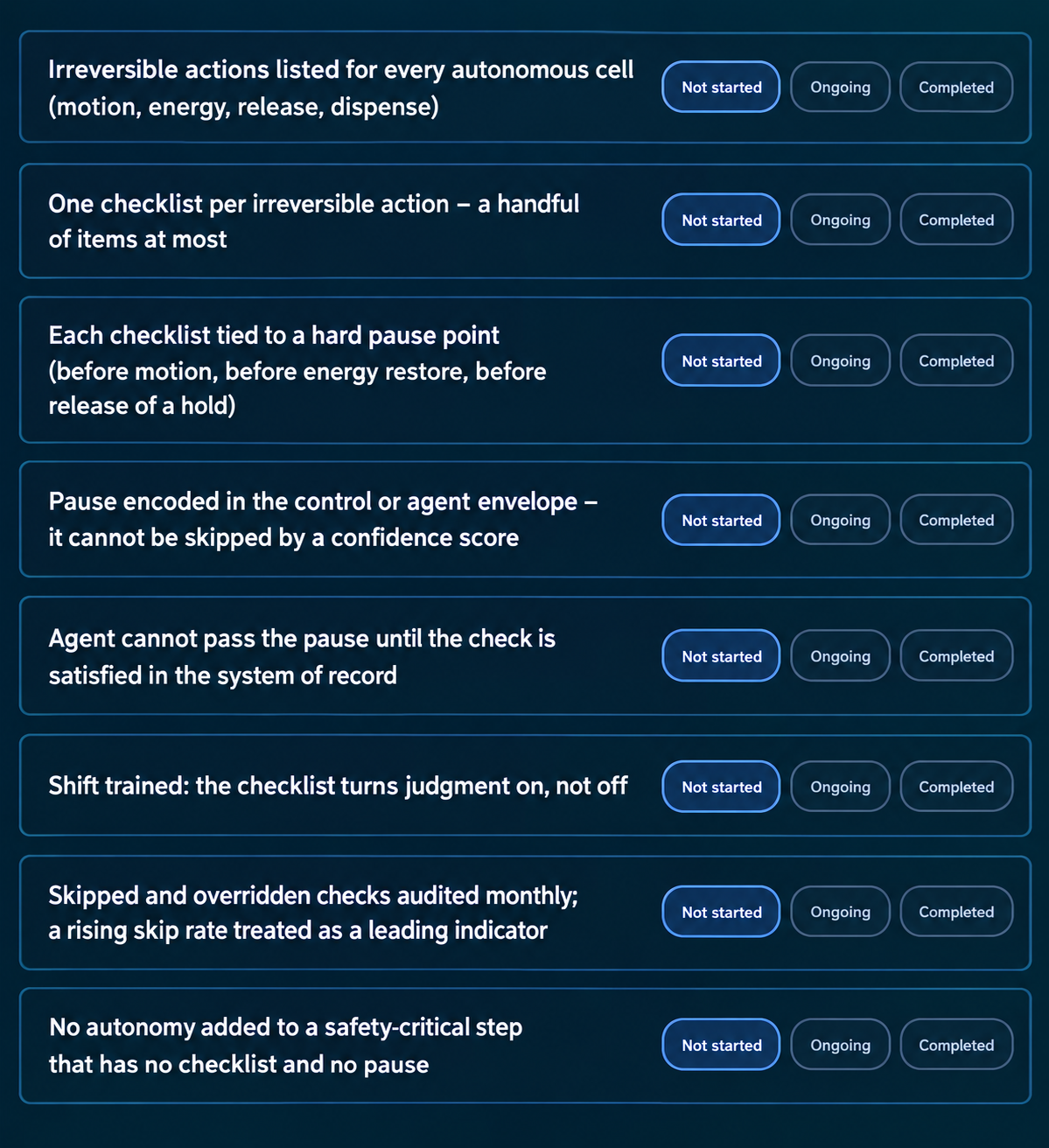
Keep them short. Tie them to pause points: before motion, before energy restore, before release of a hold. Include the agent: it may not proceed past the pause without the check being satisfied in the system of record.
Review overrides and skipped checks as seriously as process deviations. Update the list when the process changes – a stale checklist is how people learn to ignore it.
👉 Key Insight
Autonomy without a checklist is complexity without a backstop.
Action Plan for Decision Makers
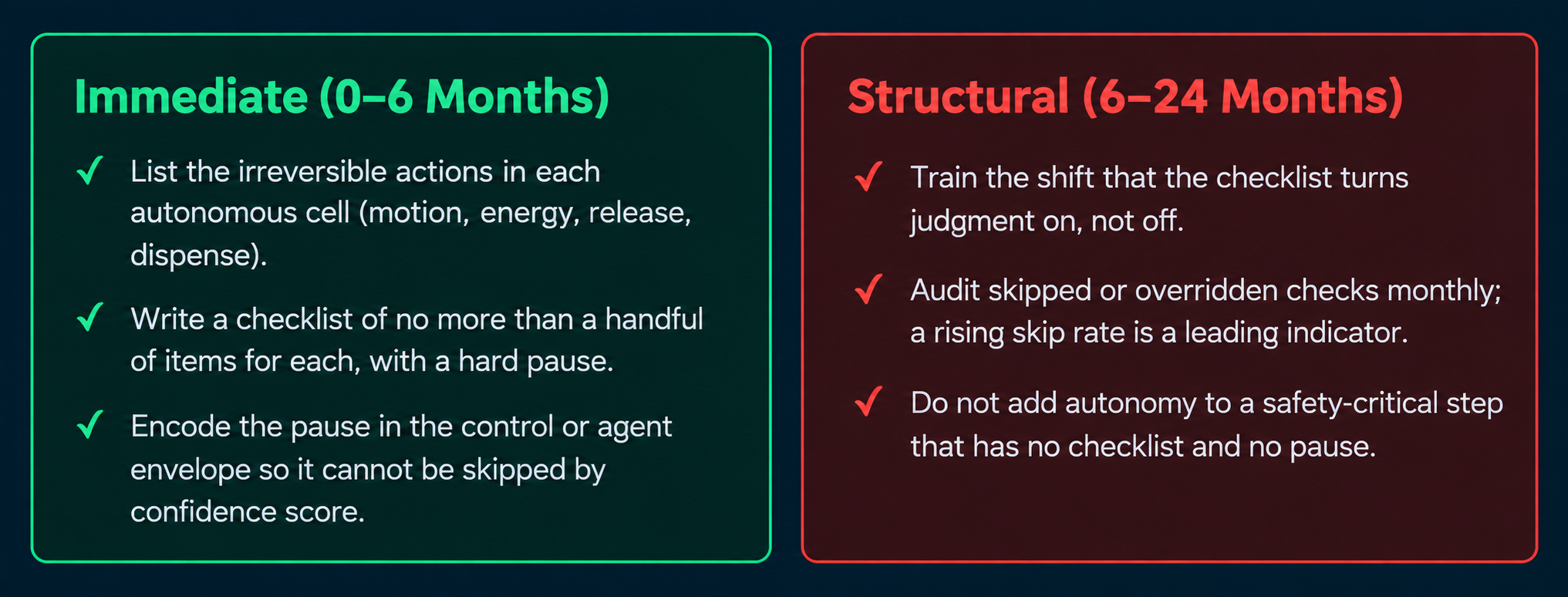
Checklist
Final Thought
The step that hurts is rarely the one nobody knew about. It is the one everybody knew about, and nobody paused for. Parts I and II of this week asked what the model understands and which data may vouch for it. This piece asks what stops the system when both answers are good and the step is still missed.
Efficiency Before Energy means the cheapest energy event is the one that never happens: a pause measured in seconds costs less than an isolation failure, a restart into an occupied zone, or a shift of lost production.
Systems don't fail. Decisions do.
Take the Next Step
Subscribe to the Weekly Punch for weekly strategic clarity, direct to your inbox.
References
Gawande, A. (2009) The Checklist Manifesto: How to Get Things Right. New York: Metropolitan Books.
Haynes, A.B., Weiser, T.G., Berry, W.R. et al. (2009) 'A surgical safety checklist to reduce morbidity and mortality in a global population', New England Journal of Medicine, 360, pp. 491–499.
Disclaimer: This article applies the arguments of a published book and a peer-reviewed study to human-agent and robotic operations in safety-critical industrial plants; the application is the author's own and is not drawn from the cited works. Figures are quoted from the cited sources and should be checked against them before relying on them. Verification Gate: flagged for pre-publication source check.
Ownership as Design.
Note: This article reflects my personalviews based on industry experience and publicly available information. It does not constitute professional, legal, or investment advice and does not represent the views of my employer. AI-generated visuals, concept and content by the author.
