LEADERSHIP | INFLECTION POINTS | NOVEMBER 2026 | Week 48 · Part III
A 10X Shift in Power, Compute or Regulation Does Not Bend the Old Curve. It Replaces It – and Most Incumbents Notice Too Late
Most leaders can name the quarter their business went wrong. Few can name the year the curve changed.
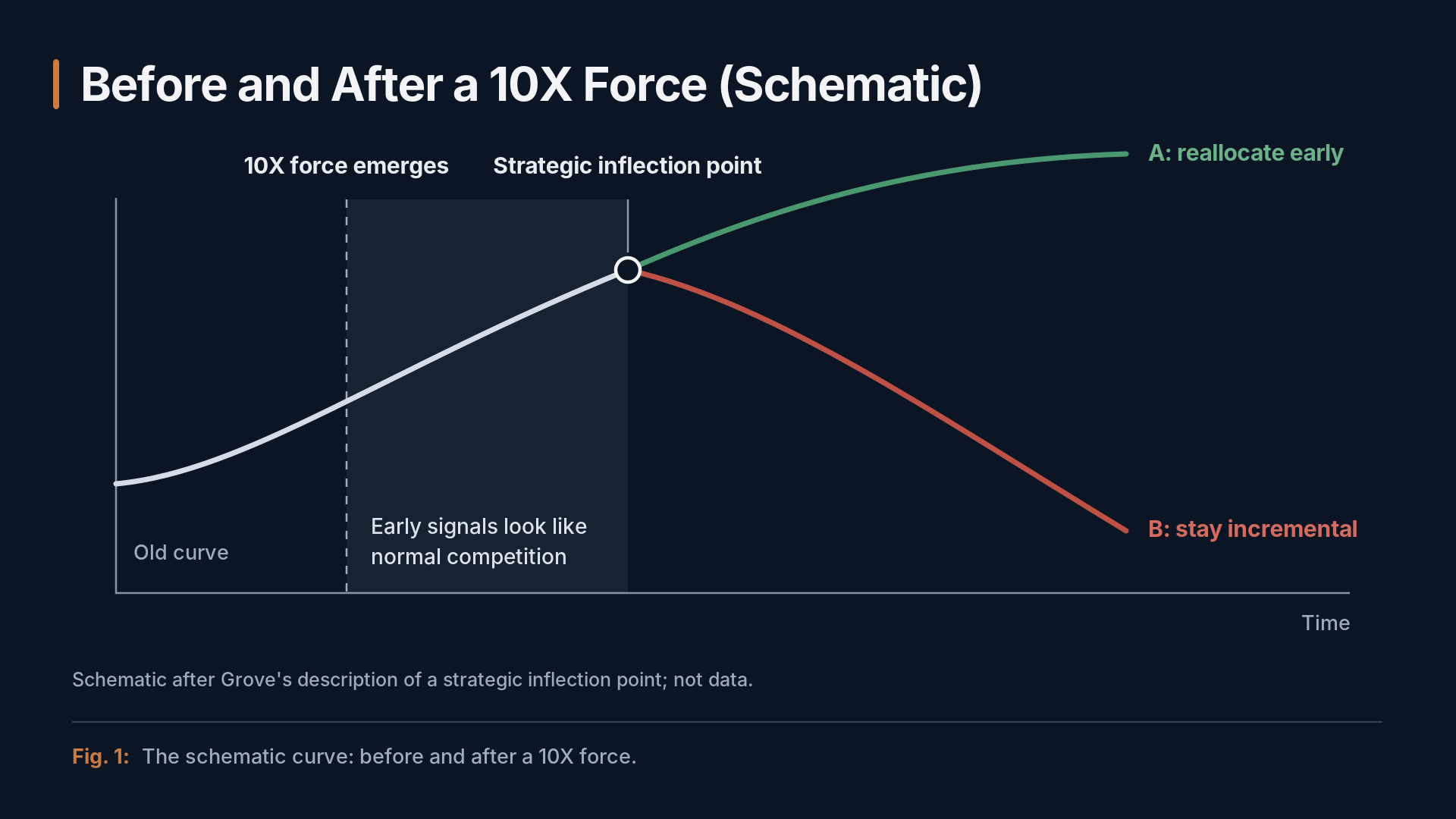
In 1996 Andy Grove gave the second moment a name: the strategic inflection point. His claim was uncomfortable then and still is: when a force becomes ten times what it was, the old curve is not bent by incremental effort. The force replaces the curve. This piece reads that framework against the AI industry's shifts in energy, compute and regulation.
Executive Summary
IN 60 SECONDS:
Grove defined a strategic inflection point as a time in the life of a business when its fundamentals are about to change, and the old way of competing stops working. The trigger is often a 10X force: a competitor, technology, customer, supplier or complementor that becomes an order of magnitude stronger than before.*
Intel is the canonical case: Japanese producers undercut and out-built it in memory chips. In 1985 Grove asked Gordon Moore what a new CEO brought in by the board would do; the answer was to exit memory. They then did it themselves, and Intel moved into microprocessors.* The device is the outsider question.
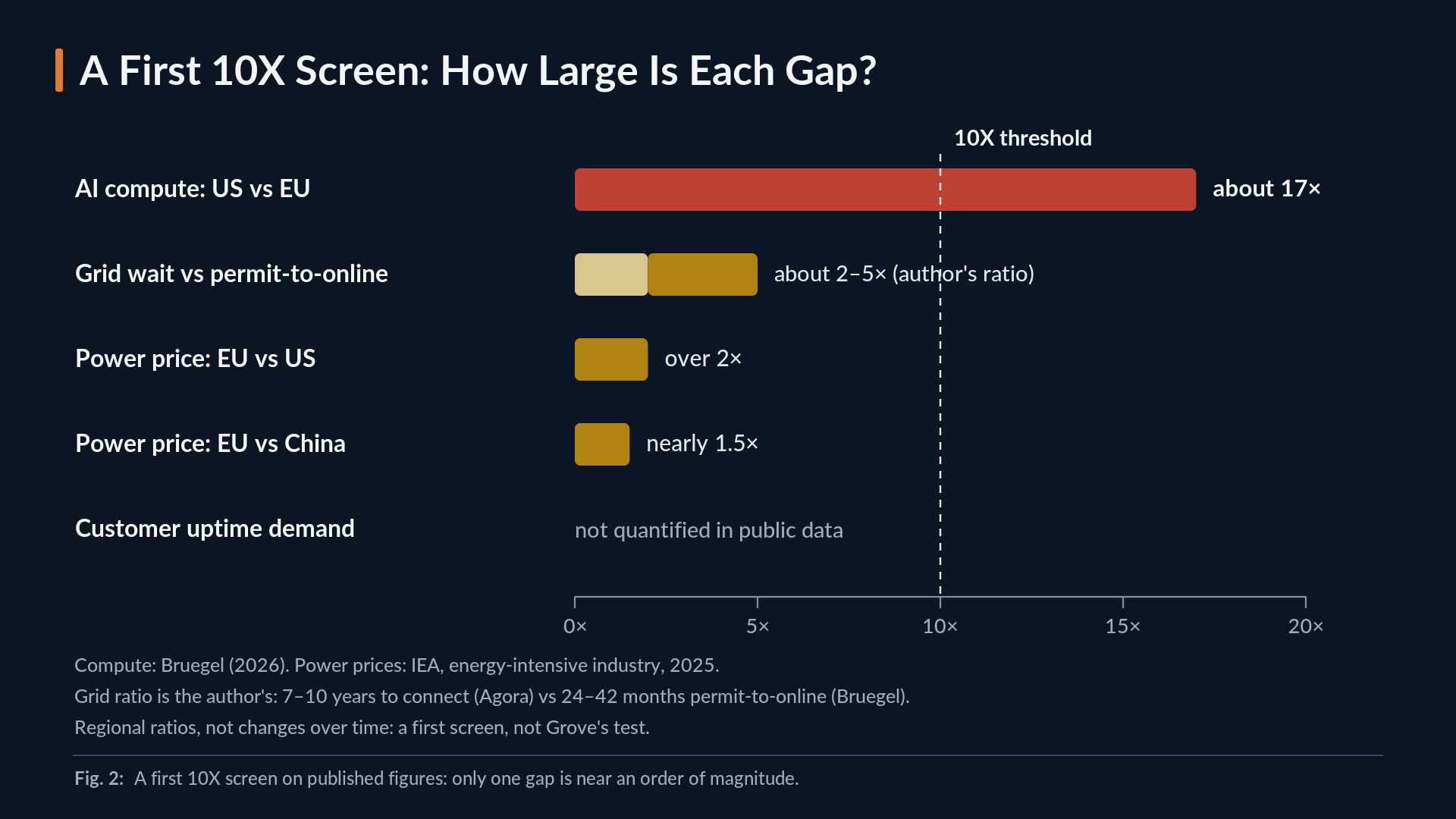
In the AI industry of 2026 the candidate forces are visible: grid connection speed, the cost of electricity, regulatory realignment, and the move from cloud training to physical actuation. A first screen of published figures shows only the compute gap near an order of magnitude; the other measurable gaps sit at about 1.5× to 5×. That is exactly the zone in which incumbents explain a force away.*
1. What Grove Required
A strategic inflection point is not a bad quarter.
Grove described it as the moment when the fundamentals of a business are about to change, when the curve changes direction and does not change back.* It can be the start of a new rise or the beginning of the end; which one depends on how early the organisation reads it. The usual trigger is a 10X force: a factor that has become ten times what it was before. Grove looked for it among six forces, existing competitors, suppliers, customers, potential entrants, substitutes and complementors.*
Recognition is hard because early signals look like normal competition. Grove's discipline was productive paranoia: keep testing whether a force has become 10X, and ask the outsider question, if we were replaced, what would the new team do? His order of work was debate, then experimentation, then focus, not consensus first.*
👉 Key Insight
Incremental responses to a 10X force are how market leaders become irrelevant.
2. Candidate Inflection in AI and Industry – One Example
An illustrative example – not a reported case – shows how the test would run.
Take a European industrial group whose automation advantage rests on installed robots, domain know-how and relatively stable power contracts. The 10X candidates are not hidden: multi-year grid queues that make local compute unobtainable; electricity prices well above competing regions (over twice the US on IEA figures); and customers who now require physical-AI uptime that the local grid cannot guarantee.
The outsider question gives the answer. A new CEO would stop assuming that European robot density equals future operating leadership, and would either secure firm power at scale, move energy-intensive inference elsewhere, or narrow the business to use cases where the power gap does not decide the outcome. The old strategy – more robots on the same energy assumption – dissolves if the constraint turns structural.
The inflection is not "AI arrived." It is "the energy and connection system that AI requires is no longer abundant where we operate."
A first screen of published figures, shown below, is sobering for anyone who wants a clean answer. Only the compute gap – US against EU AI capacity – is close to an order of magnitude, at about 17×. Grid wait against permit-to-online time (about 2–5×, the author's rough ratio) and electricity prices (over 2× the US, nearly 1.5× China) sit lower, and the customer requirement is not quantified in public data. These are regional gaps, not changes over time: a screen, not Grove's test. But this is the zone in which incumbents explain a force away.
👉 Key Insight
A force at 2× to 5× is not yet an inflection point. It is the last point at which it is cheap to notice one.
3. Why Paranoia Is a Leadership Tool Here
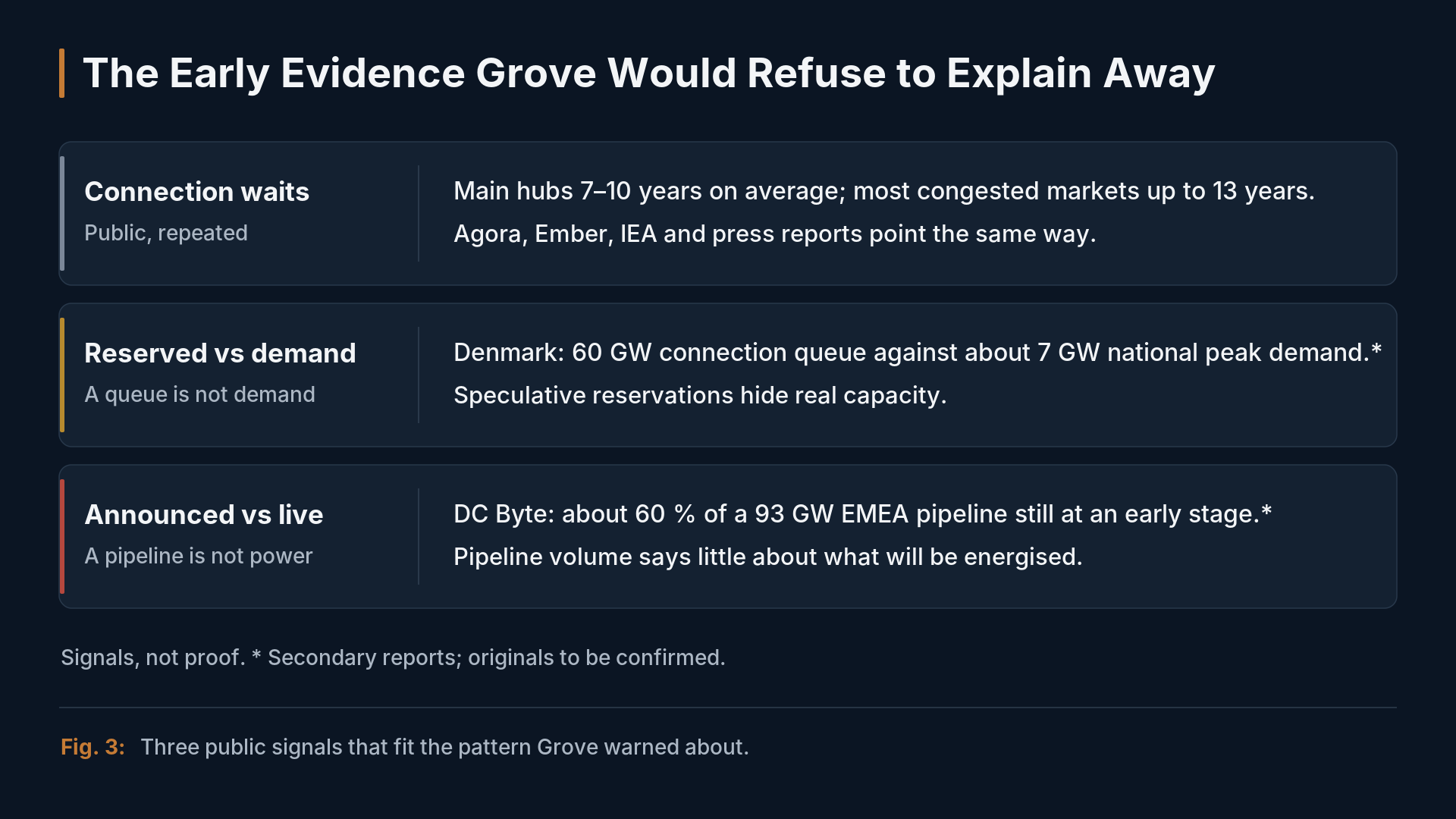
Paranoia, for Grove, was not anxiety. It was the refusal to explain away early evidence.
In AI the early evidence is public: connection waits that run to years; the gap between reserved and used capacity – in Denmark the grid operator's connection queue reached 60 GW against national peak demand of about 7 GW;* and the divergence between announced and energised capacity – DC Byte puts about 60 % of a 93 GW EMEA pipeline at an early stage.* None of it proves an inflection. All of it is what Grove would have refused to explain away.
Leaders who wait for the inflection to be obvious will meet it as a completed fact. Paranoia in this sense is a method, not a mood: name the forces, test them against a threshold, ask the outsider question, and separate the debate about whether this is an inflection from the decision about what to exit or double down on.
👉 Key Insight
Early evidence is public. What is scarce is the willingness to read it as a force.
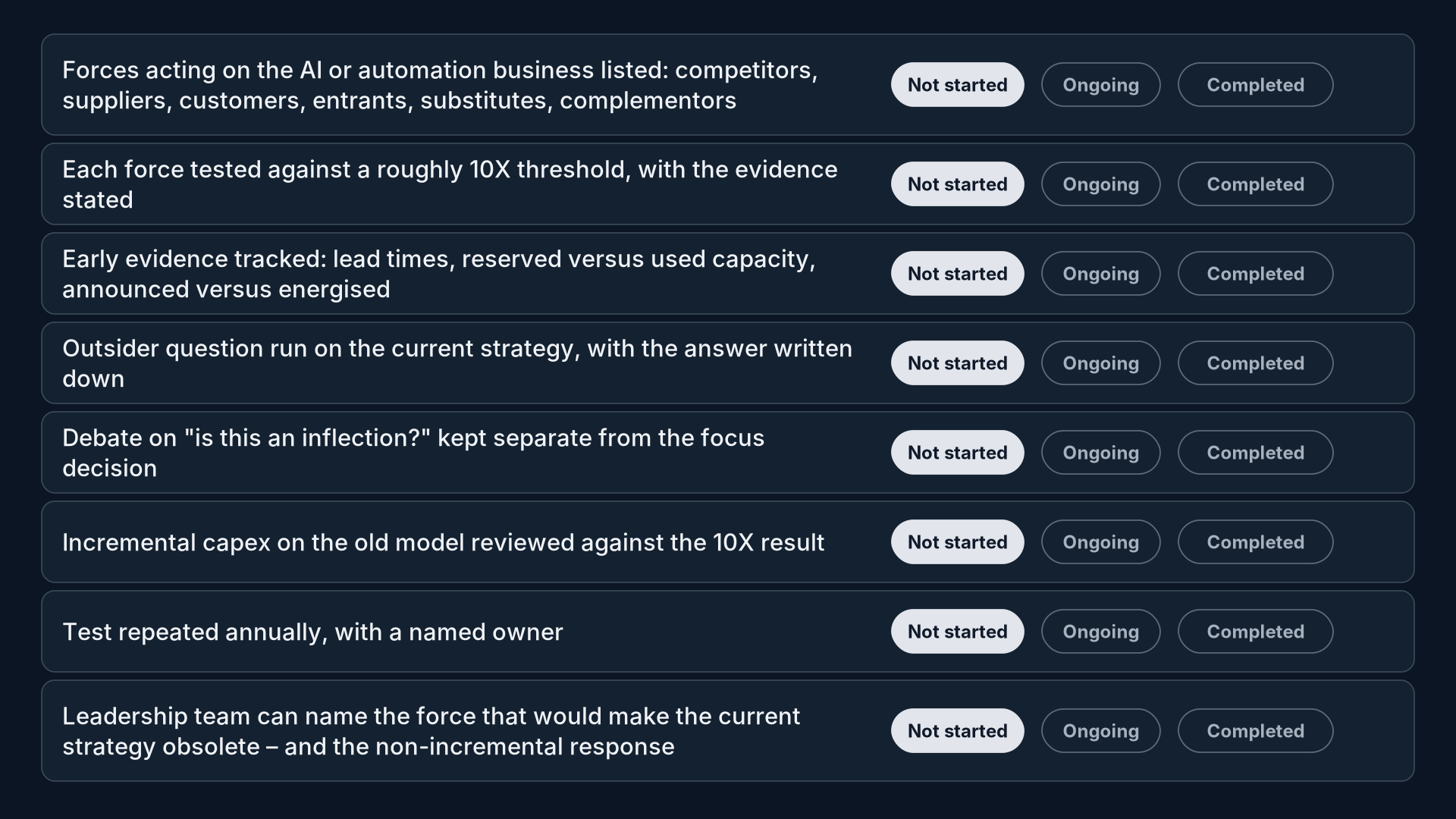
Action Plan for Decision Makers
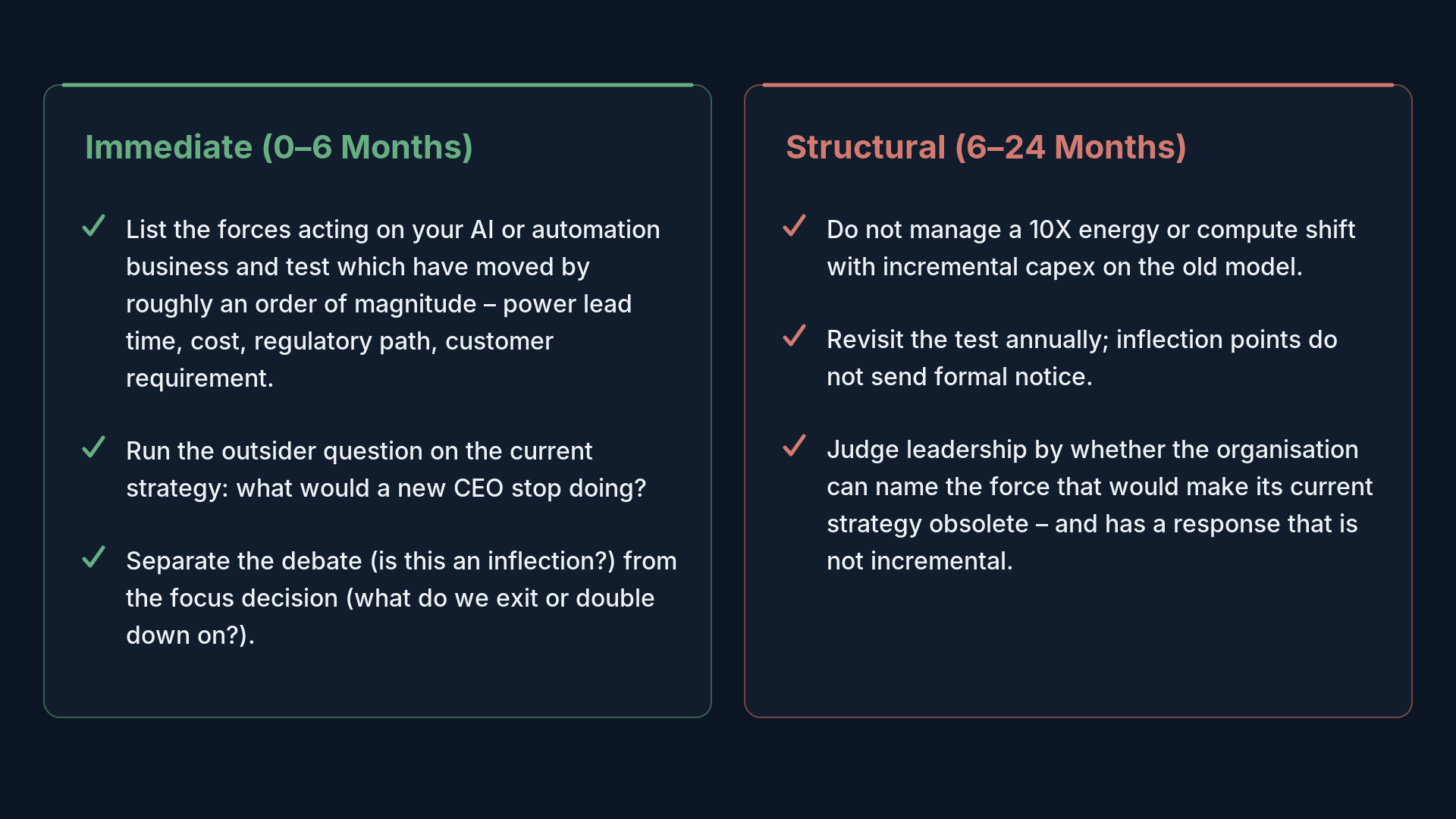
Checklist
Final Thought
Most leaders can name the quarter their business went wrong. Few can name the year the curve changed – because at the time it looked like normal competition. Parts I and II of this week showed where the evidence on grid connection, power prices and permitting is already public. The decision that matters is whether leadership reads it as a force while there is still room to reallocate.
Efficiency Before Energy means reallocating on the evidence before the old curve dissolves.
Systems don't fail. Decisions do.
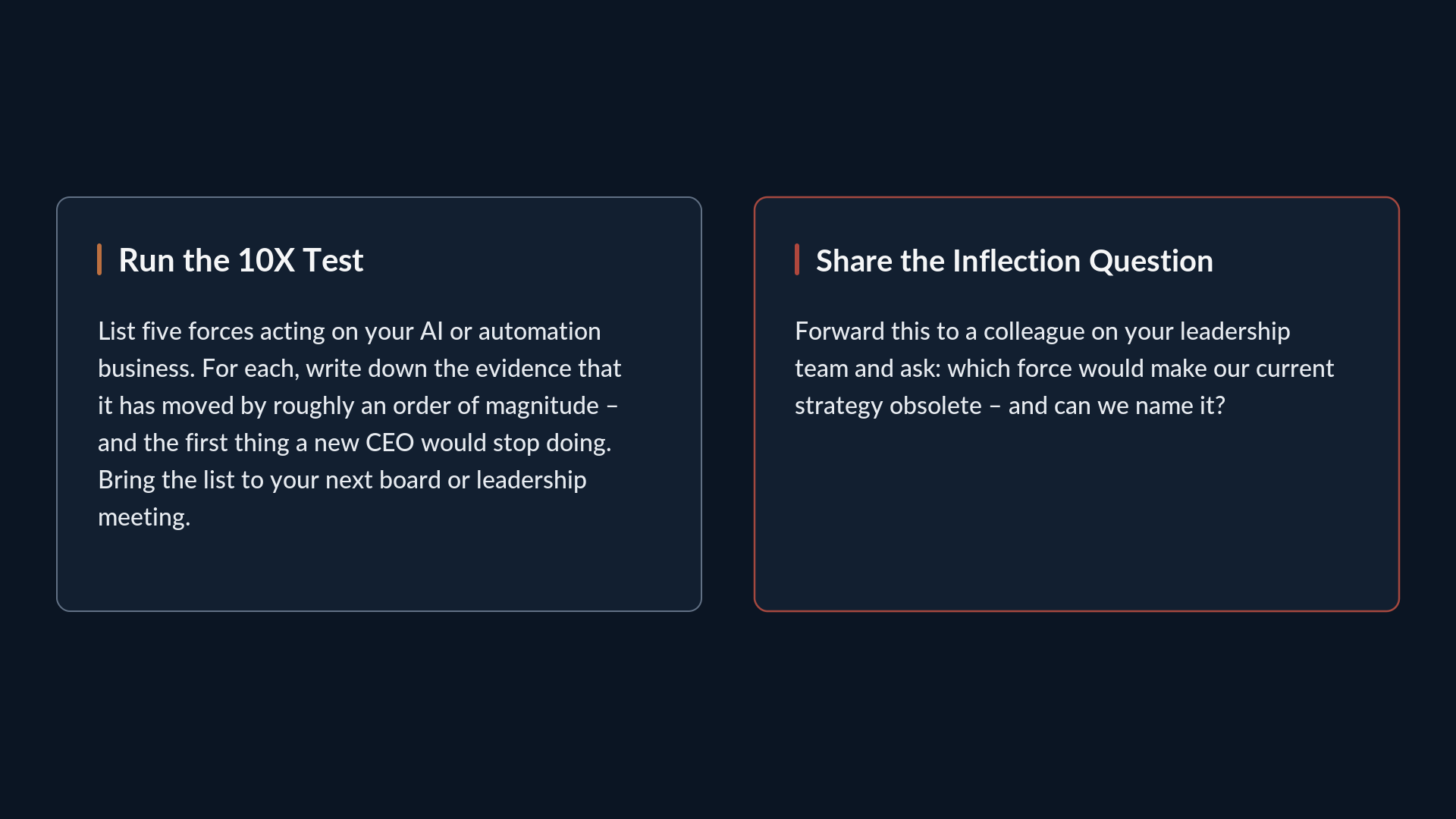
Take the Next Step
Subscribe to the Weekly Punch for weekly strategic clarity, direct to your inbox.
References
Grove, A.S. (1996) Only the Paranoid Survive: How to Exploit the Crisis Points That Challenge Every Company. New York: Currency/Doubleday (paperback: Crown Currency, 1999). German edition: Nur die Paranoiden überleben, Campus, 1997. [Book not retrieved: definitions and the Intel episode were checked against secondary summaries (Commoncog; A Wealth of Common Sense). The book is summarized, not quoted. Bibliographic details, the "debate, experimentation, focus" sequence, the six-forces list and the German edition are to be checked against the book.]
Commoncog (n.d.) Intel: the transition from memories to processors [case page, title as in the URL]. Available at: commoncog.com/c/cases/intel-transition-memories-processors/ (accessed 21 November 2026). [Secondary source: Grove–Moore exchange in mid-1985; exit implemented in 1986; Japanese competition on quality and price.]
A Wealth of Common Sense (2016) Andy Grove on the Importance of an Outsider's Perspective. March 2016. Available at: awealthofcommonsense.com (accessed 21 November 2026). [Secondary source: Grove's question to Moore about what a new CEO would do.]
Martens, B. and Schenk, T. (2026) How can Europe address its pressing AI compute infrastructure shortfall? Bruegel Policy Brief 18/2026, 10 September 2026. Brussels: Bruegel. [Checked: 35.28 GW (US) against 2.07 GW (EU) of operational AI compute; permit-to-online times of 24 months (US) and 42 months (Germany).]
International Energy Agency (2026) Electricity 2026, section on prices. Paris: IEA. [Checked: EU energy-intensive industry over twice US prices and nearly 50 % above China in 2025.]
Agora Energiewende (2026) How data centre flexibility can help solve Europe's grid bottleneck. Press release, 20 April 2026. Berlin: Agora Energiewende. [Checked: lead times of 7–10 years.]
Secondary reports, originals to be confirmed: Data Center Knowledge (2026) EMEA Data Center Expansion Faces a Delivery Test, 7 October 2026, citing DC Byte (93 GW; about 60 % early-stage); The Next Web (2026), 19 August 2026 (Energinet queue of 60 GW against about 7 GW peak demand).
Not confirmed against a primary source: that the Intel episode involved "the leadership team" as in the brief (the secondary sources describe Grove and Moore); the application of Grove's framework to AI energy, compute and regulation, the 2–5× grid ratio and the example in section 2 are the author's own. [Primary source to be confirmed – claims marked * rest on this item.]
Disclaimer: This article applies Grove's framework to the AI industry. That application, the example in section 2 and the ratios in the second figure are the author's own and illustrative: they compare regions, not periods, and the grid ratio relates two different measures. Grove's book was not retrieved; its arguments are summarized, not quoted, and should be checked against the original before readers rely on them. Figures marked * rest on secondary reports. Verification Gate: flagged for pre-publication source check.
Ownership as Design.
Note: This article reflects my personalviews based on industry experience and publicly available information. It does not constitute professional, legal, or investment advice and does not represent the views of my employer. AI-generated visuals, concept and content by the author.
