AI in Recruiting 2026: Why Most Systems Will Fail When Humans Surrender Their Judgment
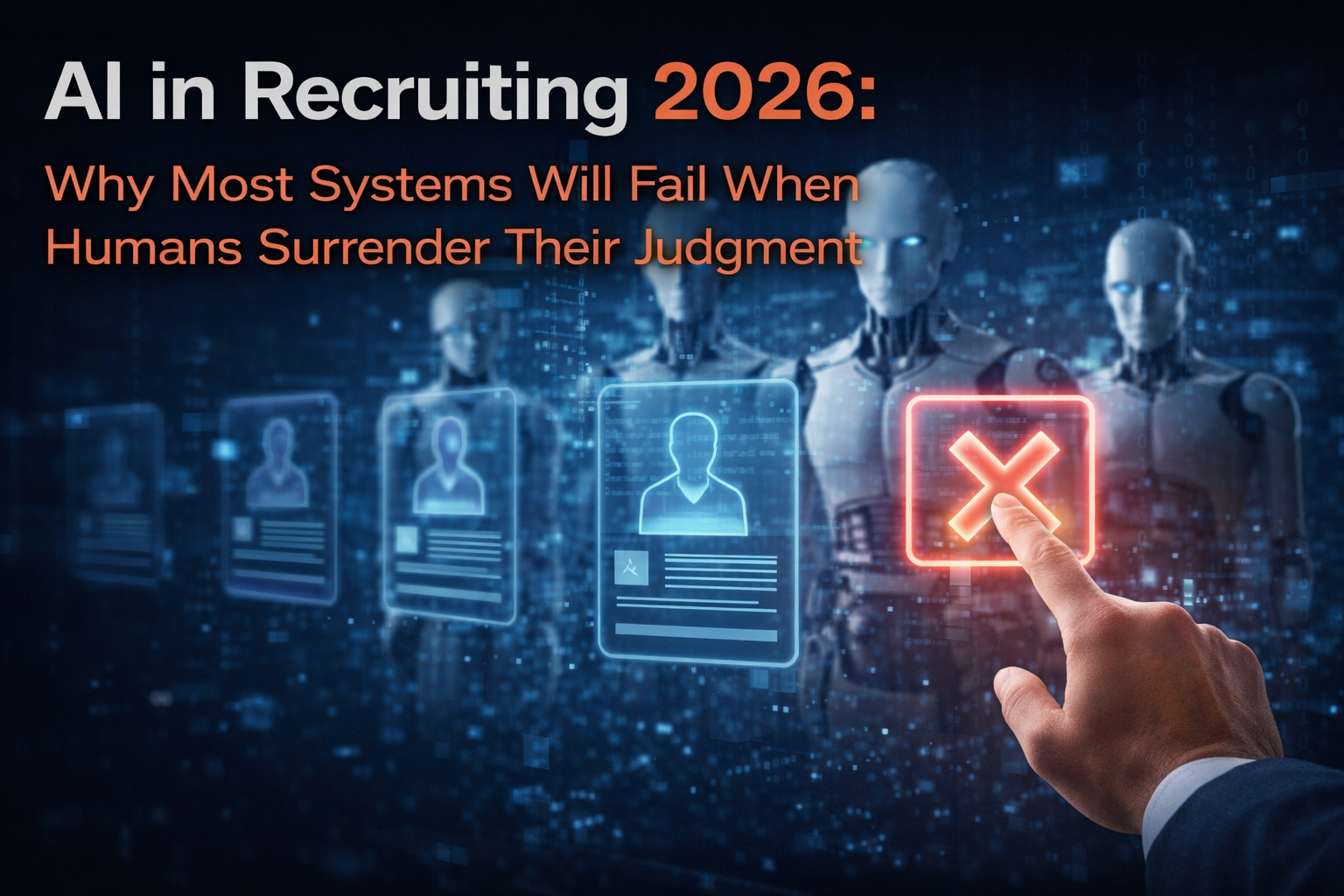
Recruiting · AI · Human Judgment · Talent Acquisition
March 2026
EXECUTIVE SUMMARY
2026 is the year autonomous AI agents officially join recruiting teams. More than half of talent leaders plan to integrate them as new colleagues, not simple chatbots, but agents that independently source, screen, schedule, and provide initial assessments. This sounds like liberation. For many organisations, it marks the beginning of a quiet loss of control. Recruiting systems are not failing in 2026 because the technology is too weak. They are failing because of decisions about where humans must retain genuine judgment.
Key empirical findings:
• 52% of talent leaders plan to integrate autonomous AI agents into their teams, many are already building digital identities for these agents with their own profiles and permissions (Korn Ferry, 2026)
• Gartner estimates: by 2028, up to 25% of all applicants could be fake, generated or heavily optimised by AI (Gartner, 2025)
• HBR describes an "AI arms race" in hiring: candidates use AI aggressively to optimise applications, organisations respond with more AI to detect manipulation, a spiral of distrust and inauthenticity (HBR, 2026)
• 68% of recruiters believe AI could reduce bias, experimental research shows that humans unconsciously adopt the bias of AI systems when it is not obviously apparent (University of Washington, 2024)
• In high-volume roles, AI is projected to handle up to 80% of recruiting work, but no-show rates and early attrition are rising fastest in precisely these segments (Korn Ferry, 2026)
Three conditions for successful human, AI recruiting:
• Clear human-in-the-loop rules for every process stage: which decisions may the agent make alone? Where must a human intervene?
• Skills-based hiring with guardrails: transparent, regularly audited criteria , combined with experience-based assessments, not just algorithmic scores
• Retain the relationship layer: for critical positions, human contact must exist early, AI-screened candidates who never spoke to a real recruiter decline offers more often and leave faster
This article explains where AI in recruiting creates genuine value, where human judgment is lost, and what the winners of 2026 do structurally differently.
1. The Quiet Loss of Control, How AI-First Leads to System Failure
Systems don’t fail. Decisions do.
Recruiting systems are not failing in 2026 because the technology is too weak. They are failing because leaders do not clearly decide where humans must retain judgment. That is the decisive distinction between AI as a lever and AI as a loss of control.
Korn Ferry (2026) shows: 52% of talent leaders plan to integrate autonomous AI agents as new colleagues, with their own profiles, permissions, and accountabilities. 84% plan greater AI deployment in general. These numbers no longer describe cautious pilots. They describe a systemic restructuring taking place in most organisations without the necessary governance infrastructure.
HBR (2026) names what results an "AI arms race" in hiring: candidates use AI to optimise applications, tailor CVs precisely to job descriptions, and train on typical interview questions. Organisations respond with more sophisticated detection tools. The outcome is a spiral of distrust and inauthenticity, in which both sides spend increasing resources optimising AI against AI, rather than assessing genuine human fit.
Particularly critical: HBR labels the phenomenon "AI redundancy washing", headcount reductions in recruiting teams are justified by future AI performance, while the actual capability of the tools remains far behind the promises. This is not a technology failure. It is a leadership decision made under cost and speed pressure without thinking through the structural consequences.
👉 AI-first in recruiting without clear decision rights is not an efficiency gain. It is a loss of control that only becomes visible when attrition rises and teams fail to hold.
2. The AI Arms Race: When Technology Destroys Trust
The dynamic HBR (2026) describes as the AI arms race follows a consistent escalation logic: the more candidates use AI to optimise, the more organisations respond with additional detection layers. The more sophisticated the detection, the further candidates optimise. The result is a system in which both sides invest substantial resources in a competition that benefits no one.
Gartner (2025) quantifies the consequence: by 2028, up to 25% of all applications could be fake or heavily manipulated by AI. This is not primarily a technical problem, it is a trust problem. When candidates systematically submit optimised rather than authentic applications, organisations lose the ability to assess genuine human qualities. And when organisations respond to AI-optimised profiles with AI screening, the entire process becomes a game between algorithms in which genuine human judgment has no place.
WEF (2026) describes the counter-trend: leading companies are deliberately reintroducing "high-touch" elements, in-person assessment events, experience-based tasks, structured conversations with real hiring managers early in the process. These elements are not nostalgic. They are the answer to a systemic authenticity problem that AI alone cannot solve.
👉 The AI arms race creates speed and volume, but it destroys what recruiting is actually supposed to deliver: the reliable assessment of human qualities under uncertainty.
3. The Illusion of Bias Reduction
The most frequently cited argument for AI in recruiting is the reduction of human bias. 68% of recruiters believe AI can remove prejudice. It sounds compelling. The data is more nuanced.
AI systems learn from historical data. When that data is skewed, through past hiring practices that favoured certain groups, the tool reproduces exactly those distortions. The most well-known example is Amazon's earlier recruiting tool, which systematically disadvantaged women because it was trained on male-dominated historical data. This is not an isolated case: comparable patterns appear in ongoing litigation against AI-supported screening tools.
More problematically: the University of Washington (2024) demonstrates experimentally that people adopt the biases of a slightly skewed AI system as long as those biases are not glaringly obvious. When leaders decide that AI handles the first filter and humans only perform "final review", without clear criteria and regular auditing, bias is not eliminated. It is concealed and made systemic.
Gartner (2025) warns of a further consequence: excessive dependence on generative AI and algorithms causes people's own judgment capabilities to atrophy. Some forward-thinking organisations are already introducing "AI-free" skills assessments, not as a rejection of technology, but as a deliberate exercise to preserve human judgment.
👉 AI does not automatically reduce bias. It displaces it, and simultaneously makes it harder to detect. That is more dangerous than obvious human prejudice.
4. Skills-Based Hiring: Promise and Limit
Skills-based hiring sounds rational: rather than prioritising degrees or previous job titles, AI objectively assesses demonstrable capabilities. In theory, this reduces bias and opens the talent pool to diverse candidates. In practice, a clear limit emerges.
Technical skills are measurable. Cultural fit, resilience under pressure, the capacity for complex trade-offs, and behavioural integrity in everyday situations are not, at least not through algorithmic scores alone. Korn Ferry (2026) shows that organisations introducing skills-based hiring without experience-based components achieve faster time-to-hire but higher attrition in the first 12 months and lower performance rates in high-complexity roles.
The core problem: candidates use AI to optimise their skills profiles. They generate cover letters, tailor CVs precisely to job descriptions, and train on typical assessment questions. The result is a flood of superficially perfect but inauthentic applications. At the end, recruiters face profiles that AI has optimised against AI, and where does the genuine assessment of human qualities remain?
WEF (2026) describes the pattern of leaders: they combine skills-based screening with simulated work tasks, structured behavioural interviews by trained hiring managers, and early in-person elements for critical positions. This combination is not slower than pure AI processes. It is more precise.
👉 Skills-based hiring is a necessary evolution. But without experience-based elements, it optimises for paper-fit, not reality-fit.
5. Where Systems Fail: The Five Typical Decision Errors
The patterns in which recruiting systems fail in 2026 are consistent. They follow five typical decision errors at the leadership level.
Error 1: AI-First Without Clear Decision Rights
The organisation buys tools but does not define which decisions the agent may make alone and where a human must intervene. The result: agents de facto take decisions that nobody explicitly delegated, and nobody monitors.
Error 2: Headcount Reduction Before Real AI Proof
HBR (2026) calls this "AI redundancy washing": positions are eliminated in anticipation of AI performance that has not yet been achieved. When the tools then fail to deliver, the human capacity to close the gap is missing. The result: overloaded remaining recruiters, declining candidate quality, rising no-show rates.
Error 3: Bias Blind Spot
AI handles screening but is not regularly audited. Bias accumulates invisibly. Only external litigation or conspicuous diversity anomalies make the problem visible, often at a politically and legally sensitive moment.
Error 4: Relationship Layer Fully Automated
Even critical positions run through purely digital processes. Candidates never encounter a real person before receiving an offer. The consequences: higher offer rejection rates, faster early attrition, and teams that fit on paper but fail under real team pressure.
Error 5: Success Measured Only by Speed
Time-to-hire and cost-per-hire are the only KPIs. Retention after 6 and 12 months, performance under pressure, and quality of decisions in complex roles are not measured, and therefore not managed.
👉 None of these errors is technical. All five are leadership decision errors, made under cost and speed pressure without thinking through the structural consequences.
6. What the Winners of 2026 Do Differently
The winners of 2026 will not be those who automate the most. They will be those who define the clearest decision rights and retain human judgment where it matters.
Korn Ferry (2026) describes the pattern of successful hybrid teams: they do not treat AI agents as replacements for recruiters, but as highly capable assistants with precise task domains. The agent sources and pre-qualifies. The human recruiter conducts the first genuine conversation, evaluates cultural signals, and makes the final recommendation. The accountability matrix is explicit, not implicitly evolved.
WEF (2026) shows that these hybrid approaches are not only qualitatively superior. They are economically superior: lower attrition in the first 12 months, higher hiring manager satisfaction with new employees, and lower total costs, because mis-hires are more expensive than a recruiter. Gartner (2025) confirms: projects with explicit human-AI collaboration protocols have three times the adoption rate and significantly lower failure rates than projects in which agents operate without a governance structure.
The pattern of winners reduces to three principles: first, AI for volume and routine, humans for judgment and relationship. Second, regular auditing of AI outputs for bias and quality. Third, measuring success across the full employee lifecycle, not only until offer acceptance.
👉 The winners in recruiting 2026 are not those who deploy AI most aggressively. They are those who most clearly define what AI is permitted to decide, and what it is not.
7. 3-Month Outlook: April to June 2026
Available data allows a structured assessment of the next 90 days.
• Adoption (accelerating): autonomous AI agents are being deployed in further recruiting teams, often without adequate governance structures. The pressure to reduce costs and increase speed outweighs awareness of risks (Korn Ferry, 2026)
• Regulatory development (moderate confidence): the EU AI Act creates new requirements for AI-supported hiring decisions, organisations without auditing processes will face compliance problems from 2027
• Authenticity crisis (growing): the share of AI-optimised applications continues to grow. Organisations without clear authenticity signals in the process, experience-based assessments, early human conversations, will increasingly struggle to identify genuine quality
• Attrition signal (delayed but clear): organisations that aggressively shifted to AI-only processes in 2024/25 will see measurable attrition peaks in the first 6 months by June 2026
• Regulation vs. innovation: first court rulings on AI bias in hiring will apply further pressure for transparency and auditing, organisations without demonstrable bias controls expose themselves to legal risk
👉 The window for sound governance decisions is now, before regulation and attrition data make the consequences unavoidable.
8. Recommendations
Abstract AI strategy in recruiting generates no movement. The following distinction is operational: what is actionable this week, and what requires a 24-month commitment?
Immediate actions (this week)
• Decision rights audit: which decisions is your AI agent currently making de facto alone, without explicit delegation? List every process step and mark where a human must be mandatorily involved, or whether the tool is already deciding
• Establish a bias baseline: for the three most active sourcing and screening processes: what demographic patterns do the AI outputs show? Are there differences in pass-through rates between groups that cannot be explained by qualification?
• Extend success metrics: add retention after 6 and 12 months and hiring manager performance ratings to your time-to-hire and cost-per-hire dashboards. Without this data, you are optimising the wrong objective
• Pre-mortem for the current process: where would your current recruiting system fail if 30% of applications are AI-optimised? Where is the human depth missing that could detect this?
Strategic commitments (6–24 months)
• Formalise the human-in-the-loop matrix: for every process stage, explicitly define which decisions the agent may make alone and where a human must intervene. Document this matrix, communicate it, and review it quarterly
• Introduce experience-based assessment components: simulated work tasks, structured behavioural interviews with trained hiring managers, and, for critical positions, early in-person elements. These components are not a luxury. They are the quality filter AI cannot replace
• Introduce regular AI auditing: at minimum quarterly review of AI outputs for bias patterns, quality deviations, and unintended effects. The EU AI Act will mandate similar requirements from 2027, starting now creates a compliance advantage
• Actively develop recruiter judgment: introduce training on critically questioning AI outputs. Judgment capabilities atrophy when not actively required, "AI-free" assessment rounds once per quarter are one way to prevent this
• CEO-level ownership: elevate talent quality as a strategic topic to the leadership agenda, with clear decision rights over how much autonomy AI agents hold in recruiting decisions
👉 The distinction between winners and losers in recruiting 2026 is not the tool. It is the clarity about what the tool is permitted to decide.
FINAL THOUGHT
Recruiting systems are not failing in 2026 because of the technology.
They are failing because humans are surrendering their judgment.
The difference from previous automation waves: this time, it is judgment itself that is being delegated to AI, not merely the task. When AI decides who gets to interview, who receives a rejection, and which profile "fits", without humans having set clear rules, this is not an efficiency gain. It is the abdication of responsibility.
The real winners define clear rules for when AI decides and when the human steps in. They automate the routine, but retain the relationship layer and hard judgment where it counts: in evaluating character, resilience, and the capacity to make the right calls under pressure.
The best recruiting tool in 2026 is not the cleverest algorithm. It is the clearest decision about where the human remains.
References
Gartner (2025) Predicts 2026: Artificial Intelligence in HR and Talent Acquisition. Gartner Inc.
Harvard Business Review (2026) 9 Trends Shaping Work in 2026 and Beyond. January.
Korn Ferry (2026) Talent Acquisition Trends 2026: Human–AI Power Couple. Korn Ferry Institute.
University of Washington (2024) Algorithmic bias adoption in AI-assisted decision-making: experimental evidence. Working Paper.
World Economic Forum (2026) The Future of Jobs Report 2026. Geneva: WEF.
