Computing with Light: How Photonic Computing Could Reinvent Data Centers
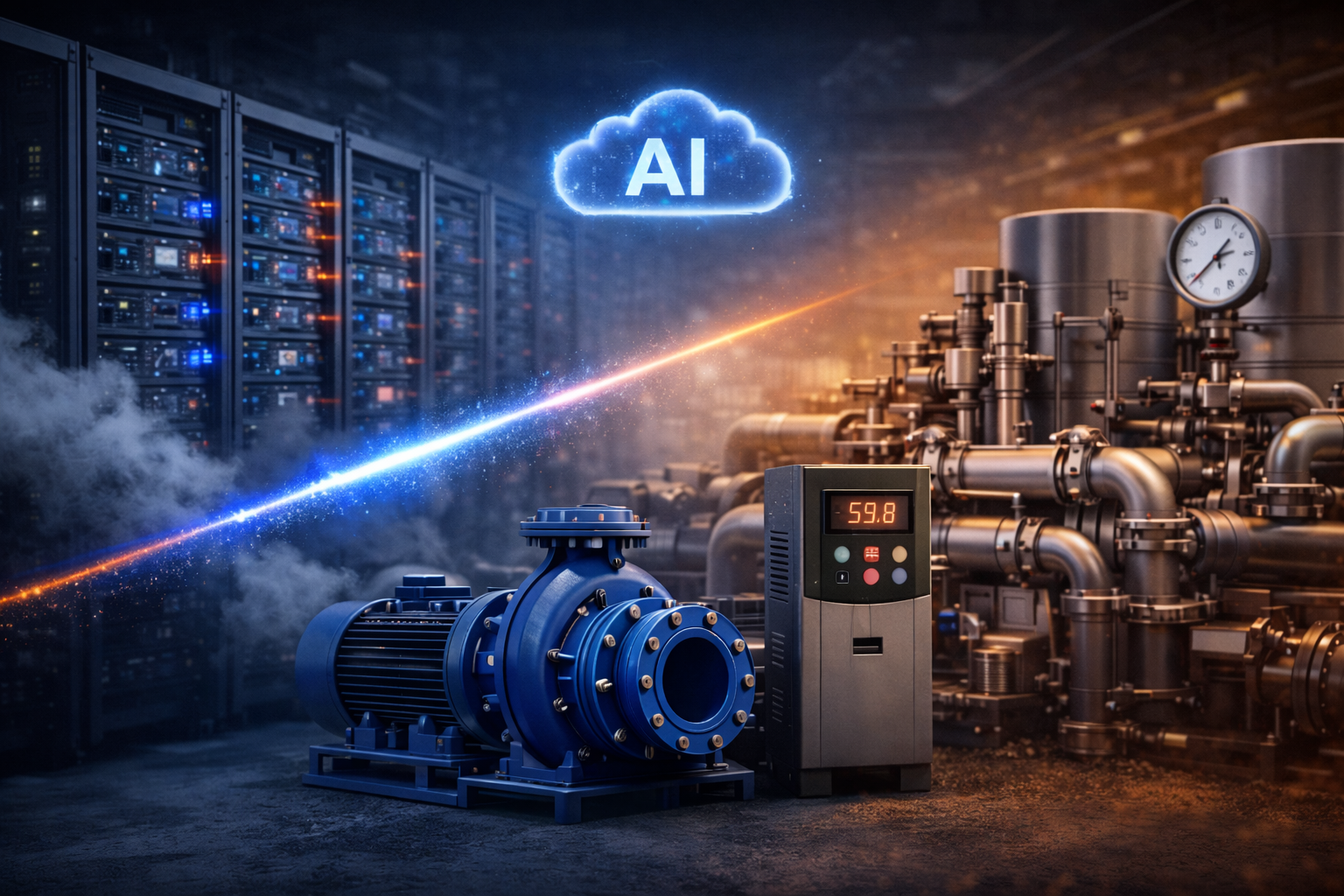
Why photonic chips could redefine energy, cooling, and AI scalability
Artificial Intelligence is no longer constrained by algorithms. It is constrained by energy, cooling, and infrastructure.
As AI workloads scale, data centers are approaching physical and economic limits that cannot be solved by incremental optimization alone. This raises a fundamental question for decision-makers:
Can data center architecture itself become the next strategic lever?
One emerging answer is photonic computing, computing with light instead of electricity.
Not as a distant research vision, but as an early operational reality.
The starting point: Data centers are hitting structural limits
The current trajectory is difficult to ignore.
In the United States, data centers could account for up to 9% of national electricity consumption by 2030, roughly double today’s level.
In Europe, electricity demand from data centers is expected to triple, exceeding 150 TWh by 2030.
At the same time, AI infrastructure is becoming dramatically more power-dense:
GPU clusters operating at 50–100+ MW per site
Rack densities moving toward 100 kW and beyond
Liquid cooling systems growing in size, cost, and operational complexity
Cooling is no longer a secondary concern. It has become a primary bottleneck.
At scale, this is not a sustainability discussion alone. It is a question of economic viability and grid feasibility.
The deeper issue: AI runs on an architecture never designed for it
Most AI workloads today still run on CMOS-based electronic architectures developed decades ago.
These systems rely on:
addition
multiplication
bit shifting
They work, but inefficiently for neural networks.
A significant share of energy is consumed not by “intelligence”, but by data movement, memory access, and control overhead.
As Michael Förtsch (Q.ANT) puts it succinctly:
“We want AI, but we are using processors that were never designed for it. This inefficient coupling creates massive energy loss.”
At some point, better cooling no longer fixes a fundamentally mismatched architecture.
Computing with light: why photonics changes the equation
Photonic processors replace electrical signals with light.
Instead of electrons flowing through resistive materials, computations are performed optically, often using lithium niobate on silicon as the core material.
The implications are profound:
Light propagates without electrical resistance
Once generated, it does not require continuous energy input
Heat generation drops dramatically
Empirical results from research and early deployments show:
up to 90× lower energy consumption for specific workloads
50×+ reduction in data movement
clock rates up to 30 GHz
minimal heat dissipation → drastically reduced cooling demand
Förtsch compares photonic Native Processing Units (NPUs) to a Formula-1 car: complex mathematical functions executed in a single optical step, rather than thousands of electronic operations.
From lab to reality: real systems are already running
This is no longer theoretical.
Q.ANT GmbH (Germany)
Gen-2 photonic NPU presented in November 2025
up to 8 GOPS, improved nonlinear processing
power envelope ~150 W
commercial server shipments starting H1 2026
standard PCIe cards, 19-inch server form factor
first deployments at:
Lightmatter (USA)
Passage photonic interconnect platform
up to 1,024 GPUs per rack
30 Tb/s bandwidth
synchronous processing without switch bottlenecks
$400M funding, ~$4.4B valuation
manufacturing partnerships with GlobalFoundries and Amkor
Academic benchmarks
MIT / Harvard-affiliated research demonstrates:
The technology exists. The systems are running. The question is scale.
Why this matters specifically for data centers
From a data center perspective, photonic computing alters several core assumptions:
Energy: orders-of-magnitude efficiency improvements
Cooling: reduced or eliminated need for massive liquid cooling systems
Density: higher compute per square meter
OPEX: structurally lower long-term operating costs
Grid impact: less peak load pressure
This is not about replacing all electronic computing. It is about offloading the most energy-intensive AI operations to architectures better suited for them.
The race is open — and strategic
According to Prof. Michael Resch ( HLRS - Höchstleistungsrechenzentrum Stuttgart Stuttgart):
“Software optimization alone is not enough. Reducing a 100-MW data center to 95 MW is not a breakthrough.”
Several paradigms are competing:
quantum computing
neuromorphic computing
photonic computing
What will decide is not elegance, but industrial scalability and ecosystem maturity.
Photonics currently stands out because:
it builds on existing semiconductor manufacturing
it integrates into current server architectures
it directly addresses energy and cooling constraints
What still needs to happen
Even proponents are transparent about the gaps.
There is no universal killer application yet
Algorithms are still maturing
Production must scale from tens of thousands to millions of chips per year
Ecosystems need time to form
Q.ANT itself describes Gen-1 as “1990s-level” and Gen-2 as “early 2000s” maturity.
The next leap will matter most.
Strategic implications for Europe and beyond
Europe is currently planning AI gigafactories and large-scale compute investments.
The strategic risk is clear:
If these facilities rely solely on classical architectures, energy dependence and cost pressure increase.
Photonics offers an alternative path:
lower energy intensity
reduced cooling complexity
greater infrastructure sovereignty
The question is no longer if photonic computing matters, but how early regions and organizations position themselves.
Final thought
Photonic computing will not dominate headlines tomorrow.
But it addresses the hardest constraint in AI scaling: energy and cooling.
The technology exists. Early systems are operational. The economics are compelling.
Those who engage early shape standards, ecosystems, and cost curves. Those who wait risk dependence, not on software, but on infrastructure limits.
Have you already explored photonic systems in data center environments? Where do you see the biggest hurdles: software, manufacturing, or adoption?
I look forward to the discussion.
#Photonics #AI #DataCenters #EnergyEfficiency #Sustainability #HPC #Q.ANT #Lightmatter #FutureOfCompute
References (Harvard Style)
Bandyopadhyay, S. et al. (2025/2026). An integrated large-scale photonic accelerator with ultralow latency. Nature.
Bergman, K. et al. (2025). 3D Photonics for Ultra-Low Energy, High Bandwidth-Density Chip Data Links. Nature Photonics.
Harvard John A. Paulson School of Engineering and Applied Sciences (SEAS) (2025). Ultra-thin chip for quantum photonics. Harvard University.
International Energy Agency (IEA) (2024). Electricity Demand from Data Centres, AI and Crypto. Paris: IEA.
Lightmatter Inc. (2025). Passage Photonic Interconnect Platform. Lightmatter.
Q.ANT GmbH (2025). NPU Gen-2 Product and Deployment Information. Stuttgart: Q.ANT.
Data Center Diaries (2026). Energy constraints, AI infrastructure and the future of data centers [Podcast]. Available at: https://podcasts.apple.com/de/podcast/datacenter-diaries/id1670945852?i=1000744415611 (Accessed: 1 February 2026).
