Photonic Computing and the Structural Reconfiguration of Data Center Infrastructure
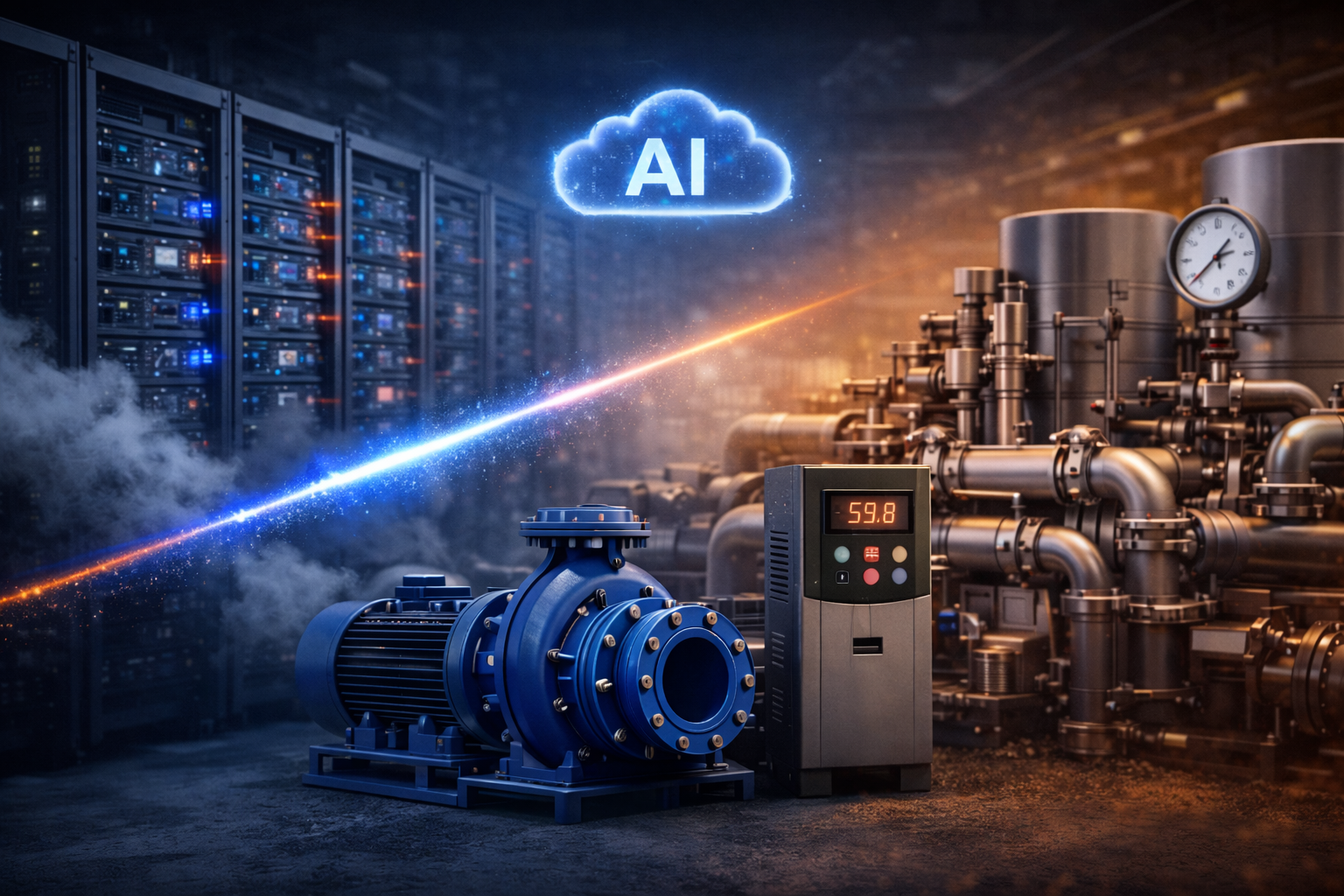
Why the Next AI Breakthrough Is Not Just About Chips - But About Pumps, Motors and Capital Allocation
Executive Abstract
The AI revolution is currently measured in teraflops. It should be measured in megawatts.
As AI workloads scale, data centers are no longer primarily constrained by algorithms or semiconductor performance. They are constrained by energy, cooling, and infrastructure. A 100 MW AI cluster today resembles a heavy industrial facility: thousands of meters of piping, megawatt-scale pump systems, hundreds of variable frequency drives (VFDs), and cooling infrastructure comparable to municipal utility systems.
Photonic computing, including silicon photonic interconnects, co-packaged optics (CPO), and emerging photonic processors, has the potential to structurally reduce heat generation per unit of computation. This is not merely a semiconductor efficiency improvement. It is a thermodynamic shift with direct consequences for mechanical and electrical (M&E) infrastructure.
This article establishes a quantified engineering baseline for a representative 100 MW AI cluster under current electronic architectures (2025/2026) and models three adoption scenarios for photonic integration through 2030. The results suggest potential cooling-load reductions of 5–40%, translating into proportional reductions in pump capacity, VFD deployment, heat rejection systems, and cooling-related OPEX.
For operators, this is an infrastructure design question. For equipment manufacturers, it is a demand-intensity question. For investors, it is a capital allocation question.
Photonic computing is not just a technology story. It is an industrial strategy story.
1. The Infrastructure Reality of AI
Modern AI data centers are industrial plants.
A dedicated 100 MW AI cluster today requires:
Water flows exceeding 100,000 L/min
Installed pump-motor capacity of ~1.17 MW (N+1 redundancy)
Cooling tower fan motors totaling 1,000–1,500 kW
Hundreds of VFD-controlled pumps and fans
Estimated annual cooling-related OPEX of ~8–12 million EUR (based on typical 2025 European industrial electricity and water tariffs; McKinsey & Company, 2025a)
The physics are simple:
Nearly 100% of electrical energy consumed by electronic processors becomes heat.
A GPU cluster drawing 100 MW of IT power produces ~100 MW of thermal load. Cooling systems must reject that heat continuously.
This explains:
Liquid cooling dominance above 50 kW/rack
Rack densities of 60–132 kW (NVIDIA, n.d.)
Liquid cooling spending growing 45–50% annually
Heat rejection infrastructure growing 30–35% annually
The AI boom has become a cooling boom.
2. Engineering Baseline: The 100 MW Electronic Cluster
Assumptions:
IT Load: 100 MW
PUE: 1.35 (advanced liquid cooling reference / Uptime Institute, 2025)
Liquid cooling share: 80%
Water flow rate: 1.3–1.5 L/min/kW depending on ΔT 8–12 K (CoolIT Systems, 2025)
System pressure drop: 3.5 bar
Pump efficiency: 78%
Redundancy: N+1 ≈ 1.5×
Derivation
Cooling load ≈ 100 MW Liquid portion = 80 MW
Required flow:
80,000 kW × 1.3 L/min = 104,000 L/min ≈ 1,733 L/s
Hydraulic power:
P = Q × Δp / η ≈ 778 kW
Installed pump-motor capacity (N+1):
≈ 1,170 kW
This mechanical footprint is thermodynamic necessity.
3. Hydraulic Scaling Logic: Why Heat Reduction Compresses Infrastructure
Before modeling scenarios, the mechanical scaling must be explicit.
For a closed liquid cooling loop:
Q = m · cp · ΔT
Where:
Q = heat load
m = mass flow rate
cp = specific heat capacity
ΔT = temperature spread
Assuming:
Constant coolant properties
Constant temperature spread (ΔT)
Identical operating conditions
Mass flow scales directly with thermal load.
Hydraulic pump power follows:
P = (Q × Δp) / η
Where:
Q = volumetric flow
Δp = system pressure drop
η = pump efficiency
If Δp and η remain constant, pump power scales proportionally with volumetric flow, and therefore with heat load.
Accordingly:
A 40% reduction in thermal load enables a proportional 40% reduction in installed hydraulic capacity in greenfield deployments.
Important qualification:
This does not automatically mean exactly 40% fewer pump units. In retrofit environments, the reduction may primarily occur through smaller pump classes rather than unit-count elimination. In new facilities designed for photonic architectures, aggregate count reduction becomes structurally feasible.
The scaling logic is linear under constant system assumptions.
4. Photonic Computing: Changing the Heat Equation
Photonic technologies include:
Silicon photonic interconnects
Co-packaged optics
Photonic AI accelerators
Reported efficiency improvements:
5–10× interconnect efficiency (World Economic Forum, 2025)
Up to 90× energy reduction in specific workloads (Lightmatter, 2025)
Even under conservative assumptions, aggregate heat reduction of 20–40% is defensible for mixed AI workloads.
Less energy → less heat → less cooling → smaller hydraulic systems.
5. Scenario Modeling to 2030
Three trajectories:
Scenario 1 – Optimistic (–40% heat)
Rapid scaling of CPO and photonic accelerators.
Scenario 2 – Hybrid (–20% heat)
Photonic interconnects widely deployed.
Scenario 3 – Marginal (–5% heat)
Limited optical substitution.
Infrastructure Compression per 100 MW AI Cluster
| Scenario | Cooling Load | Pump Capacity | VFD Intensity | Cooling OPEX Impact |
| --------------- | ------------ | ---------------- | ------------- | ---------------------- |
| Baseline | 100 MW | 1,170 kW | 100% | — |
| S1 – Optimistic | 60 MW | 702 kW | –40–60% | 2.5–3.5M EUR |
| S2 – Hybrid | 80 MW | 936 kW | –20–30% | 1.3–1.8M EUR |
| S3 – Marginal | 95 MW | 1,112 kW | –5% | 0.3–0.4M EUR |
Under Scenario 1:
~40% reduction in installed hydraulic capacity and potential aggregate pump count reduction in greenfield designs
40–60% fewer VFDs
35–45% lower cooling OPEX
PUE potentially ~1.15
This is not incremental efficiency. It is infrastructure compression.
6. Structural Impact on Equipment Industries
Pump Manufacturers
Proportional hydraulic downsizing reduces demand intensity per MW.
Motor Producers
Shift toward smaller power classes.
VFD Vendors
Amplified exposure due to high unit counts and high margin per unit.
Cooling OEMs
Reconfiguration toward modular, precision-oriented systems.
7. The Growth Offset
If AI capacity grows 4× while cooling intensity drops 40%:
Net cooling load ≈ 2.4× 2025 baseline.
Demand decelerates, but does not disappear.
8. Strategic Implications for Europe
Energy efficiency, water usage, and regulatory exposure decrease under photonic scenarios.
European equipment manufacturers must plan for intensity reduction, not infinite linear scaling.
9. Conclusion: Thermodynamics Drives Capital
Photonic computing does not eliminate infrastructure.
It reshapes it.
Less heat → less cooling → less hydraulic capacity → lower capital intensity.
The impact window: 2027–2030.
This is not a semiconductor story.
It is a capital allocation story.
And thermodynamics does not negotiate.
References (Harvard Style)
Amin Isazadeh, D., Ziviani, D. and Claridge, D. (2023) ‘Global trends, performance metrics, and energy reduction measures in datacom facilities’, Renewable & Sustainable Energy Reviews.
CoolIT Systems (2025) ‘CoolIT Advances Single-Phase Direct Liquid Cooling Technology with 4000W Coldplate’, HPCwire.
Deloitte (2025) TMT Predictions 2025. Deloitte.
Lightmatter (2025) Photonic AI Acceleration, A New Kind of Computer.
McKinsey & Company (2025a) Beyond compute: Infrastructure that powers and cools AI data centers.
McKinsey & Company (2025b) Technology Trends Outlook 2025.
Uptime Institute (2025) Global Data Center Survey Results 2025.
World Economic Forum (2025) How photonic computing can move from promise to commercialization.
