Ownership Is Not a Feeling. It's a Design.
Most organisations talk about ownership. Few design for it.
The difference shows up not in town halls or culture decks. It shows up in a specific moment: when someone faces an uncomfortable decision and has to choose between the easy option and the right one.
Some years ago, during a routine financial review, we identified a problem. A long-standing customer. Regular orders. Everything stable on the surface. But updated figures showed the customer's liquidity had deteriorated significantly. We had built up a six-figure euro exposure that would have been entirely at risk in a default scenario.
My first instinct was to pick up the phone. I have the relationship. I have the seniority. I could have resolved it in one call.
I deliberately did not do that.
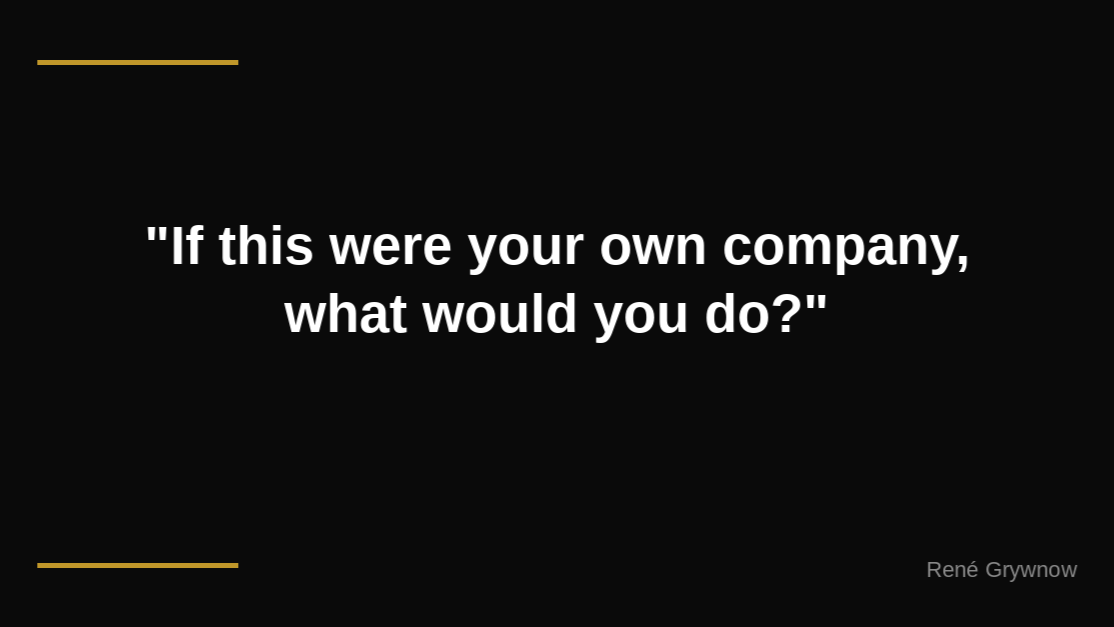
Instead, I went to the Sales Manager responsible for that account. I showed him the data. I explained the exposure. Then I asked him one question: "If this were your own company, what would you do?"
That question is a switch. It moves someone from an employee mindset, where the default is to wait for direction, to an ownership mindset, where the default is to take responsibility.
He knew the customer. He understood the relationship dynamics. He had operational context I didn't have. Once he stepped into that ownership frame, he was the right person to address it. Not me.
He was nervous. Worried about damaging the relationship. Worried about losing the order. Those are legitimate concerns, and I acknowledged them. But I was also clear: avoiding the conversation would not make the risk disappear. It would make it worse.
We worked through the approach together. He would go to the customer with facts. Not accusations. Not ultimatums. He would explain that updated financial data raised questions, and ask for either current financial statements, advance payment, or a bank guarantee.
The customer agreed to advance payment immediately. No escalation. No conflict. The relationship was preserved.
Now consider the alternative. If I had stepped in and handled it directly, the immediate risk would have been resolved. But the Sales Manager would have learned something else entirely: under real pressure, accountability transfers upward.
That lesson undermines everything else you are trying to build.
Empowerment either holds under pressure or it isn't real. There is no middle version.
Three things make ownership culture work, and none of them are communication programmes.
First: clarity is a stress management tool. The Sales Manager was not under stress because of workload. He was under stress because he was carrying a problem without a path forward. Once we had a clear structure, here is the risk, here is the ask, here is how you frame it, the pressure dropped significantly. Not because the situation changed. Because the uncertainty was replaced by direction.
Second: co-creation is built through expectation, not participation. Asking for people's opinions is not the same as giving them real accountability. People know the difference. When the expectation is explicit, you are expected to think in consequences, not just in tasks, the behaviour follows. When the expectation is absent, no engagement initiative will close the gap.
Third: incentive structures tell the truth. If your performance management system only captures revenue and volume, you are structurally selecting for short-term thinking. If you reward people who raise problems early, not just people who close deals, you build an organisation where risk surfaces when it is still manageable. If you do the opposite, you build an organisation that hides bad news until it becomes a crisis.
Culture follows incentives. Everything else is secondary.
The thread running through all of this is straightforward: ownership is not a feeling you cultivate. It is a design you build, through the expectations you set, the pressure you hold, and the moments where you choose not to take over even when you could.
Growth becomes sustainable when people understand what it protects. Not just what it demands.
This topic was part of my conversation on the 11th Thing Podcast, Episode 37: Driving Growth through Employee Ownership. If you want to hear the full discussion, including the questions I pushed back on, the link is in the comments.
