The 6 a.m. Email and the Governance Vacuum: What Oracle Teaches Leaders About AI Decisions
Why AI governance is now a leadership responsibility, and which decision rules are currently missing
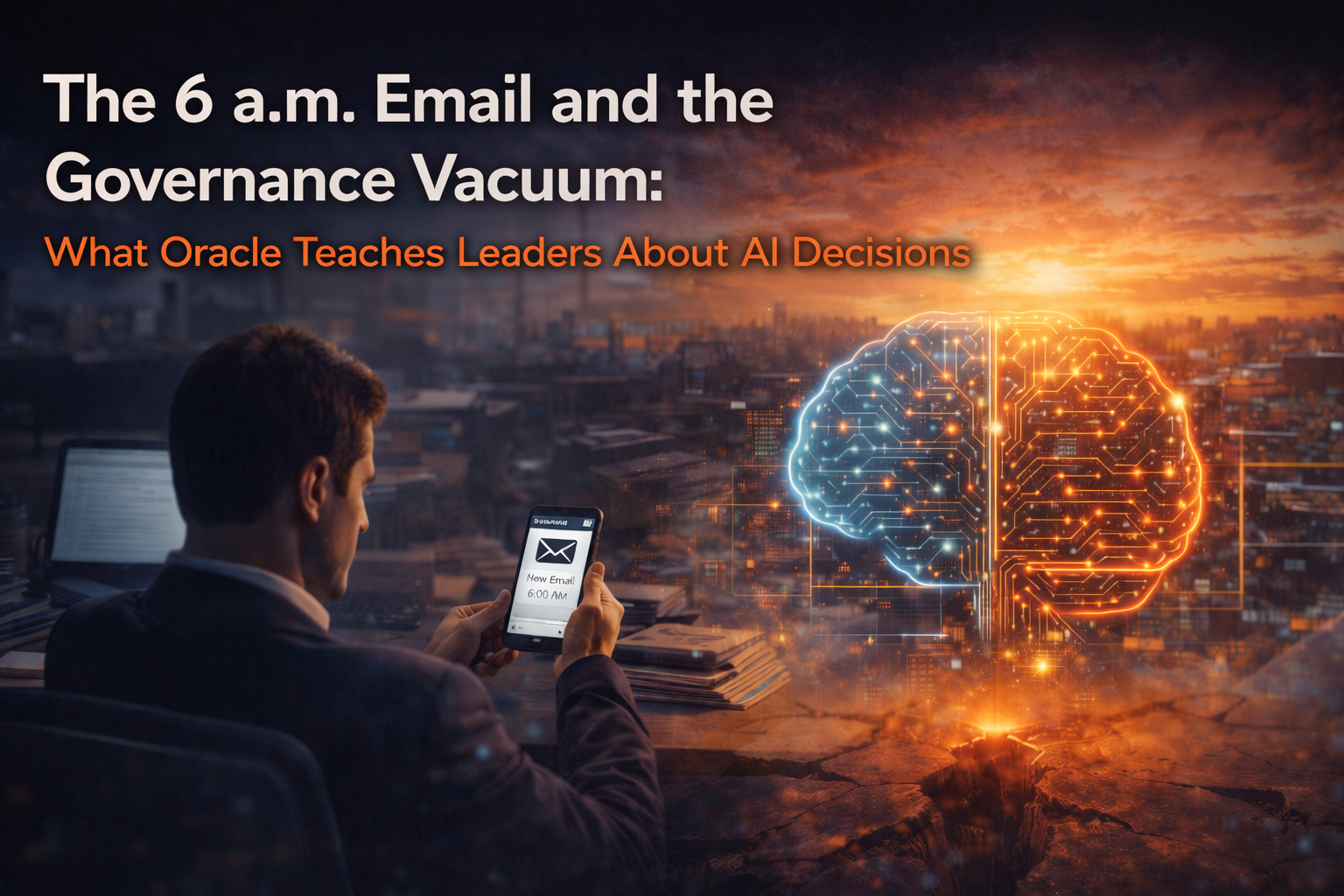
On 31 March 2026, up to 30,000 Oracle employees woke up to an email from "Oracle Leadership", no individual name, no prior conversation, no notice. System access: revoked immediately. Last working day: today. What Oracle demonstrated is not an isolated communication failure. It is the visible symptom of a more fundamental problem: investing billions in AI infrastructure without a governance architecture that explains why, how and with what human consequences decisions are made.
Executive Summary
On 31 March 2026, Oracle terminated up to 30,000 employees (~18% of its workforce) via a 6 a.m. email, with no advance notice from HR or managers, to free an estimated USD 8–10 billion in annual cash flow for an AI data centre buildout funded by USD 58 billion in new debt accumulated over just two months (TD Cowen, 2026; The Next Web, 2026).
The paradox: Oracle simultaneously reported net income of USD 6.13 billion (+95% YoY) and remaining performance obligations of USD 523 billion (+433% YoY), the layoffs are not a crisis response but a capital reallocation decision executed without a visible decision framework.
The strategic damage exceeds the communicative failure: trust destruction among the remaining workforce, employer brand erosion, and the signal to markets that AI investment and workforce strategy are not integrated, a pattern replicable in any organisation that treats AI as a pure cost-reduction instrument.
1. What Oracle Actually Decided, and What This Has to Do With Governance
Oracle did not communicate poorly. Oracle made no decision about communication, because no governance architecture existed that would have required one.
The facts are precisely documented: on 31 March 2026, at 6 a.m. EST, employees in the United States, India, Canada, Mexico and Uruguay simultaneously received an identical termination email, signed "Oracle Leadership" with no individual name. System access was revoked immediately. Unvested restricted stock units were forfeited on the spot. No HR conversation, no manager communication, no advance notice of any kind (Bloomberg, 2026; Business Insider, 2026). TD Cowen estimates the layoffs will free USD 8–10 billion in annual cash flow, funds Oracle needs for its AI data centre expansion, for which the company has accumulated USD 58 billion in new debt over two months (The Next Web, 2026).
This is not a communication failure. It is the consequence of a governance gap: Oracle decided to invest USD 50 billion in capex in AI infrastructure, without publicly visible decision rules governing which roles are affected, on what criteria, with what notice and with what dignity. The outcome was not accidental. It was the logical result of absent governance architecture. Systems don't fail. Decisions do.
👉 Key Insight: The 6 a.m. email is not an HR failure, it is evidence that AI investment decisions and workforce decisions were made in separate governance spaces, without connection and without shared criteria. This pattern is active in many organisations today.
2. The Capital Logic Paradox: Why Profit Alone Is Not Governance
Oracle is not a company in distress. It is a company with record profits placing a capital bet on AI infrastructure, and eliminating a workforce it could, by the numbers, comfortably afford to retain.
The figures are remarkable: in Q3 fiscal 2026, Oracle reported net income of USD 6.13 billion, a 95% increase year on year. Remaining performance obligations, a measure of contracted future revenue, stood at USD 523 billion, up 433% year on year, driven almost entirely by large-scale AI contracts (The Next Web, 2026). At the same time, Oracle's stock has fallen more than 50% from its September 2025 peak, and the company has accumulated USD 58 billion in new debt over two months.
The layoffs are not a response to financial necessity. They are a capital reallocation decision: people exchanged for infrastructure, or more precisely, for data centres. The KORE1 analysis puts it plainly: "They cut people to fund buildings." The affected roles were not replaced by AI; they were eliminated to fund AI infrastructure investment (KORE1, 2026). This distinction matters: AI governance is not only about managing automation consequences. It is about embedding AI investment decisions within a human decision framework, before the capital allocation happens, not after.
👉 Key Insight: AI governance is not only the question of which jobs AI will take. It is the question of the rules by which capital is reallocated between infrastructure and people, and who is accountable for those rules. Without this question, AI remains a cost-reduction instrument, not a value driver.
3. The Trust Rupture and Its Strategic Cost
Psychological safety cannot be terminated by email. A 6 a.m. notification causes irreversible damage for the entire remaining workforce, not only for those who have gone.
What was documented in internal Slack channels and on Blind is instructive: employees described "widespread fear, frustration, and uncertainty", and this applied primarily to those who remained. Oracle's internal Slack user count fell measurably from 165,000 to 155,000; the psychological impact on the remaining workforce is not directly quantifiable, but it is substantial (HR Executive, 2026). Peter Banko, author of The Necessary Goodbye and a veteran health system CEO, formulates it precisely: "How you do it, what you do with it and what you say, everyone, particularly remaining employees, is watching" (HR Executive, 2026).
The strategic cost has three dimensions. First: subsequent attrition. Remaining employees, particularly high performers with external options, leave organisations after mass layoff events at disproportionately high rates, a pattern documented in turnover research as survivor syndrome. Second: employer brand erosion. Oracle's approach was documented globally in the media; the recruiting damage in technology-intensive markets will likely far exceed whatever was saved by the email approach. Third: productivity loss among the remaining workforce from sustained uncertainty, invisible in any restructuring calculation, but visible in quarterly results over the next 12 to 18 months.
👉 Key Insight: The immediate damage from a termination affects those who leave. The strategic damage affects those who stay. AI governance is therefore also a retention strategy, and a productivity protection measure for the 80 to 82% of the workforce expected to continue performing after such an event.
4. The Governance Framework Oracle Lacked, and That You Need Now
AI governance is not a compliance topic. It is a leadership framework that establishes, in advance, who decides, on what criteria, with what notice and with what dignity before a decision is made.
The difference between Oracle and a governance-capable organisation is not the decision itself, restructuring is legitimate and necessary under certain conditions. The difference is the decision framework. Bloomberg reported on 5 March 2026 that layoffs were being planned (Bloomberg, 2026). Between that date and 31 March, 26 days elapsed, enough time for a structured process. What was missing was not time, but governance.
Four elements are non-negotiable for a functional AI governance framework. First: written decision rules, established before AI investment decisions trigger workforce consequences, which roles are augmented, which are changed, which are eliminated, and on what criteria. Second: an interdisciplinary decision body bringing together technology, HR, legal counsel and operational leadership, not sequentially, but simultaneously. Third: dignified transition protocols that guarantee affected individuals real advance notice, personal communication from leaders and substantive outplacement support. Fourth: transparent communication with the remaining workforce, not as a PR measure, but as a trust architecture that explains what was decided and why.
👉 Key Insight: AI governance is a leadership responsibility not because regulation demands it, but because the consequences of absent governance become visible at the leadership level, in trust erosion, attrition and strategic reputational damage that extends far beyond the immediate event.
Action Recommendations
Immediate Measures: This Week
Review AI investment and workforce decisions within your own area of responsibility: are there current or planned AI initiatives that will have workforce consequences, and does an explicit decision framework exist for them? If not, that is the first governance gap.
Address psychological safety in your team actively: Oracle is not an abstract headline for employees in technology-adjacent environments. Leaders who remain silent amplify uncertainty. A clear statement about your own governance approach is not a weakness, it is leadership.
Audit communication protocols for workforce decisions against the dignity standard: who communicates role changes in your organisation, and how? The 6 a.m. email is an extreme, but many organisations delegate difficult messages to HR rather than anchoring them at leadership level.
Strategic Commitments: 6 to 24 Months
Establish an AI Impact Board: an interdisciplinary body (technology, HR, legal, operational leadership, works council where applicable) that systematically evaluates AI investment decisions with workforce consequences, before implementation, not after.
Fix decision criteria in writing: which roles are augmented? Which are changed? Which are eliminated? On what criteria? Who decides? With what notice? These questions must be answered before the next AI initiative begins.
Anchor reskilling as a leadership responsibility: not as an HR programme, but as an explicit leadership commitment. Plan at least 5 to 10% of working time per employee for AI-related learning, and communicate this as a strategic investment, not an optional development offer.
Develop a transition protocol: for the event of workforce changes, a clear, dignified protocol exists, with personal leadership communication, genuine notice (at least 4 to 8 weeks), substantive outplacement support and concrete assistance for those affected.
Final Thought
The 6 a.m. email is the opposite of leadership. It is the delegation of a human decision to a process that does not recognise dignity as a variable. Oracle, with record profits and half a trillion dollars in contracted future revenue, decided that the fastest route to AI infrastructure runs through 30,000 termination emails. The paradox: the people expected to execute Oracle's AI strategy, carrying the institutional knowledge, the customer relationships and the domain expertise that strategy requires, are in part the same people who just received that email. AI governance is not the question of whether to invest in AI. It is the question of whether you understand what you lose in doing so, and whether you are willing to be accountable for that loss.
Does your organisation have an explicit governance framework for AI-driven workforce decisions, or are these decisions made ad hoc and in separate silos? Join the discussion or read our analysis: What Turnover Really Costs, the evidence on hidden costs of employee departures.
References
Banko, P. (2026) cited in: HR Executive (2026) Oracle layoffs hit, via a 6 a.m. email. Available at: hrexecutive.com (Accessed: April 2026).
Bloomberg (2026) Oracle Plans Job Cuts in the Thousands Across Multiple Divisions. 5 March 2026. Available at: bloomberg.com (Accessed: April 2026).
Business Insider (2026) Oracle Layoff Email Text: Full Termination Notice Reviewed. 31 March 2026. Available at: businessinsider.com (Accessed: April 2026).
Careerminds (2025) Layoff Communication and Employer Brand Impact Report. Wilmington: Careerminds Group.
KORE1 (2026) Oracle Layoffs 2026: What Displaced Workers Need to Know. Available at: kore1.com/oracle-layoffs-2026/ (Accessed: April 2026).
Oracle Corporation (2026) Form 10-Q, Fiscal Q3 2026: Restructuring and Related Charges. Redwood City: Oracle Corporation. Filed with the U.S. Securities and Exchange Commission, March 2026.
TD Cowen (2026) Oracle Workforce Reduction Analysis: Cash Flow Implications for AI Infrastructure Investment. New York: TD Cowen Research.
The Next Web (2026) Oracle is cutting up to 30,000 employees to pay for AI data centres. 31 March 2026. Available at: thenextweb.com/news/oracle-layoffs-march-2026 (Accessed: April 2026).
