The Multiplier Effect: How Pump Efficiency Turns a Drydock Retrofit into a 25% Package
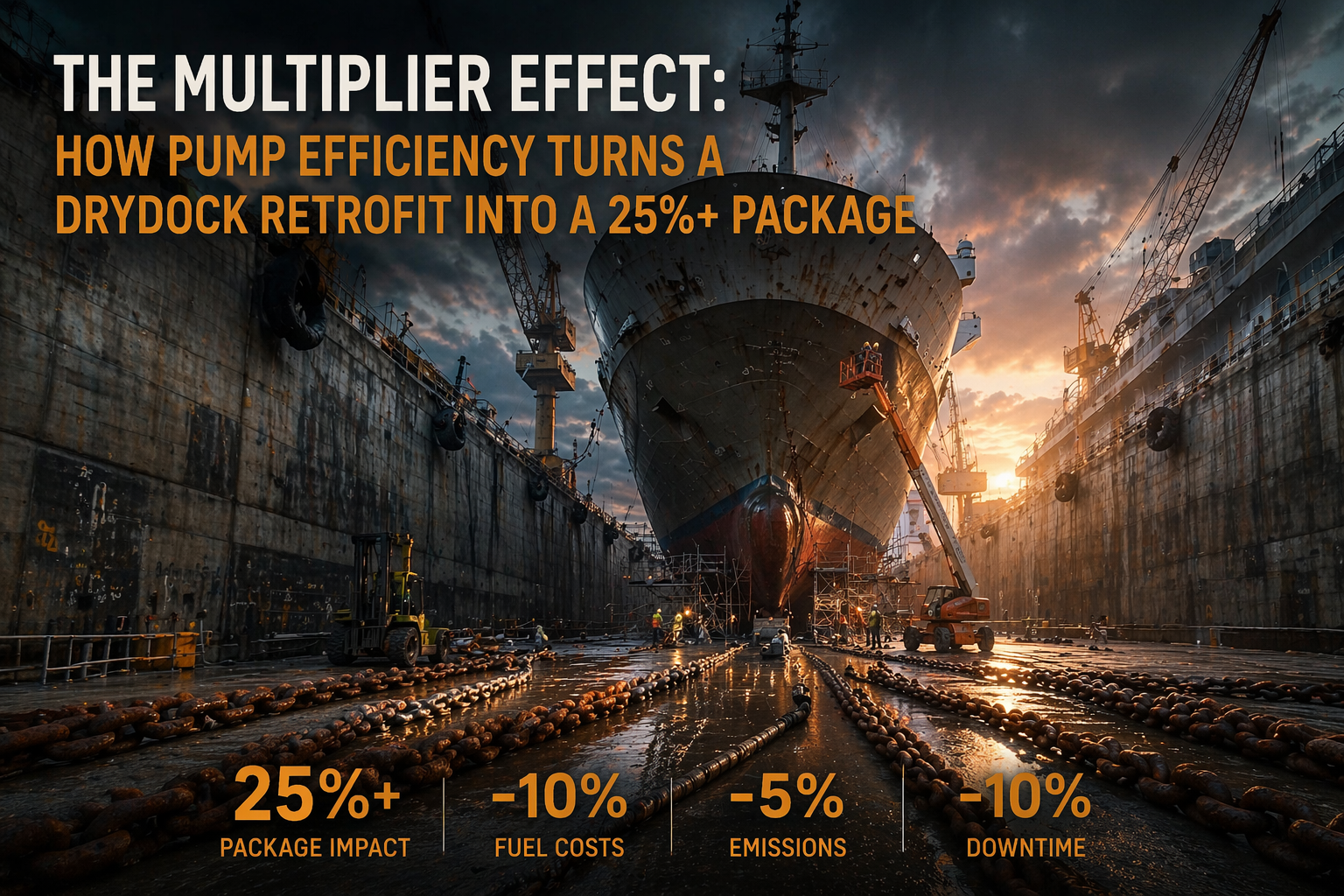
Why the biggest planning error in 2026 is still treating pumps as auxiliary works rather than drydock strategy
This analysis closes the Efficiency Before Fuel series, as a synthesis of Part II (drydock retrofits), Part III (pump efficiency) and the leadership post (why decarbonisation strategies fail). The focus is on the combination logic that turns individual measures into an integrated efficiency package.
Shipowners who optimise hull coating, propeller and ESDs in drydock achieve 12 to 18% savings. Shipowners who simultaneously integrate pump upgrades achieve 20 to 25%. The difference is not the sum of two measures, it is their multiplier effect. Yet in most drydock specifications for 2026, pump systems still appear under "auxiliary works." That is the most expensive planning error shipowners are currently making.
Executive Summary
Combining classical drydock measures (hull coating, propeller redesign, ESDs) with pump upgrades (IE4/IE5 + VFD) generates a multiplier effect: instead of 12 to 18%, total savings of 20 to 25% become achievable, at comparable payback periods.
Pump retrofits can be executed within the drydock window without significant additional lay time: mobilisation costs and class inspection are incurred only once, the economic advantage over separate projects is structural, not marginal.
Anchoring pump efficiency as an integral component of the drydock specification creates measurable compliance improvements under EEXI, CII and FuelEU Maritime, and a verifiable data foundation for charter conversations and financing partners.
1. Why the Multiplier Has Been Underestimated
A drydock visit typically lasts two to four weeks. Planning begins 12 to 24 months in advance. And yet pumps appear in most specifications as auxiliary works, as though their efficiency carried no strategic significance.
The error is not technical but structural: drydock planning is usually developed by the technical department with primary focus on propulsion systems and class certification. Pumps fall into the category of auxiliary systems addressed only at failure or inspection. The result is a systematic under-utilisation of the docking window, because pump upgrades are either not planned at all or deferred as a separate, later measure.
Yet the physical synergies between drydock retrofits and pump efficiency are real and documented. Better flow conditions from new hull coatings improve the hydraulic efficiency of cooling water pumps operating with a changed resistance profile. An optimised propeller with reduced cavitation tendency lowers vibration levels and load fluctuations across the entire drivetrain, pumps run more stably in the part-load range, precisely where IE4/IE5 motors deliver their disproportionate efficiency advantage. The best efficiency point (BEP) of pumps shifts as the vessel's resistance profile changes, and IE4/IE5 motors are specifically designed to maintain their advantage across a wider operating window (Wärtsilä/EcoNavis Synergy Studies, 2026). And the downtime is used once, not twice: mobilisation costs, class inspection and yard coordination are incurred once in a combined project versus twice in sequential projects (ABS Retrofit Reports, 2026; DESMI, 2025/2026).
👉 Key Insight: Pump efficiency is not an add-on to drydock strategy, it is the multiplier that turns a 12 to 18% standard package into a 20 to 25% efficiency package. Failing to integrate it costs not one measure but the synergy effect of all measures combined.
Figure 1: Drydock 2026 synergy matrix, total savings by measure package (typical ranges, 2026 field data)
Figure 1
2. The Mechanics of the Multiplier: Why 1 + 1 Delivers More Than 2
Synergy effects are frequently overstated in efficiency discussions. In the specific case of drydock retrofits combined with pump efficiency upgrades, they are physically and economically well founded, and documented in field data.
The physical logic: hull coating reduces frictional resistance and thereby alters flow conditions across the entire underwater area. This affects not only propulsive efficiency, it also changes hydraulic conditions for cooling water pumps, ballast pumps and hull penetrations. An optimised propeller with reduced cavitation tendency lowers vibration levels and load fluctuations across the entire drivetrain, allowing pumps to run more stably in the part-load range and thereby fully realising the efficiency gain of IE4/IE5 motors. The best efficiency point of pumps shifts as the vessel's resistance profile changes, and IE4/IE5 motors are specifically designed to maintain their advantage across a broader operating window (Wärtsilä/EcoNavis Synergy Studies, 2026).
The economic logic is at least as compelling: mobilisation costs, class inspection, yard coordination and measurement infrastructure are incurred only once in drydock. In sequential projects, drydock in year zero, pump retrofit in year two, these costs arise twice. ABS Retrofit Reports (2026) quantify that the separate-project variant increases pump retrofit costs by typically 15 to 25% and complicates CII reporting documentation, because baseline measurements and post-retrofit verification are temporally separated.
👉 Key Insight: The multiplier effect is dual: physical (measures reinforce each other's impact) and economic (joint implementation saves 15 to 25% of project costs). Both effects together explain why the payback period of the combined package is shorter than for individual measures, despite a higher total investment.
3. Practical Integration: Bringing the Multiplier into the Drydock Specification
The multiplier effect does not arise automatically. It must be planned, 12 to 18 months before the docking event, with the right process and the right participants.
The first step is an early IE class inventory of the main pumps: which motors are still in IE1/IE2 class? At what part-load do pumps typically operate? Which pumps have the highest operating hours and therefore the greatest savings value? This inventory should be available 12 to 18 months before the planned docking, not as a separate study, but as an integrated component of drydock preparation.
The second step is the cross-functional brief: Technical, Commercial and Finance must jointly decide which pumps to prioritise, not on the basis of technical data alone, but on the basis of combined ROI from bunker savings, EU ETS cost reduction and CII rating improvement. This step is the most frequent bottleneck: when Technical and Finance do not make the drydock specification decision in the same session, pump upgrades land in the "later measures" category, and the synergy is lost.
The third step is the explicit yard specification: "pump retrofit within drydock window" must appear as a standalone line item in the tender, not as an optional add-on. This saves separate mobilisation costs, secures parallel execution and enables unified documentation for CII reporting and financing partners. Monitoring systems, simple power and flow sensors, should be installed simultaneously: they create the data foundation that SEEMP Part III, CII verification and charter conversations are increasingly demanding (Drydock Magazine, 2026).
👉 Key Insight: The multiplier is created in planning, not in execution. A drydock specification without an explicit pump upgrade line item is a half-efficiency strategy, delivering a fraction of the achievable ROI.
4. Compliance Return: What the Multiplier Means for EEXI, CII and Charter Conversations
20 to 25% total savings is a number. Its significance becomes visible only in the regulatory and commercial consequences.
Under the current CII regime, a 20 to 25% reduction in total fuel consumption translates to a CII rating improvement of one to two categories, from D to C or from C to B, depending on the starting rating and vessel type. This has direct commercial consequences: charter contracts in 2026 increasingly contain CII clauses that link rates and contract terms to the rating. A vessel with a B rating has a measurable advantage over a D-rated vessel in charter negotiations, and a growing advantage in fleet financing, as banks and lessors price ESG metrics more actively.
FuelEU Maritime calculates GHG intensity on a Well-to-Wake basis: every kWh not consumed through more efficient pumps and better main propulsion systems reduces the FuelEU compliance burden proportionally. EU ETS costs, covering 100% of reported emissions from 2026, decline directly with consumption. For a tanker with annual consumption of 5,000 tonnes VLSFO and an EU ETS price of EUR 70 per tonne CO₂, a 20% consumption reduction equates to an annual ETS cost saving of approximately EUR 220,000, from the ETS effect alone, without bunker price savings.
👉 Key Insight: The combined drydock package with pump multiplier is not only an operational efficiency measure, it is a regulatory and commercial repositioning instrument that simultaneously improves CII rating, charter attractiveness and financing conditions.
Action Recommendations
Immediate Measures: This Week
Extract the drydock planning for the next 24 months and flag all vessels with CII rating D or E: these vessels have the highest priority for the combined drydock package and the highest ROI on pump upgrades.
Initiate an IE class check for the main pumps of prioritised vessels: how many are still running on IE1/IE2? That is the starting point for the synergy calculation.
Start a first synergy ROI calculation: bunker savings + EU ETS reduction + CII rating effect, aggregated across the full docking cycle. That is the number that belongs in the investment decision, not only the investment cost alone.
Strategic Commitments: 3 to 12 Months
Create a "Drydock Synergy Roadmap": a vessel-specific prioritisation matrix that brings hull/propeller measures and pump upgrades together in a unified ROI model, with clear decision points for the Technical-Commercial-Finance board.
Include pump upgrade as a standalone line item in all drydock tenders: not as an option, but as a fixed component of the yard specification, with parallel execution and integrated monitoring installation.
Integrate synergy savings into CII and FuelEU projections: incorporate the combined savings values into SEEMP documentation and regulatory forecasts, as proof of compliance strategy for flag state, EU authorities and financing partners.
Conduct charter conversations with the drydock roadmap in hand: charterers and financing partners expect concrete, verifiable efficiency paths in 2026. The drydock synergy roadmap is the document that supports these conversations with numbers.
Final Thought
This series began with a simple thesis: efficiency before fuel. Those who wait for green fuels before pulling efficiency levers forfeit years and millions. The drydock multiplier is the most precise expression of this thesis: it shows that the greatest efficiency gains do not come from individual, sequentially implemented measures, but from their integrated, synergistic combination. Hull, propeller and pumps are not a menu to choose from. They are a system that must be optimised together. Shipowners who understand this now, and translate it into their drydock specifications, will not need to wait for the IMO's fuel decision between 2026 and 2030. They will be in a position to await it with greater composure, because their foundation is built from measurable efficiency.
Have you already included pump efficiency in your next drydock specification, and how significant do you estimate the multiplier effect to be for your specific vessel type? Join the discussion or read the starting point of this series: Efficiency Before Fuel, operational and regulatory measures as the primary decarbonisation lever.
References
ABS (2026) Retrofit Reports 2026: Drydock Efficiency Packages and Combined Measure Performance. Houston: American Bureau of Shipping.
DESMI A/S (2025/2026) OptiSave™ Energy Saving System: Fleet Performance Data and Synergy Field Reports. Nørresundby: DESMI A/S.
Drydock Magazine (2026) Integration of Pump Retrofits in Drydock Planning: Industry Best Practice Review. April 2026.
IEC 60034-30-1:2014 Rotating electrical machines – Part 30-1: Efficiency classes of line operated AC motors (IE Code). Geneva: International Electrotechnical Commission.
IMO (2022) MEPC.1/Circ.905: Interim Guidelines on the Method of Calculation of the Attained EEXI. London: International Maritime Organization.
IMO (2025) CII Reduction Factors (Z-Factors) 2027–2030: Official Guidance. London: International Maritime Organization.
Wärtsilä Corporation; EcoNavis (2026) Synergy Studies: Combined Drydock Retrofit and Auxiliary System Efficiency. Helsinki / Munich: Wärtsilä; EcoNavis GmbH.
