Why Decarbonisation Strategies Fail: The Five Leadership Errors No Regulator Can Fix
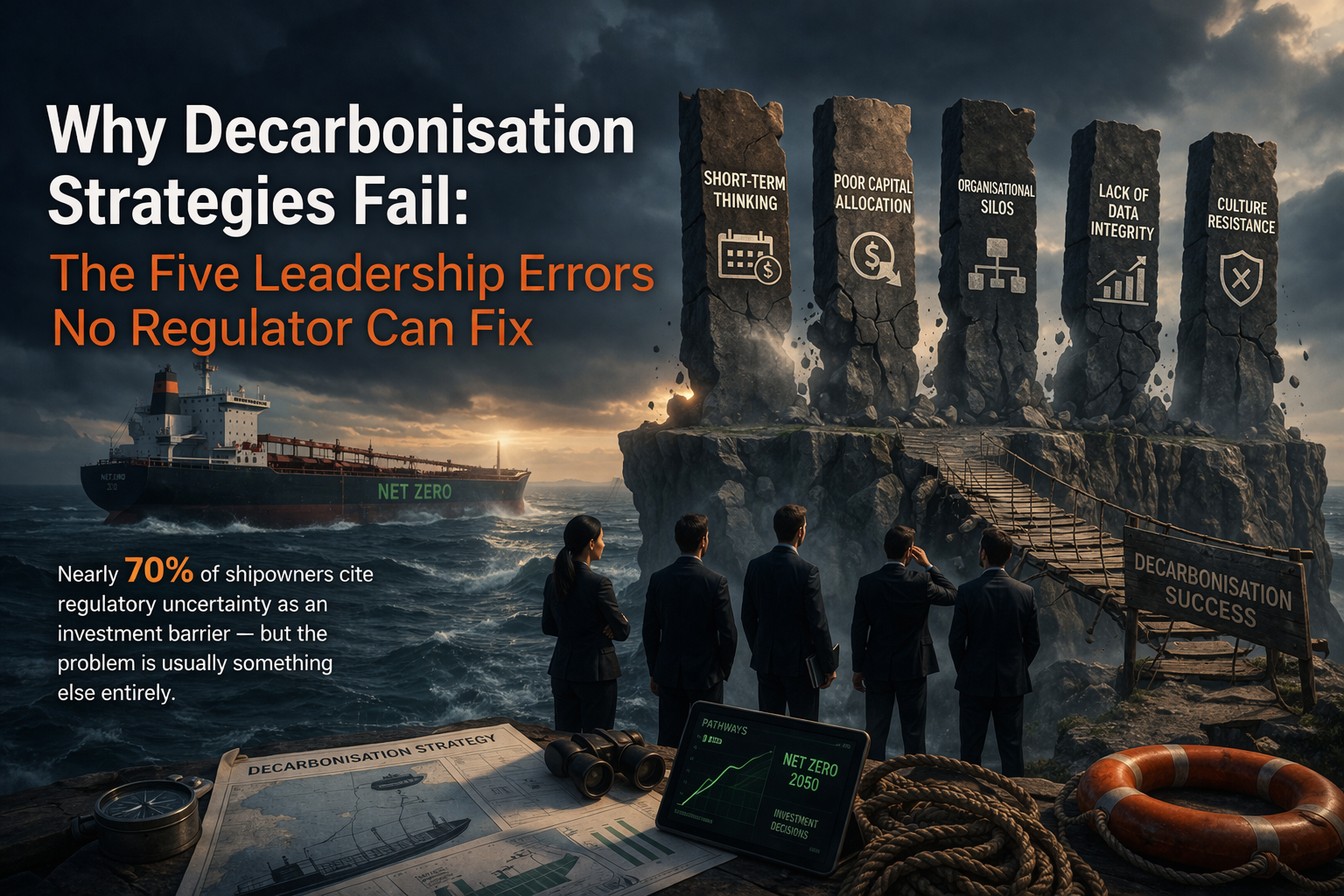
Nearly 70% of shipowners cite regulatory uncertainty as an investment barrier, but the problem is usually something else entirely
This analysis is part of the Efficiency Before Fuel series, as a synthesis to Part I (operational measures), Part II (drydock retrofits) and Part III (pump efficiency). The focus here is not technology, but the leadership decisions that determine whether technology gets deployed or not.
The IMO has deferred the Net-Zero Framework to November 2026. FuelEU Maritime has completed its first reporting year. And nearly 70% of maritime leaders report in Wärtsilä surveys that regulatory uncertainty is blocking investment. That sounds like a regulatory problem. It is not. Most decarbonisation strategies fail not because of insufficient technology, too-high investment costs, or insufficient regulatory clarity. They fail because of leadership thinking in the wrong categories, and in doing so, forfeiting efficiency potential that would be actionable today.
Executive Summary
Nearly 70% of maritime leaders cite regulatory uncertainty as the primary investment barrier (Wärtsilä, March 2026), yet silo thinking, fuel bias and weak change leadership are the actual drivers of inaction.
Five leadership errors systematically explain why decarbonisation strategies fail: overreliance on alternative fuels, lack of scenario flexibility, siloed governance, blindness to immediately available efficiency wins, and weak change leadership.
Shipowners who prioritise efficiency as a strategic lever, establish cross-functional governance and develop adaptive leadership will not only be compliant by 2026 to 2030, they will be operationally more resilient, lower-cost and more attractive to charterers than the rest of the market.
1. The Fuel-Focus Trap: When Strategy Bets on the Future and Ignores the Present
Ammonia, methanol, green hydrogen, the industry is debating the fuels of the 2030s with an intensity entirely disproportionate to the pace of implementation. In the pump room, an IE1 motor from 1997 is still running.
The structural error is straightforward to describe: strategies oriented primarily toward alternative fuels require infrastructure that simply is not available in sufficient quantities at competitive prices between 2026 and 2028. Green methanol bunkering is partially available in European ports; green ammonia is barely accessible on a spot basis. The IMO's deferral of the Net-Zero Framework from April 2025 to November 2026 systematically reinforces this "wait-and-see" thinking: those who wait for regulatory clarity before investing frequently wait for the second deferral.
The paradox is quantifiable: while waiting for green fuels, 20 to 40% of auxiliary power consumption runs through pump systems operated with IE1/IE2 motors, an efficiency potential that is actionable today, without a docking requirement, with a payback period of 12 to 24 months (IEC 60034-30-1; DESMI, 2025/2026). CII and EEXI do not wait for green fuels. They measure the consumption happening now.
👉 Key Insight: Defining decarbonisation primarily as a fuel problem means forfeiting the immediately available efficiency potential of 20 to 40% in auxiliary power, and with it the real, measurable compliance advantages under EEXI, CII and FuelEU Maritime.
Figure 1: The five leadership errors in decarbonisation, and their strategic counter-principles
Figure 1
2. Scenario Rigidity: When a Strategy Has to Bet on a Single Future
"Once we switch to methanol in 2030…", so begins a strategy that assumes the regulatory landscape, fuel prices and market structure will be stable and predictable at a specific date. They will not be.
The reality is more volatile: the IMO's deferral of the Net-Zero Framework from April 2025 to November 2026 was not the first delay, and will not be the last. Regional fragmentation between EU ETS, FuelEU Maritime and the global IMO framework generates differing compliance requirements for different trade routes. Fuel availability and pricing vary substantially by region. Those who optimise their decarbonisation strategy for a single scenario risk two distinct forms of stranded assets: technical stranded assets (investments in infrastructure that becomes regulatorily obsolete) and strategic stranded assets (missed opportunities because "waiting for clarity" ran too long).
Wärtsilä surveys show that 70% of leaders identify uncertainty as the greatest investment barrier (Wärtsilä, March 2026). That is an honest diagnosis, but not a strategy. Adaptive leadership does not mean eliminating uncertainty. It means developing strategies that function across multiple scenarios and can be adjusted rapidly when the framework shifts. The tool for this is scenario planning: three plausible futures, IMO regulation strongly implemented, regionally fragmented, substantially delayed, each with defined trigger points for strategy adjustments.
👉 Key Insight: In a world that is non-linear, accelerated, volatile and interconnected, a single-scenario strategy is not a conservative approach, it is the highest strategic risk. Adaptive leadership keeps multiple paths open and defines when each path is taken.
3. Silo Thinking and Quick-Win Blindness: Two Sides of the Same Problem
Decarbonisation has migrated from the technical department into commercial and finance teams. Most organisational structures have not yet arrived there.
Sean Riley of Veson Nautical puts it precisely in the Lloyd's List Podcast: decarbonisation is today a commercial and financial question, not merely a technical one (Lloyd's List, April 2026). Charter clauses contain CII requirements. EU ETS costs must be priced into freight rates. FuelEU Maritime penalty exposure is balance sheet risk. Yet technical teams, commercial teams and finance departments in most companies operate in separate accountabilities, with separate budgets and separate success metrics. The result is structurally predictable: no integrated strategy, investment decisions without complete cost accounting, and quick wins that disappear into silo separation.
Quick-win blindness is the direct consequence: pump efficiency (IE4/IE5 + VFD), voyage optimisation, trim optimisation and waste heat recovery together deliver 10 to 35% savings with payback periods of 12 to 24 months, without new fuels and without drydock in many cases. These measures rarely feature at the top of the agenda because they are neither marketable as a "green revolution" nor championed by a single department. Global Maritime Forum research confirms: leadership challenges and wrong incentive structures, rewarding short-term cost control rather than operational efficiency, are the actual brakes on decarbonisation (Global Maritime Forum, January 2026).
👉 Key Insight: Cross-functional governance is not an organisational measure, it is the prerequisite for quick wins being recognised and prioritised as strategic levers at all. Without shared governance, decarbonisation remains a technical department topic with commercial consequences that no one owns.
4. Change Leadership: The Human Dimension of Transformation
The technology is available. Regulation is clear enough, despite delays, to act. The remaining barrier is human. And that is the hardest one.
Resistance to change in maritime organisations is not resistance to climate action. It is resistance to uncertainty, to shifting power structures, to new competency requirements and to incentive systems that do not reward the new. A chief engineer whose performance evaluation is based on failure rates and maintenance costs will assess IE4 motor upgrades differently from a chief financial officer who sees EU ETS costs in the balance sheet. Both are right within their perspective, and both need a governance structure that brings these perspectives together rather than isolating them against each other.
Relational intelligence, the capacity to lead people through uncertainty without simulating control that does not exist, is the central leadership competency of transformation. The Global Maritime Forum documents that leadership challenges, insufficient psychological safety, lack of transparency about strategy paths and inconsistent communication, systematically constrain operational efficiency and decarbonisation initiatives (Global Maritime Forum, January 2026). Calm leadership does not mean having all the answers. It means creating a decision framework within which employees remain capable of action, even when external uncertainty is high.
👉 Key Insight: The technology of decarbonisation is solvable. The leadership question, how to guide an organisation through a multi-dimensional, multi-decade transformation without losing credibility and trust, is the actual strategic challenge.
Action Recommendations
Immediate Measures: This Week
Run a 60-minute workshop with Technical, Commercial and Finance: which three efficiency levers have been identified in the past 24 months, and which of them have not been implemented? Why not? The answers show governance gaps directly.
Audit the current decarbonisation strategy for fuel bias: what percentage of planned emission reduction relies on alternative fuels? What percentage on operational efficiency? An answer of more than 60% on fuels with less than 30% on efficiency is a warning signal.
Incentive system check: what metrics are used for leaders in technical, commercial and operations roles? If none of them include operational CO₂ efficiency or CII rating development, that is the first point of intervention for change leadership.
Strategic Commitments: 3 to 12 Months
Establish a cross-functional Decarbonisation Board: Technical, Commercial, Finance and CEO/COO level, not as a reporting body, but as a decision-making authority with clearly defined mandates and quarterly milestones.
Develop three regulatory scenarios and define trigger points: IMO Framework strongly implemented by 2028 / regionally fragmented by 2030 / substantially delayed. For each scenario: which measures continue, which are adjusted, which are stopped?
Institutionalise quick-win discipline: every decarbonisation strategy must contain at least two measures with a payback period under 24 months, as proof of operational capability and as a cashflow base for larger investments.
Integrate efficiency KPIs into Commercial and Finance budgets: CII rating trajectory, auxiliary power consumption per nautical mile and bunker costs per dwt-nautical-mile as operational management variables, not only as technical metrics, but as P&L-relevant indicators.
Final Thought
The maritime industry has a technology problem and a regulatory problem, both are solvable and are being solved. What is harder to solve: a leadership culture that still thinks in 20th-century categories. Silos in which decarbonisation is a technical responsibility. Strategies that bet on a single fuel scenario. Incentive systems that reward short-term cost control and fail to see operational efficiency. The shipowners who correct these leadership errors now, not in 2028 when regulatory pressure is even greater, will not merely be compliant by 2030. They will be more profitable, more resilient and more attractive to charterers and investors than all those who waited for clarity.
Which of the five leadership errors do you recognise most clearly in your own organisation, and what is the first concrete step to address it? Join the discussion or read the full technical foundation of this series: The 30% Lever in the Engine Room, pump efficiency as an immediately available compliance measure.
References
DESMI A/S (2025/2026) OptiSave™ Energy Saving System: Fleet Performance Data. Nørresundby: DESMI A/S.
Global Maritime Forum (2026) Maritime Operational Efficiency: Leadership Challenges and Organisational Barriers. Copenhagen: Global Maritime Forum. January 2026.
IEC 60034-30-1:2014 Rotating electrical machines – Part 30-1: Efficiency classes of line operated AC motors (IE Code). Geneva: International Electrotechnical Commission.
IMO (2025/2026) Postponement of Net-Zero Framework Adoption: MEPC 83 Outcomes and Revised Timeline. London: International Maritime Organization.
Lloyd's List (2026) Shipping Podcast: Interview with Sean Riley, Veson Nautical. 1 April 2026. Available at: lloydslist.com (Accessed: April 2026).
Wärtsilä Corporation (2026) Uncertainty Complicates Efforts to Prioritise Shipping Investments: Industry Survey Results. Helsinki: Wärtsilä Corporation. 25 March 2026.
