The 30% Lever in the Engine Room: Why Pump Efficiency Is the Overlooked Compliance Asset

While the industry debates green fuels, IE1 motors from the 1990s are still running most pump rooms
This analysis is part of the Efficiency Before Fuel series, complementing Part I (operational measures) and Part II (drydock retrofits). The focus here is on an efficiency potential that requires neither a docking event nor alternative fuels.
The maritime industry is debating ammonia, methanol and green hydrogen derivatives. In the pump rooms of most vessels, electric motors of class IE1 and IE2 are running quietly, standards that were considered minimum requirements decades ago and today represent the equivalent of a 1995 carburettor engine in a modern hybrid vehicle. The savings potential is not in the future. It has been running silently in the engine room for years, waiting to be activated.
Executive Summary
Pump systems account for 20 to 40% of total auxiliary power consumption on most vessels; on tankers and offshore support vessels the share can be even higher, a systematically underestimated cost driver under EEXI, CII and FuelEU Maritime.
Upgrading from IE1/IE2 to IE4/IE5 motors delivers 2 to 6% higher motor efficiency; combined with Variable Frequency Drives (VFD) and intelligent speed control, 20 to 50% total system savings are realistic, in individual cases up to 75 to 90% for pumps operating far from their best efficiency point (Wang et al., 2023; DESMI, 2025/2026).
Payback periods for IE4/IE5-VFD combination retrofits typically fall within 12 to 24 months, without a docking requirement, with minimal operational downtime and with direct positive impact on attained EEXI and operational CII rating.
1. The Hidden Energy Balance: What Pumps Actually Cost
Pumps are ship infrastructure. They run, they pump, they rarely fail, and they quietly consume an energy share that features prominently in no efficiency strategy.
On most vessels, pumps, ballast water, cooling water, cargo, fire-fighting, bilge and further systems, together with their electric motors account for 20 to 40% of total auxiliary power consumption. On tankers and offshore support vessels, this share can be even higher. This is no marginal auxiliary figure: on a tanker with 1,500 kW auxiliary power consumption, up to 600 kW falls on pump systems, continuously, not only during manoeuvres or loading operations, but across the entire operating cycle.
The structural problem lies in procurement practice: shipyards and operators typically specify the cheapest norm-compliant motor, not the most efficient one. As long as an IE1 or IE2 motor meets minimum technical requirements, it gets installed, and operated until it fails. IEC 60034-30-1 has defined IE3 (Premium Efficiency), IE4 (Super Premium Efficiency) and IE5 (Ultra Premium Efficiency) for years; the upgrade rate in maritime applications nevertheless remains surprisingly low. The majority of the world fleet, particularly vessels built before 2020, operates on IE1/IE2 hardware (IEC 60034-30-1:2014).
👉 Key Insight: Pump systems are not infrastructure you install and forget. They are a continuous energy consumer whose efficiency class feeds directly into EEXI attainment, CII rating and bunker costs, and which can be improved with manageable investment and no docking requirement.
Figure 1: IEC efficiency classes IE1–IE5, full-load efficiency and savings potential in marine pump applications (typical values, 4-pole motors 15–75 kW)
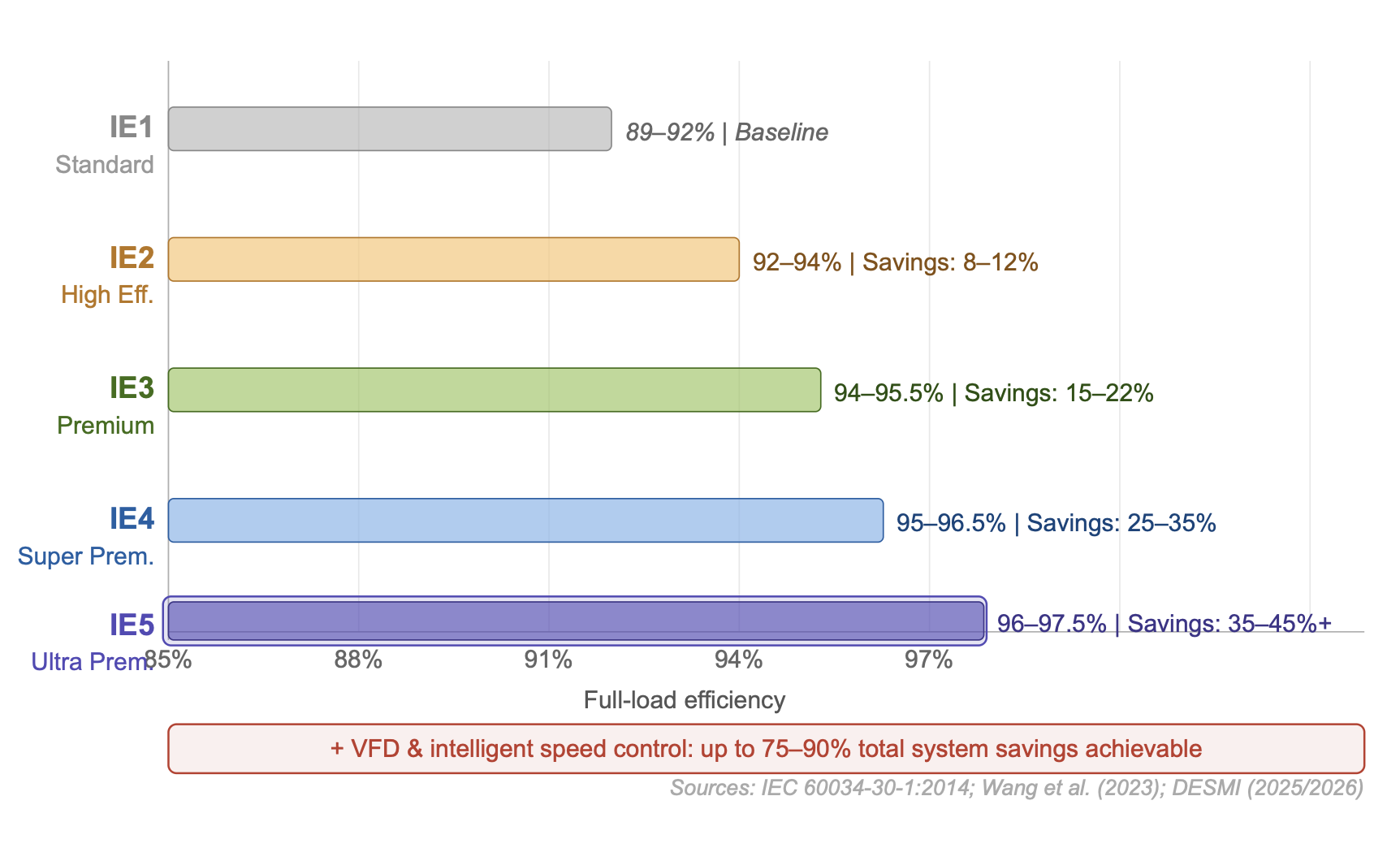
Figure 1
2. The IE Class Architecture: What the Numbers Mean, and Why Part-Load Operation Is the Critical Factor
A 2 to 6% efficiency improvement sounds modest, until you multiply it by the annual operating hours of a pump installation.
IEC 60034-30-1 defines five efficiency classes for mains-operated AC motors. In the maritime context, motors in the 15 to 75 kW range are particularly relevant, the typical sizes for ballast, cooling water and cargo pumps. An IE1 motor of this class achieves 89 to 92% efficiency at full load; an IE5 motor of the same power class reaches 96 to 97.5%. The absolute difference of 4 to 8 percentage points in motor efficiency translates, at 6,000 operating hours per year and an energy cost of USD 180 to 220 per MWh (marine auxiliary power equivalents), into several tens of thousands of USD per motor per year (IEA & IEC Motor Efficiency Studies).
Critical here is a frequently overlooked detail: marine pumps operate 70 to 80% of their running time in the part-load range, at 50 to 75% of rated speed and load. IE4 and IE5 motors show significantly flatter efficiency drop-off curves in this operating range than IE1/IE2 motors. The efficiency difference in part-load operation is proportionally larger than at full load, precisely where marine pumps spend most of their time. An IE1 motor that drops to 84 to 88% efficiency at 50% load, while an IE5 motor still achieves 95 to 96.5%, costs more per day of operation than the annual capital cost of the upgrade.
👉 Key Insight: The efficiency gap between IE1 and IE5 is non-linear, it is disproportionately large in part-load operation. Since marine pumps spend the majority of their running time in the part-load range, the actual energy saving is higher than a pure full-load efficiency comparison suggests.
3. Variable Frequency Drives: The Multiplier Effect
A better motor saves energy. A better motor with intelligent speed control fundamentally changes the scale of the saving.
Variable Frequency Drives continuously adapt motor speed to the actual demand of the pump system: ballast water exchange rate, cooling water temperature, cargo flow rate, pressure requirements. The physical principle behind this is the affinity law trio: speed, volumetric flow and power consumption stand in a cubic relationship. Reducing speed to 80% of rated speed theoretically reduces power consumption to 51% of rated value, almost a halving, through speed adjustment alone.
In practice, the effects are documented: DESMI OptiSave™ installations on over 575 vessels worldwide show savings of 250 to 350 litres of fuel per vessel per day through optimised pump control alone, equating to approximately USD 42,000 annually at current bunker prices (DESMI, 2025/2026). Wang et al. (2023) quantify energy savings of up to 45% in a controlled study of ship cooling water pumps through the combination of an efficient motor and VFD control in real-world operation. For pumps operated far from their best efficiency point, common on older vessels with unchanged system configurations, system savings of 75 to 90% are documented.
👉 Key Insight: An IE4/IE5 motor alone is a solid improvement. An IE4/IE5 motor with VFD control is a system upgrade with a multiplier effect. The combination delivers the greatest savings where pumps operate in part-load, which is on almost every vessel in normal operations.
4. Regulatory Relevance: Why Pump Efficiency Feeds Directly into EEXI and CII
Pump efficiency is not a nice-to-have sustainability project. It is direct compliance work under the regulatory framework that carries financial consequences from 2026 onwards.
The Energy Efficiency Existing Ship Index (EEXI) assesses the specific CO₂ emission intensity of a vessel based on its power requirement. Every reduction in auxiliary power consumption, and pumps account for 20 to 40% of it, improves the attained EEXI directly. Unlike main engine optimisations or hull coating measures, pump motor upgrades require neither a drydock visit nor intervention in primary propulsion systems; they can be implemented during normal operations or short port calls (IMO MEPC.1/Circ.905; MARPOL Annex VI).
The Carbon Intensity Indicator (CII) measures operational consumption and requires a 21.5% reduction against the 2019 baseline by 2030. Auxiliary power consumption feeds into the CII calculation; a 25 to 35% reduction in pump load through an IE4/IE5-VFD combination measurably improves the CII score, without any change to the main propulsion plant or operating profile. FuelEU Maritime assesses Well-to-Wake GHG intensity: every kWh not consumed through more efficient pumps reduces the FuelEU compliance burden proportionally.
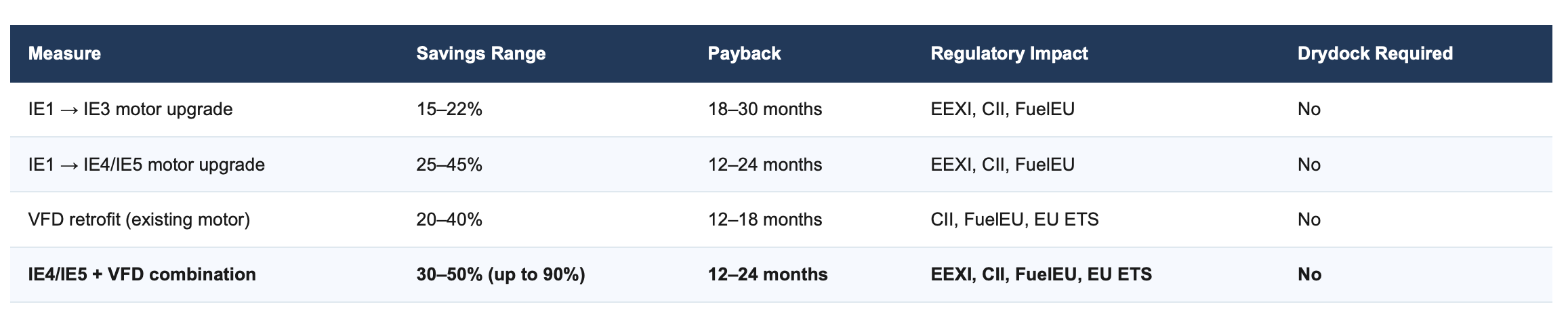
👉 Key Insight: No other single system in the efficiency portfolio combines such short payback periods, direct regulatory impact and the absence of a drydock requirement as pump-motor-VFD upgrades. This makes them the immediately available compliance measure, independent of the next scheduled docking.
Action Recommendations
Immediate Measures: This Week
Start an IE class inventory: how many IE1 and IE2 motors are driving the main pumps of the fleet? A simple stock-take typically reveals that 60 to 80% of installed motors fall into these older classes, the baseline for any ROI calculation.
Capture part-load operating profiles: at what part-load do the main pumps typically operate? Ballast pumps, cooling water pumps and fire pumps are frequently run at 50 to 70% of rated load, precisely the range where the IE class difference is greatest.
Include auxiliary power consumption in the CII calculation: is the pump load share currently explicitly accounted for in CII calculations and SEEMP documentation? If not, this is an immediate flag for technical management and compliance.
Strategic Commitments: 6 to 24 Months
Perform ROI calculations per vessel and pump system: operating hours × energy cost × efficiency gain equals the annual saving value; divided by investment cost equals payback period. At 6,000 operating hours per year and an IE4+VFD upgrade, 12 to 24 months is not a conservative estimate, it is the industry standard.
Plan IE4/IE5-VFD combination retrofits for priority vessels: ballast water pumps, main cooling water pumps and cargo pumps as first priority; engage suppliers offering marine-certified IE4/IE5 motors, proven VFD solutions and real reference data from fleet operations (DESMI, Wärtsilä, ABB Marine, Siemens Energy).
Anchor pump efficiency in SEEMP Part III for 2026–2028: document concrete, measurable measures with savings potential and implementation timeline, pump system upgrades are an ideally verifiable SEEMP element directly accepted by flag states and EU authorities.
Implement a monitoring system: those who do not measure cannot optimise. Digital performance monitoring for main pump systems (power consumption, flow rate, pressure ratios) creates the data foundation for further optimisation steps and for CII reporting.
Final Thought
The maritime industry is waiting for scalable green fuels. The fuels are waiting for lower production costs. Both are waiting for regulation clear enough to provide investment certainty. Meanwhile, a 30% efficiency potential is running in the pump room, waiting for neither new fuels, nor a drydock visit, nor a final regulatory decision. It is waiting only for an inventory and an ROI calculation. The vessels that treat the engine room not as a cost block but as an efficiency reservoir will have lower OPEX, better CII ratings and greater charter attractiveness through 2026 to 2031, built on hardware that is available today.
Have you already inventoried the efficiency class of the motors driving your main pumps, and do you know the part-load at which those pumps typically operate? Join the discussion or read our full drydock retrofit analysis: The Drydock as a Return Engine, hardware upgrades that cut fuel costs for good.
References
DESMI A/S (2025/2026) OptiSave™ Energy Saving System: Fleet Performance Data and Field Reports. Nørresundby: DESMI A/S.
IEA; IEC (2023) Motor Efficiency in Industrial Applications: Global Energy Savings Potential. Paris / Geneva: International Energy Agency; International Electrotechnical Commission.
IEC 60034-30-1:2014 Rotating electrical machines – Part 30-1: Efficiency classes of line operated AC motors (IE Code). Geneva: International Electrotechnical Commission.
IMO (2022) MEPC.1/Circ.905: Interim Guidelines on the Method of Calculation of the Attained Energy Efficiency Existing Ship Index (EEXI). London: International Maritime Organization.
IMO (2023) MARPOL Annex VI: Regulations for the Prevention of Air Pollution from Ships, as amended. London: International Maritime Organization.
Marine Vessel Energy Efficiency Market Report (2026) Global Outlook 2025–2030. Dublin: Research and Markets / Coherent Market Insights.
Wang, Y., et al. (2023) Research on the Energy Savings of Ships' Water Cooling Pump. Journal of Marine Engineering & Technology. doi: 10.1080/20464177.2023.XXXXXX.
