The Five Anchors of Leadership
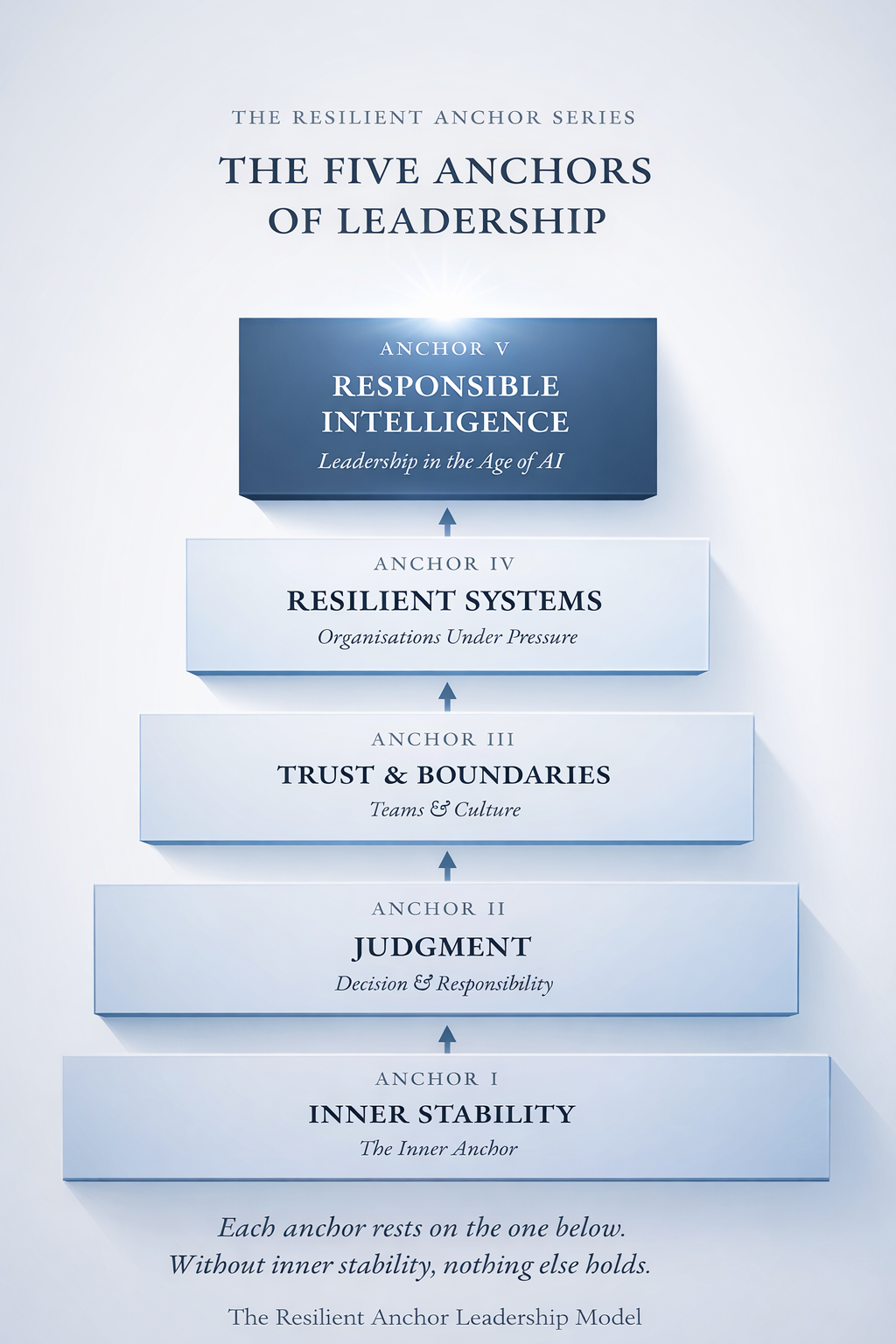
Why leadership fails where it tries to scale
Categories: Leadership · Organizational Resilience · Decision Science · AI & Responsibility
Executive Summary
Leadership does not fail because leaders lack capability.
It fails because leadership is built for individuals —
and deployed as systems.
Across five volumes of The Resilient Anchor Series, a consistent pattern emerges:
Organizations collapse not at the point of strategy,
but at the point of translation.
From:
individual stability
to judgment
to team dynamics
to organizational systems
to technological environments
Each level depends on the one below.
Most organizations try to fix leadership at the level where failure appears.
They should go one level deeper.
The Structural Illusion of Leadership
Leadership development assumes a linear model:
Better leader → better team → better organization
Reality is different.
Organizations are layered systems.
Each layer introduces its own failure mode.
What works at one level does not automatically transfer to the next.
You can have:
strong individuals
and weak teams
You can have:
strong teams
and failing systems
The problem is not competence.
It is translation.
Anchor I — Inner Stability
Where leadership begins
Pressure is not external.
It is internal.
When pressure rises:
cognitive capacity narrows
emotional reactivity increases
consistency disappears
Leaders do not suddenly become incapable.
They lose access to their capability.
Insight
Inner stability is not a personality trait.
It is the condition under which leadership functions — or collapses.
Anchor II — Judgment
Clarity when certainty disappears
Leadership is often described as decisiveness.
But decisiveness is not the goal.
Decision quality is.
Under real conditions:
information is incomplete
time is limited
consequences are irreversible
Confidence increases precisely when accuracy decreases.
The leader who feels most certain is often the least calibrated.
Insight
Judgment is not the absence of doubt.
It is the ability to think clearly in conditions designed to prevent it.
Anchor III — Trust & Boundaries
Where leadership becomes collective
Teams do not fail because they disagree.
They fail because they cannot rely on each other.
What breaks under pressure is not alignment.
It is predictability.
When roles are unclear:
decisions slow
accountability dissolves
coordination collapses
Trust is not emotional.
It is structural.
Insight
Trust is the outcome of reliability.
Not intention.
Anchor IV — Resilient Systems
Where leadership becomes organizational
Most organizations treat resilience as a planning problem.
It is not.
Plans assume stability.
Reality does not.
Resilient organizations do not depend on predefined responses.
They depend on systems that can:
interpret
adapt
decide
in real time.
Processes alone fail because they remove judgment.
And without judgment, systems cannot respond to the unexpected.
Insight
Resilience is not stored in plans.
It is embedded in systems that can learn under pressure.
Anchor V — Responsible Intelligence
Leadership in the age of AI
Artificial intelligence changes how decisions are made.
But it does not change responsibility.
AI can:
process data
optimize outcomes
detect patterns
But it cannot:
carry consequences
define values
take responsibility
The danger is not that AI replaces leadership.
The danger is that it obscures it.
When decisions are mediated by systems,
accountability becomes harder to see — but not less real.
Insight
AI does not reduce leadership responsibility.
It makes it unavoidable.
The Dependency Principle
Leadership always fails below where you are looking.
Organizations diagnose problems at the visible level:
a failing team
a broken culture
a poor decision
But the cause sits one layer deeper.
You cannot fix:
culture without structure
structure without judgment
judgment without stability
Every level depends on the integrity of the one below.
Final Thought
Leadership does not degrade under pressure.
It reveals what was never built to hold it.
Organizations that discover this in crisis call it bad luck.
Those that discover it in reflection call it insight.
Those that design for it in advance —
call it strategy.
The five anchors do not describe aspiration.
They define dependency.
Remove one —
and everything above it does not weaken.
It collapses.
